Facebook Ads ideas are easy to collect and hard to organize.
A marketer may have audience ideas from sales calls, creative ideas from competitor research, hooks from customer reviews, offers from the founder, and targeting suggestions from a client. The problem starts when all of those ideas go straight into campaign setup without structure.
The ad creation flow itself is simple enough: choose a goal, add visuals and text, define an audience, set budget and duration, and publish. But that flow works best when the advertiser already knows which ideas deserve to become campaign inputs.
For performance marketers, agencies, growth teams, SMB owners, affiliate marketers, and B2B lead-generation teams, idea organization is a performance issue. It determines whether the campaign produces clean learning or scattered data.
The Problem
The problem is trying to build Facebook Ads from an unorganized pile of ideas.
Unorganized ideas create messy campaigns because every idea feels potentially useful. One person wants to test a new audience. Another wants to test a new hook. Another wants to test a discount. Another wants to test video. Another wants to target competitor followers. Another wants to promote a webinar instead of a demo.
None of these ideas are automatically bad.
The issue is that they are not sorted by function.
An audience idea is not the same as a creative idea. A hook is not the same as an offer. A campaign goal is not the same as a KPI. A funnel-stage idea is not the same as a landing page idea.
When everything is mixed together, setup becomes confusing and performance review becomes unreliable.
Why This Problem Hurts Performance
Poor idea organization hurts campaign performance because it creates mixed tests.
A mixed test changes too many variables at once. If the campaign works, the team does not know why. If it fails, the team does not know what to fix.
This affects CPC because the ad may not match the audience. It affects CPA because the offer may not match user intent. It affects CAC because the campaign may attract low-quality leads or buyers who need too much education. It affects ROAS because purchase behavior may be driven by short-term incentives rather than scalable demand.
It also slows down testing velocity.
When ideas are not organized, every new campaign requires fresh debate. Teams spend time deciding what to launch instead of learning from a structured testing roadmap.
Common Scenarios Where This Happens
An agency receives a client brief full of ideas: promote a guide, test founders, target competitors, use testimonials, launch video ads, retarget website visitors, and try a discount. The campaign goes live with too many variables, making results hard to explain.
A B2B team wants more qualified demo requests but mixes job-title targeting, broad lookalikes, webinar offers, direct demo CTAs, and thought-leadership content in one campaign structure.
An ecommerce brand collects hooks from reviews but does not group them by buyer motivation. Ads about price, quality, convenience, ingredients, and social proof all run together.
A local business has seasonal promotions, customer testimonials, service-area messages, and emergency-offer ads but no structure for deciding which idea supports which objective.
An affiliate marketer finds several promising niche communities but does not separate audience tests from offer tests. When CPA rises, the marketer cannot tell whether the audience source or the offer angle failed.
Why the Problem Happens
This problem happens because many advertisers treat ideas as campaign-ready too early.
A useful Facebook Ads idea needs to be translated into one of several campaign building blocks:
Goal.
Audience.
Message angle.
Offer.
Creative format.
Proof point.
CTA.
Destination.
KPI.
Budget rule.
Another reason is that teams often lack a testing hierarchy. They do not decide which assumption matters most. As a result, campaigns test everything at once.
The third cause is poor documentation. Ideas live in chats, calls, spreadsheets, notes, screenshots, and memory. Without a single planning document, strong ideas get lost and weak ideas slip into setup.
The Solution
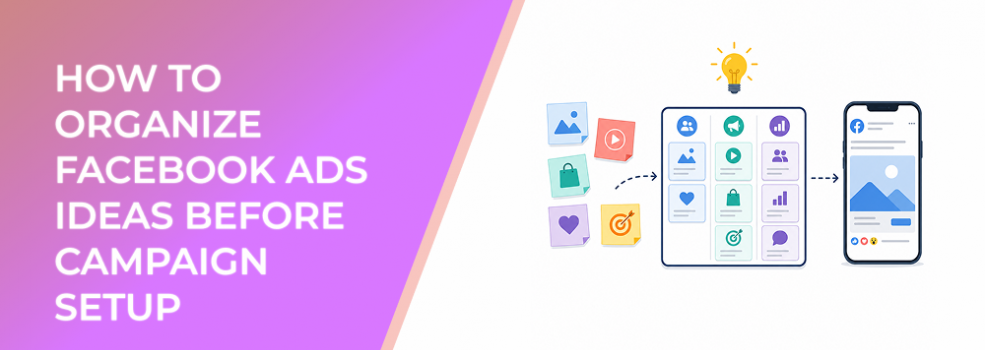
The solution is to organize Facebook Ads ideas into a campaign planning matrix before setup.
The matrix should separate raw ideas from launch-ready decisions.
Step 1: Capture Every Idea Without Judging It
Start with a raw idea dump.
Include all ideas from:
Customer reviews.
Sales calls.
Support conversations.
Competitor ads.
Organic social posts.
Founder insights.
Client requests.
CRM notes.
Audience research.
Search terms.
Community discussions.
Past campaign results.
At this stage, do not decide whether the idea is good or bad. The goal is to capture everything in one place.
Step 2: Sort Ideas By Category
Next, categorize every idea.
Use these categories:
Audience idea.
Creative hook.
Message angle.
Offer.
Proof point.
Funnel stage.
CTA.
Landing page or destination.
Campaign objective.
KPI or success metric.
Budget or test rule.
For example, “target HR directors” is an audience idea. “Stop wasting budget on unqualified leads” is a hook. “Free checklist” is an offer. “Book a demo” is a CTA. “Cost per qualified demo request” is a KPI.
Sorting prevents ideas from competing with each other when they should be supporting each other.
Step 3: Connect Each Idea To A Business Goal
Every idea should support a goal.
If the goal is qualified leads, prioritize ideas that improve buyer fit, intent, trust, and conversion readiness.
If the goal is sales, prioritize ideas that support purchase confidence, product clarity, urgency, and profitability.
If the goal is retargeting, prioritize ideas that move warm users toward a specific next action.
If an idea does not support the goal, save it for another campaign.
Step 4: Turn Audience Ideas Into Audience Hypotheses
Audience ideas need more detail before setup.
A strong audience hypothesis should include:
Buyer type.
Intent signal.
Source or targeting logic.
Message match.
Expected action.
Example:
“We want to test operations managers at growing ecommerce companies who are likely to care about fulfillment delays because they may respond to a cost-saving operations angle and request a demo.”
That is stronger than “target ecommerce people.”
Step 5: Match Hooks To Audience Intent
Hooks should not be selected randomly.
Match each hook to the audience’s awareness stage.
Problem-aware audiences may respond to pain clarity.
Solution-aware audiences may respond to comparison.
Competitor-aware audiences may respond to differentiation.
Warm audiences may respond to proof.
High-intent audiences may respond to urgency or offer clarity.
This creates a stronger connection between audience and creative.
Step 6: Prioritize Tests
After ideas are sorted, choose what to test first.
Prioritize based on:
Business importance.
Confidence level.
Audience size.
Expected impact.
Ease of execution.
Budget required.
Quality of available creative.
Do not launch every good idea at once. A strong testing roadmap protects learning quality.
Step 7: Build The Campaign Brief
The final output should be a campaign brief.
Include:
Campaign goal.
Primary KPI.
Audience hypothesis.
Message angle.
Creative assets.
Offer.
CTA.
Destination.
Budget.
Review window.
Decision rule.
Only after this brief is clear should the advertiser enter campaign setup.
How LeadEnforce Helps
LeadEnforce helps when organized audience ideas need to become real audience tests.
Many Facebook Ads ideas start as source-based observations:
“Our buyers are active in these Facebook groups.”
“Competitor followers on Instagram look like a strong audience.”
“People engaging with these niche profiles seem highly relevant.”
“We need to reach specific LinkedIn job titles through Meta placements.”
“We have a list of social profiles from event attendees, community members, or research.”
LeadEnforce can help advertisers turn those source ideas into custom audience inputs. Its feature pages describe building audiences from Facebook group members, Instagram followers, LinkedIn-derived professional data, and custom social-profile links.
This is valuable because organized ideas are only useful if they can be tested cleanly.
Instead of keeping “target competitor followers” as a vague note, the advertiser can define the competitor profiles, map the message angle, create the audience, and launch a structured test. Instead of broadly targeting “B2B decision-makers,” the advertiser can build a professional audience around relevant titles, industries, or company criteria and match creative to that role.
LeadEnforce fits into the audience activation step. The strategic work still comes first.
Risks and Considerations
Not every organized idea deserves budget.
Some ideas sound good but lack buyer intent. Some source audiences are popular but commercially weak. Some creative hooks attract curiosity but not qualified action. Some offers produce cheap leads but poor sales outcomes.
Avoid over-segmentation. If every idea becomes its own ad set, budget may fragment and learning may slow. Also avoid testing tiny audiences without a clear reason, because frequency can rise quickly and performance may become unstable.
If using LeadEnforce, source quality is critical. A Facebook group, Instagram profile, LinkedIn segment, or social-profile list should be evaluated for relevance, freshness, audience fit, and commercial intent.
Prerequisites and Dependencies
To organize Facebook Ads ideas effectively, the team needs a clear business objective, ICP, offer, and success metric.
It also needs a shared planning document or matrix. Without one place to organize ideas, the process will drift back into scattered notes and rushed setup.
For audience testing, the team needs usable source signals. These may include communities, Instagram profiles, Instagram engagers, LinkedIn professional filters, CRM segments, website behavior, or custom social-profile lists.
Campaign tracking or manual lead-quality review should also be in place. Otherwise, the team may judge ideas by surface metrics instead of business outcomes.
Practical Recommendations
Before campaign setup, separate raw ideas from launch-ready tests.
Organize every idea into a category: audience, hook, offer, proof, CTA, destination, objective, or KPI.
Prioritize one main campaign question at a time.
Use LeadEnforce when an audience idea depends on specific communities, Instagram profiles, LinkedIn-derived professional signals, or custom social-profile data.
Keep a testing backlog. Ideas that are not launched now should not be lost. They should be saved, categorized, and revisited after the first test produces learning.
Final Takeaway
Facebook Ads ideas become valuable only when they are organized into a testable plan.
Before setup, sort ideas by function, connect them to a business goal, prioritize the strongest hypotheses, and turn the best ones into a clear campaign brief. That structure helps the campaign launch faster, test cleaner, and produce more useful performance data.
To turn organized audience ideas into source-based Facebook and Instagram audience tests, join the free 7-day LeadEnforce trial period.
Related LeadEnforce Articles
- Define Who Your Facebook Ads Should Reach Before You Launch — Helps translate audience ideas into clearer pre-launch reach decisions.
- Fix Facebook Ads When the Audience Is Unclear — Useful for diagnosing and repairing weak or vague audience definitions.
- Building Buyer Personas for Facebook Ads Based on Engagement Data — Shows how engagement behavior can support better persona and audience planning.
- Facebook Targeting Hacks to Find High-Intent Buyers — Relevant for advertisers turning raw targeting ideas into higher-intent audience tests.