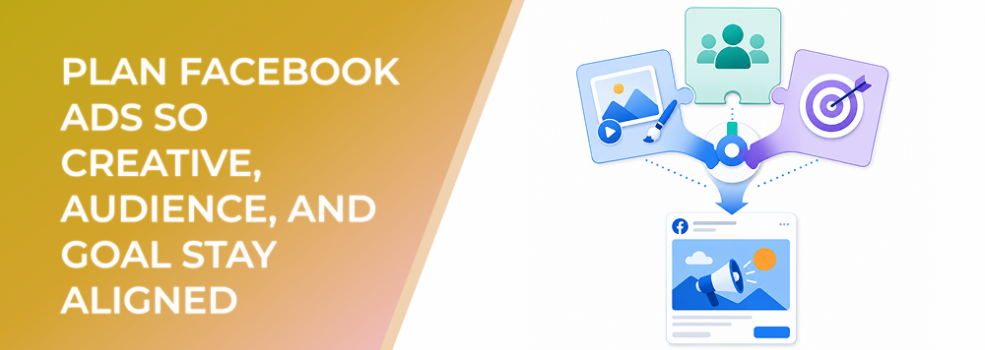
Facebook Ads often fail because the goal, audience, and creative are not aligned.
The campaign may have a reasonable objective. The audience may look relevant. The ad may be well designed. But if those pieces are planned separately, the campaign can still attract the wrong clicks, weak leads, low purchase intent, or confusing performance data.
Meta’s ad creation workflow asks advertisers to choose a goal, add visuals and text, define an audience, set budget and duration, and publish. That sequence is useful, but it can also make campaign setup feel like a checklist.
Performance does not come from checking boxes. It comes from making sure every campaign input supports the same outcome.
The Problem
The problem is misalignment between creative, audience, and goal.
This happens when the campaign objective says one thing, the audience suggests another, and the creative speaks to a third.
For example, a campaign may use a leads objective but target a broad awareness audience with a direct demo CTA. Or a campaign may target high-intent competitor followers but show generic brand-awareness creative. Or an ecommerce campaign may optimize for purchases while using educational content that does not give users a reason to buy now.
The campaign can still spend. It can still generate impressions, clicks, engagement, or leads. But the results are often lower quality because the system is not built around one clear strategic direction.
Why This Problem Hurts Performance
Misalignment hurts performance because every Facebook Ads decision influences the quality of the next one.
If the goal is unclear, the wrong objective may be selected.
If the audience is unclear, the creative becomes generic.
If the creative is generic, the campaign attracts mixed engagement.
If the offer does not match the audience’s readiness, conversion rate falls.
If the KPI does not match the business goal, reporting becomes misleading.
This can raise CPC because relevance is weak. It can increase CPA because the audience is not ready for the requested action. It can increase CAC because sales or retargeting must compensate for poor initial fit. It can lower ROAS because the campaign attracts interest without enough buying intent.
Misalignment also makes scaling dangerous. Scaling a misaligned campaign simply buys more of the wrong result.
Common Scenarios Where This Happens
A B2B SaaS company wants qualified demo requests but targets broad job titles with educational content and a soft CTA. The campaign gets traffic but few serious sales conversations.
An ecommerce brand wants purchases but runs lifestyle creative to a cold audience without enough product clarity, proof, or offer urgency. Engagement looks fine, but conversion rate is weak.
An agency builds a campaign for a local service client using radius targeting, generic service copy, and a “Learn More” CTA, even though the business needs booked appointments from people with urgent demand.
A startup wants to validate a new offer but tests multiple audiences and creative angles under one broad campaign goal. The campaign produces data, but the team cannot tell which segment or message has real potential.
An affiliate marketer targets a niche community but uses generic offer copy that does not reflect the audience’s specific motivation. CPC may be acceptable, but CPA remains unstable.
Why the Problem Happens
Misalignment usually happens because teams plan campaign components in separate conversations.
The founder defines the business goal. The media buyer chooses the objective. The designer creates the visual. The copywriter writes the hook. The client suggests the audience. The sales team later judges lead quality.
Each decision may make sense in isolation, but the campaign fails as a system.
Another cause is platform-first thinking. Advertisers start with available objective options, audience settings, and creative placements instead of starting with the buyer situation.
A third cause is weak prioritization. Teams try to reach multiple audiences with one message or use one creative concept across multiple funnel stages. That may simplify setup, but it weakens relevance.
The Solution
The solution is to plan Facebook Ads around an alignment chain.
The alignment chain connects five decisions:
Goal.
Audience.
Message.
Offer.
Metric.
If any link is weak, the campaign becomes harder to optimize.
Define The Goal In Business Terms
Start with the business outcome.
Do not stop at “leads,” “traffic,” “engagement,” or “sales.” Define the specific result.
Examples:
Qualified demo requests from mid-market operations leaders.
Booked appointments from homeowners with urgent service needs.
First purchases from new customers at a profitable CPA.
Trial starts from problem-aware SaaS buyers.
Quote requests from high-fit local prospects.
Meta’s current objective framework includes categories such as awareness, traffic, engagement, leads, app promotion, and sales. Those categories should support the business goal, not replace it.
Define The Audience By Fit And Intent
Audience alignment starts with two questions.
Who is valuable?
Why would they care now?
Fit describes whether the person or company could become a good customer. Intent describes whether there is a reason they may respond.
A strong audience definition might be:
“Marketing directors at B2B SaaS companies with active paid social budgets who need better demo-request quality.”
Or:
“People following niche skincare educators who are likely to care about ingredient-sensitive product claims.”
Or:
“Local homeowners in renovation-focused communities who may need a contractor within the next quarter.”
The audience should be specific enough to guide creative.
Choose The Message Based On Audience Readiness
The message should match the audience’s awareness stage.
Cold audiences may need a problem-led or education-led message.
Problem-aware audiences may need a solution-led message.
Competitor-aware audiences may need differentiation.
Warm retargeting audiences may need proof.
High-intent audiences may need urgency, pricing clarity, or a direct offer.
If the message does not match readiness, users may click without converting or ignore the ad entirely.
Match The Offer To The Required Action
The offer is the bridge between interest and conversion.
For B2B lead generation, a cold audience may respond better to a diagnostic, checklist, webinar, benchmark, or guide than a direct sales call. A warm audience may be ready for a demo, consultation, or pricing conversation.
For ecommerce, cold audiences may need product education or social proof. Warm audiences may respond to bundles, limited offers, comparison pages, or reminders.
For local services, high-intent users may need fast booking, transparent availability, or a direct quote request.
The offer should reduce friction for the audience stage.
Select The KPI That Reflects The Goal
Finally, choose the KPI that proves the campaign is working.
If the goal is qualified pipeline, CPL alone is not enough. Track qualified lead rate, sales acceptance, cost per sales opportunity, or demo quality.
If the goal is profitable sales, purchase volume alone is not enough. Track CPA, ROAS, margin, AOV, and new-customer quality.
If the goal is retargeting pool growth, immediate CPA may not be the right measure. Track high-intent actions, landing page engagement, or audience quality.
The metric should close the loop between goal, audience, creative, and business value.
How LeadEnforce Helps
LeadEnforce helps with the audience side of the alignment chain.
Creative and goals can only stay aligned if the audience is clearly defined and reachable. When advertisers rely only on vague interest categories or broad assumptions, the message often becomes generic because the team is not sure exactly who the ad is speaking to.
LeadEnforce supports source-based audience creation. Advertisers can build audiences from Facebook group members, Instagram profile followers or engagers, LinkedIn-derived professional data, and custom social-profile links.
That can make alignment more practical.
A B2B campaign built around decision-maker pain can use LinkedIn-derived professional data to create a more relevant Meta audience. A community-specific campaign can use Facebook group audiences. A competitor-aware ecommerce campaign can test followers or engagers of relevant Instagram profiles. A custom research list can become a social-profile-based audience test.
LeadEnforce does not write the creative or choose the campaign goal. It helps advertisers activate the audience hypothesis so the creative has a clearer target.
Risks and Considerations
Alignment does not mean narrowing every campaign as much as possible.
Overly narrow audiences can limit delivery, increase frequency, and slow learning. Broad audiences can work when the creative, offer, and conversion signals are strong. The key is not narrow versus broad. The key is strategic fit.
Advertisers should also avoid assuming that audience precision fixes every problem. Weak creative, unclear positioning, poor landing page alignment, insufficient budget, low-quality conversion tracking, and weak offers can still hurt performance.
If using LeadEnforce, evaluate each source audience carefully. A Facebook group, Instagram profile, LinkedIn segment, or social-profile list should be relevant to the buyer and the campaign goal. Popularity alone is not enough.
Compliance considerations also matter. Advertisers should review applicable platform policies, privacy expectations, and special category restrictions before launching campaigns.
Prerequisites and Dependencies
To plan aligned Facebook Ads, the team needs a clear ICP, business objective, offer, audience hypothesis, creative direction, and success metric.
The team also needs a destination that continues the same message as the ad. If the ad promises a specific outcome, the landing page should reinforce that outcome immediately.
Conversion tracking or manual quality validation should be sufficient for the decision being made. Lead-generation teams may need CRM or sales feedback. Ecommerce teams may need revenue and margin context. Local businesses may need appointment and close-rate data.
If LeadEnforce is part of the workflow, advertisers need relevant source communities, profiles, followers, engagers, professional criteria, or social-profile data that map to the audience strategy.
Practical Recommendations
Build every Facebook Ads campaign with a simple alignment statement:
“We are targeting [audience] with [message] to promote [offer] so we can achieve [goal] measured by [KPI].”
If that sentence is difficult to complete, the campaign is not ready.
Create separate alignment statements for different audiences or funnel stages. Do not force one ad to speak to every buyer type.
Use LeadEnforce when the audience definition depends on specific communities, Instagram profiles, LinkedIn-derived professional signals, or custom social-profile sources.
After launch, review performance through the alignment chain. If results are weak, diagnose whether the issue is goal, audience, message, offer, metric, landing page, or budget.
Final Takeaway
Facebook Ads perform better when the campaign is planned as one connected system.
The goal defines the outcome. The audience defines who should care. The creative explains why they should act. The offer gives them a next step. The metric proves whether the system worked.
When creative, audience, and goal stay aligned, Facebook Ads become easier to test, optimize, and scale responsibly.
To build more relevant source-based audiences for aligned Facebook and Instagram campaigns, join the free 7-day LeadEnforce trial period.
Related LeadEnforce Articles
- How To Build Facebook Ads Around a Clear Customer Profile — Helps connect audience definition, message, and campaign direction before launch.
- Define Who Your Facebook Ads Should Reach Before You Launch — Closely supports the audience-fit and intent layer of campaign alignment.
- How to Create Facebook Ads That Speak to Different Buyer Personas — Useful for matching creative messaging to distinct buyer types.
- Targeting the Right Decision-Makers in B2B Facebook Ads — Relevant for B2B advertisers aligning audience targeting with lead quality.
- Why Narrow Audience Targeting Can Increase Facebook Ad ROI — Explains how focused audience fit can support better relevance and budget efficiency.