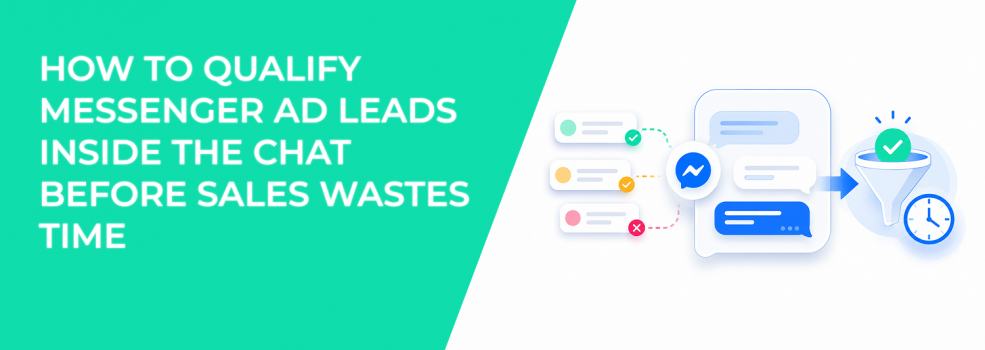
Messenger ads can create fast conversations, but fast does not always mean qualified. A campaign can generate dozens of replies while the sales team still complains that “none of these people are serious.”
That usually means the chat flow is not qualifying users early enough.
The goal is not to interrogate every lead. The goal is to ask the few questions that separate a real buyer from someone who clicked out of curiosity. Without that filter, the campaign sends too much noise into sales.
The problem: Every Messenger reply gets treated like a lead
Many click-to-message campaigns count a reply as success. That creates a reporting problem and a sales problem.
A user who asks “how much?” is not the same as a user who says “I need this by Friday.” A user who taps a quick reply is not the same as someone who shares budget, location, product need, or booking preference.
When all replies enter the same follow-up process, sales teams waste time on weak conversations. They chase users who never had enough intent to buy. Over time, this makes the campaign look worse than it is because the follow-up system becomes overloaded.
The issue is not always targeting. Sometimes the campaign reaches the right people, but the chat does not sort them properly.
That is why lead qualification filters matter inside Messenger. The filter should happen before the sales handoff, not after a rep has already spent time on the conversation.
Why weak qualification raises hidden acquisition costs
A cheap Messenger lead can become expensive when sales has to process too many weak chats.
This cost does not always appear inside Ads Manager. The platform may show a low cost per message or a low cost per lead. But the business feels the real cost through slow response times, lower close rates, and poor sales productivity.
The damage usually appears in four places:
- Sales response time gets worse. Reps spend time on weak chats while stronger buyers wait.
- Lead-to-sale rate drops. More conversations enter the pipeline, but fewer become revenue.
- Retargeting pools get polluted. Low-intent users enter audiences that should represent serious buyers.
- Budget decisions become harder. Campaigns appear efficient by message cost, but weak by revenue quality.
This is why advertisers should spot low-quality leads before they hurt your funnel. Messenger makes lead volume easy to create, but lead quality needs structure.
The solution: Use in-chat questions that reveal buying readiness
A good Messenger qualification flow does not need ten questions. It needs the right two or three.
The first question should confirm the user’s need. The second should reveal timing, fit, or budget. The third should route the user to the right next step.
For example, a home service business could ask:
- “What type of service do you need?” This separates repair, installation, maintenance, and emergency requests.
- “When do you need help?” Timing shows urgency and helps sales prioritize.
- “What ZIP code are you in?” Location confirms whether the business can serve the lead.
That is enough to route the conversation. Emergency requests can go to a live rep. Future requests can enter a follow-up sequence. Out-of-area users can be excluded or handled separately.
For B2B, the questions will look different. A software company might ask about team size, current tool, and timeline. A consultant might ask about business type, revenue range, and main problem.
The rule is simple: ask only what changes the next action.
How to avoid adding too much friction
Qualification can backfire when the chat feels like a form. If users have to answer six questions before seeing value, many will drop.
Start with the question that helps the user, not just the business.
Instead of asking, “What is your budget?” too early, ask, “Which option are you interested in comparing?” Instead of asking, “Are you ready to buy?” ask, “Are you looking for help this week or later this month?”
These questions feel useful because they match the user’s decision process. They also give sales the context they need.
A good Messenger flow should qualify without making the user feel screened out. It should feel like the business is helping them find the right next step.
How to route Messenger leads after qualification
Once the user answers, the flow should not send everyone to the same destination.
A qualified lead may need a sales rep, checkout link, booking calendar, quote form, or product recommendation. A weak lead may need education, retargeting, or a lighter follow-up. This routing protects the sales team and helps the campaign produce cleaner outcomes.
You can use a simple lead scoring model:
- High intent. The user has urgency, fit, and a clear need. Send to sales or booking immediately.
- Medium intent. The user fits the offer but needs more information. Send pricing, comparison, or proof.
- Low intent. The user is curious but vague. Send a simple resource and retarget later.
This is where you can score leads and prioritize spend. The point is not to reject people. The point is to stop treating every chat as equally valuable.
Final takeaway
Messenger lead quality improves when qualification happens inside the conversation, not after sales has already spent time.
Ask a few useful questions, route users based on their answers, and separate urgent buyers from casual responders. That keeps sales focused and makes campaign performance easier to judge.
A click-to-message campaign should not just create conversations. It should create conversations worth following up.