Most businesses build their ideal customer profile (ICP) once — then never revisit it. But people change. So do platforms, products, and buying habits. What worked last year might be why your ads aren’t working today.
If your Facebook or Instagram campaigns are losing steam, the problem may not be your ads — it might be who you’re targeting.
Luckily, paid social gives you all the signals you need to rebuild your ICP based on what your best customers actually do, not what they say or how they look.
Why basic ICPs fall short
Many marketers create ICPs based on gut feeling, surveys, or generic demographics.
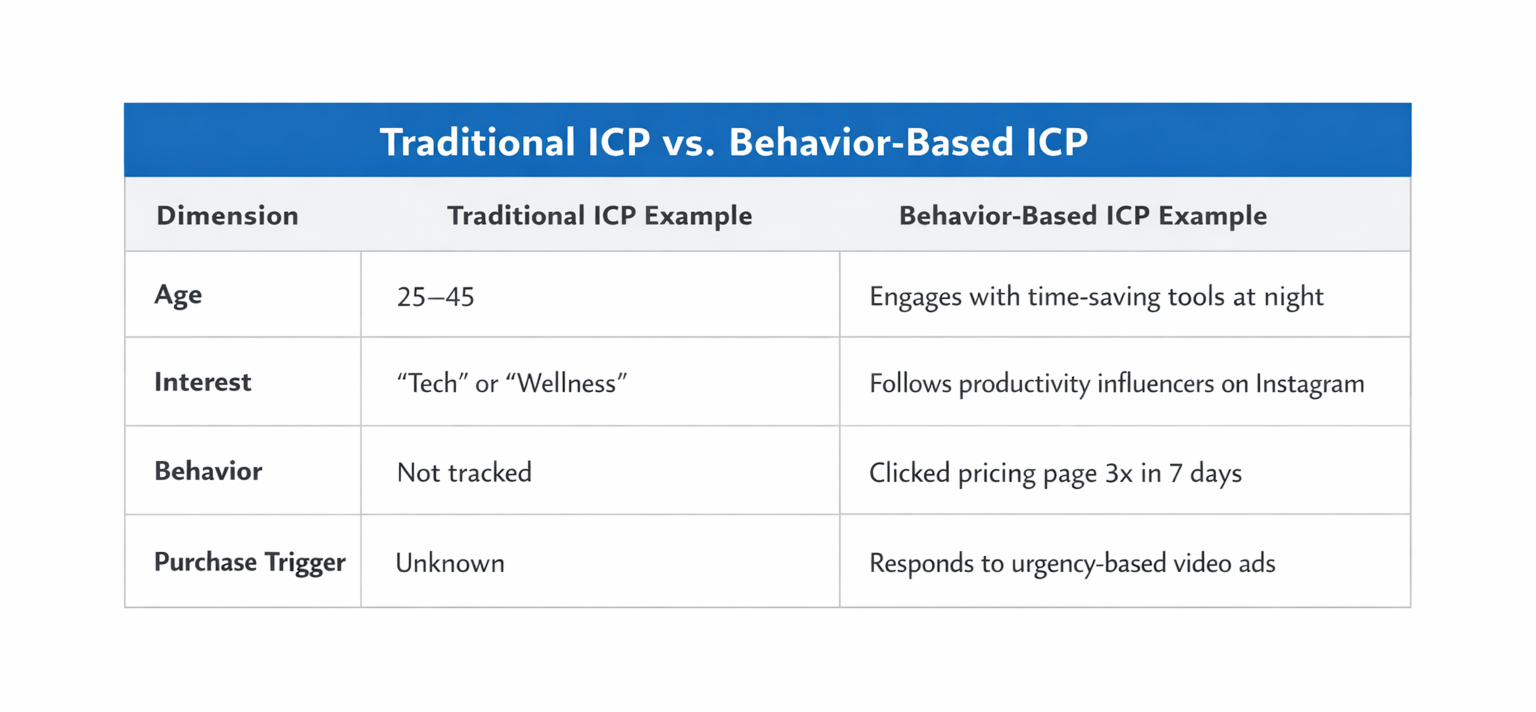
They’ll say things like:
-
“Our customer is a woman, aged 25–45.”
-
“They’re interested in wellness, tech, or entrepreneurship.”
-
“They live in the US or other English-speaking countries.”
This may help with broad messaging, but it doesn’t tell you much about what makes someone buy. Worse, these traits are often shared by millions of people who will never convert.
You don’t need a broad audience — you need a right-fit audience. That means understanding behaviors, not just interests.
For a deeper breakdown, see Behavior-Based Facebook Targeting: The Secret Weapon of Top E-commerce Brands.
Paid social shows what your best customers actually do
Instagram and Facebook are full of small actions that reveal intent. These platforms track what people click, like, save, follow, and share. With the right tools and strategy, you can turn that raw activity into better targeting and stronger results.
Think of paid social as a fast-moving feedback loop. Every time you run a campaign, you learn more about:
-
Who interacts with your content;
-
What creative grabs attention;
-
Which users move past the click and toward purchase.
Instead of guessing, you’re testing in real time.
What to watch for: high-value social signals
Here are the most useful actions to track when rebuilding your ICP from paid campaigns. These are signals that show buying intent — not just interest.
1. Ad engagement
Track people who don’t just see your ad but actually interact with it. This includes:
-
Likes and shares: Not always tied to purchases, but helpful for testing hooks.
-
Comments: Look for thoughtful questions or product-related comments.
-
Saves: A strong signal someone is considering coming back later.
This tells you which messages or visuals hit the right nerve — and who they resonate with.
Why Tracking Engagement Metrics on Facebook Ads is Crucial for Success goes deeper into how to interpret these actions.
2. Click patterns
Clicks are easy to measure but often misunderstood. Go deeper than click-through rate (CTR):
-
Did the user click on the CTA, the image, or the headline?
-
How long did they stay on your site after the click?
-
Did they explore more than one page?
Not all clicks mean interest — some are just curiosity. The quality of the click matters more than the quantity.
3. On-site behavior after the ad
Once someone lands on your site, you want to know if they stick around or bounce immediately. Use:
-
Scroll tracking to see how far they go;
-
Page depth to know how many pages they view;
-
Session duration to estimate engagement.
Someone who spends two minutes reading your product details is more valuable than someone who clicks and leaves in three seconds.
Build better custom audiences from behavior, not guesses
Once you’ve identified the behaviors of your best users, you can build smarter audiences for future campaigns. Most advertisers create lookalike audiences based on:
-
Past buyers;
-
Email lists;
-
Website visitors.
But these sources can be outdated, incomplete, or too broad. Try creating custom audiences based on intent signals from recent campaigns.
Here are some useful audience-building tips:
-
Group users who engaged with video ads and clicked through;
-
Segment people who interacted with multiple carousel cards, not just one;
-
Include users who viewed your site and returned within 3–5 days.
These actions show stronger interest than one-time views or clicks.
For additional strategies, check out Custom vs Lookalike Audiences: What Works Best for Facebook Campaigns.
Rebuild your ICP by clustering real behaviors
Think of your audience as made up of behavioral clusters. These clusters help you build profiles based on real actions — not assumptions.
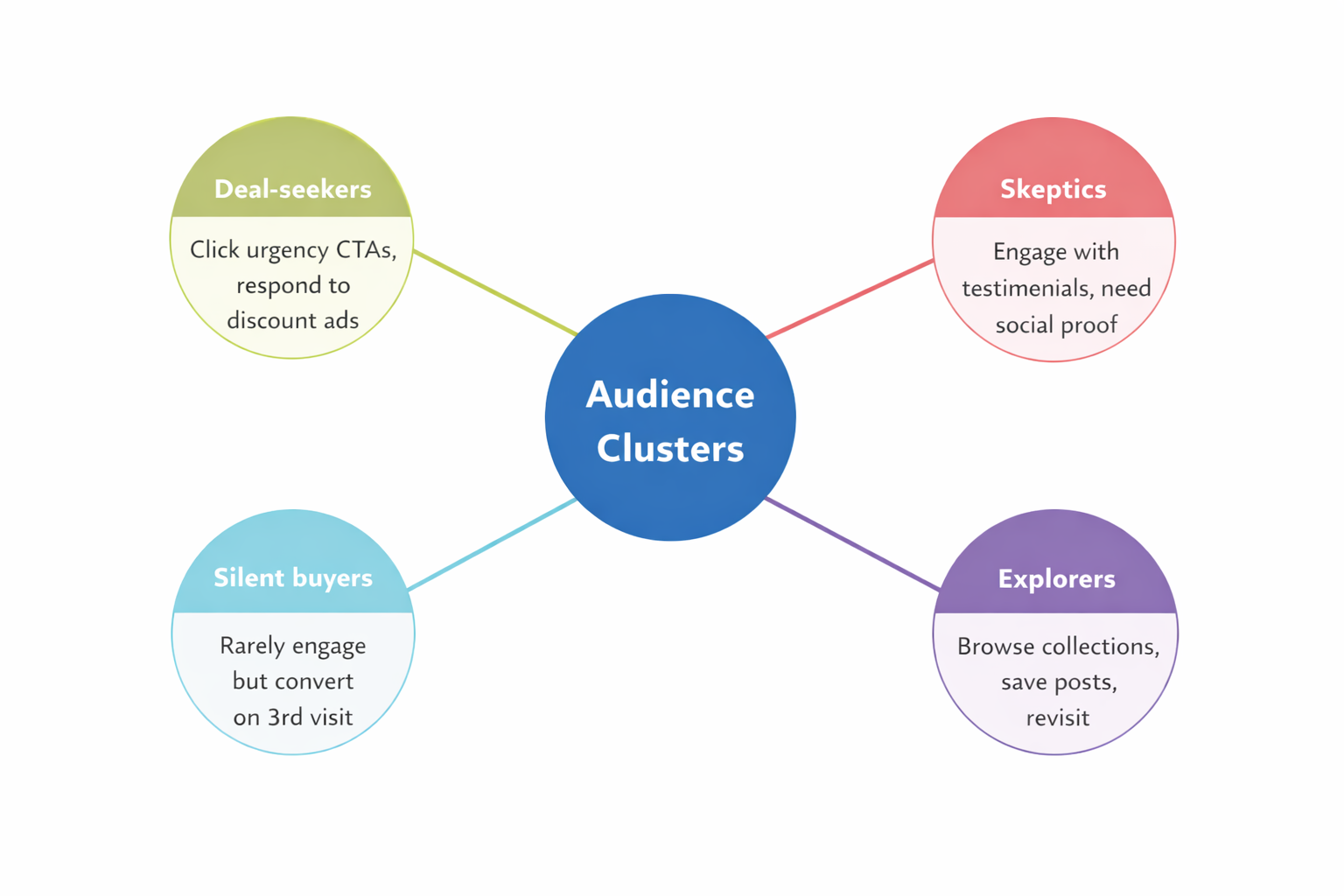
For example:
-
One cluster might include users who always respond to discounts;
-
Another might engage most with product demos or before/after shots;
-
A third might never click — but when they do, they buy.
Instead of trying to find one perfect “avatar,” look for patterns in what small groups of converters have in common.
You can then tailor your creative and landing pages to match each type.
Test fast, adjust faster: how creative helps validate your ICP
Your creative doesn’t just attract attention — it filters your audience. Different angles appeal to different people. By testing creatives, you learn who your real buyers are.
Let’s say you run three versions of an ad:
-
One focuses on product features;
-
One shows social proof (reviews, testimonials);
-
One emphasizes urgency (limited-time deal).
Track who clicks on each, and what they do afterward. People who respond to social proof may be skeptical buyers. Those who click urgency ads may be deal-hunters.
Use these insights to adjust both your targeting and your messaging.
Explore related tips in The Psychology of Facebook Ads: How to Hook Your Target Audience in Seconds.
Real-world example: turning weak leads into strong ones
Imagine you're selling productivity software. Your old ICP was:
-
Age 25–40;
-
Works in tech or marketing;
-
Lives in urban areas.
That’s broad. After analyzing your paid social data, you find something new:
-
Most conversions happen late at night, from mobile;
-
Video ads showing calendar chaos perform better than static visuals;
-
Your best-performing users also follow time management influencers.
This tells you your true ICP might be:
-
Overwhelmed freelancers working irregular hours;
-
More visual learners who respond to motion and emotion;
-
Highly engaged in specific online communities.
This is a much more actionable, testable profile.
Stop guessing. Start observing.
Your best customers are already telling you who they are — through their clicks, comments, and habits. You just have to listen.
Rebuilding your ICP doesn’t mean scrapping everything. It means adjusting based on real data from the people who are converting.
The more you test, the more you learn. The more you learn, the better your targeting becomes. And when your targeting improves, your campaigns stop wasting money on people who were never going to buy.
Paid social isn’t just for reaching people — it’s for understanding them. Use it wisely, and your ideal customer profile won’t just be a document — it’ll be a growth engine.