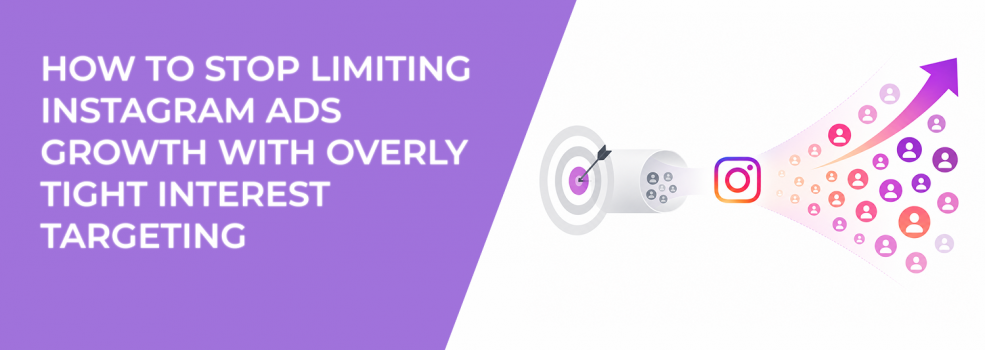
Some Instagram ad campaigns do not fail because the offer is weak.
They fail because the audience is built too tightly for growth. The campaign may get a few cheap leads, a handful of purchases, or strong early engagement. Then it hits a ceiling before the advertiser can scale spend.
This is a common problem with interest targeting. Advertisers pick only the most obvious interests, stack too many filters, and expect precision to improve efficiency. Instead, Meta has too little room to find new conversion pockets.
The campaign becomes “accurate” on paper, but too restricted in delivery.
Tight targeting can make early results look stronger than they are
A small Instagram audience can produce good numbers at low spend.
Meta often finds the easiest users first. These are people who already fit the interest signal, recently interacted with related content, or are cheaper to reach inside the auction. At $20 or $50 per day, the campaign may look stable.
The issue appears when budget increases.
The audience does not expand with the spend. Meta keeps returning to the same small pool, frequency rises, and the campaign starts paying more for similar users. CPA climbs even though nothing obvious changed in the ad.
This is why a tight audience can mislead advertisers. It may prove that some demand exists, but not that the audience can support growth.
Why Instagram growth needs audience depth
Scaling requires more than relevance.
A scalable audience gives Meta enough variation to test different user pockets while staying connected to the same buying problem. If the audience is too narrow, Meta cannot move budget toward cheaper converters because there are not enough eligible users left.
You can usually spot this problem through delivery behavior:
- Spend becomes harder to allocate. The campaign may underspend, or one ad set receives most of the budget while others stay quiet.
- Frequency rises before results improve. Meta keeps showing ads to the same users instead of finding new qualified prospects.
- CPM increases without a clear creative issue. The ad still gets clicks, but the audience is expensive to keep reaching.
- CPA becomes volatile after early conversions. The first results came from the easiest pocket, not from a scalable pattern.
This is where advertisers need to think about what makes an audience scalable, not only whether the audience seems relevant.
Interest stacking often creates hidden growth limits
Interest stacking feels controlled because every added interest looks logical.
A brand selling productivity software might target startup founders, project management, remote work, SaaS, and entrepreneurship. A fitness brand might stack gym, weight training, nutrition, running, and wellness. Each signal makes sense alone.
Together, they may shrink delivery too far.
The problem gets worse when advertisers also narrow by age, placement, location, gender, device, or behavior. Each layer removes users from the eligible pool. At some point, the campaign stops giving Meta enough auction opportunities to optimize efficiently.
That does not mean all segmentation is bad. It means each layer should earn its place.
A targeting filter should either improve conversion quality, reduce obvious waste, or separate a meaningful buyer group. If it only makes the audience feel more precise, it may be limiting growth without improving CPA.
Replace tight filters with controlled expansion
The fix is not to open targeting completely and hope Meta figures it out.
A better approach is controlled expansion. Keep the strongest signals, then remove the filters that do not clearly improve buyer quality. This gives Meta more room while preserving relevance.
For example, instead of stacking five interests into one restricted audience, test broader clusters:
- Problem-based cluster. Target users connected to the pain point, not only the product category.
- Community-based cluster. Include followers or engagers around relevant creators, groups, or similar brands.
- Use-case cluster. Build audiences around how the product is used, such as productivity, training, home improvement, or lead generation.
- Competitor-adjacent cluster. Include users connected to similar businesses without relying only on direct competitor names.
This keeps the campaign focused on intent while giving delivery more space.
It also avoids the mistake of assuming every broad audience is wasteful. The real question is why broad targeting fails for some brands while working for others. Usually, the difference is input quality, offer clarity, and conversion signal strength.
How to loosen targeting without losing control
Do not loosen everything at once.
If you remove too many constraints in one edit, you may not know what changed performance. A cleaner process is to make targeting changes in stages and watch delivery quality after each change.
Start with the filters most likely to be unnecessary. Age ranges, extra interest layers, and strict placement choices are common places to check. Then monitor CPM, frequency, CPA, conversion rate, and lead quality.
If delivery improves and qualified actions hold steady, the audience was probably too tight. If reach expands but lead quality drops, the new audience needs better inputs or stronger exclusions.
Campaign structure matters here. Advertisers should segment audiences without hurting delivery, especially when testing several Instagram growth paths at once.
Final takeaway
Overly tight Instagram interest targeting can make a campaign look precise while quietly blocking growth.
The strongest setup is not always the narrowest one. A good Instagram audience gives Meta enough qualified space to find new conversion pockets, stabilize delivery, and support higher spend.
Keep the signals that improve buyer quality. Remove filters that only create artificial precision. Then expand through problems, communities, use cases, and similar businesses instead of relying on one compressed interest stack.