Many campaigns show strong early performance but stall as soon as budgets increase. In most cases, the issue is not the creative, the bid, or the platform—it is the audience. Scalability depends on whether an audience can absorb more impressions and budget while maintaining stable performance. Understanding what makes an audience scalable helps prevent wasted spend and creates a foundation for long-term growth.
Sufficient Audience Size
Scalability starts with volume. An audience must be large enough to handle increased delivery without being overexposed. Small or overly narrow audiences may perform well initially but quickly hit frequency ceilings, leading to declining click-through rates and rising costs.
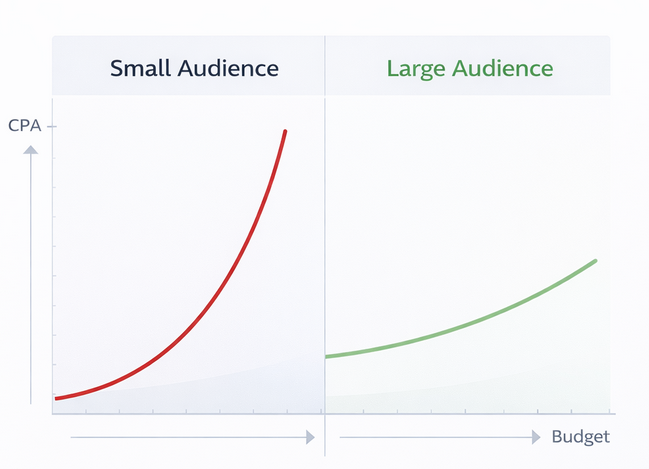
Audience size impacts CPA growth during scaling: large audiences maintain stable costs compared to narrow audiences
Industry benchmarks show that audiences under 100,000 users often experience rapid performance decay once frequency exceeds 2.5–3.0. In contrast, larger audiences can sustain higher spend while keeping frequency within a healthy range.
Stable Conversion Signals
A scalable audience consistently produces conversion events across different budget levels. Platforms rely on conversion data to optimize delivery, so audiences that generate sporadic or low-volume signals struggle to exit the learning phase or re-enter it when budgets increase.
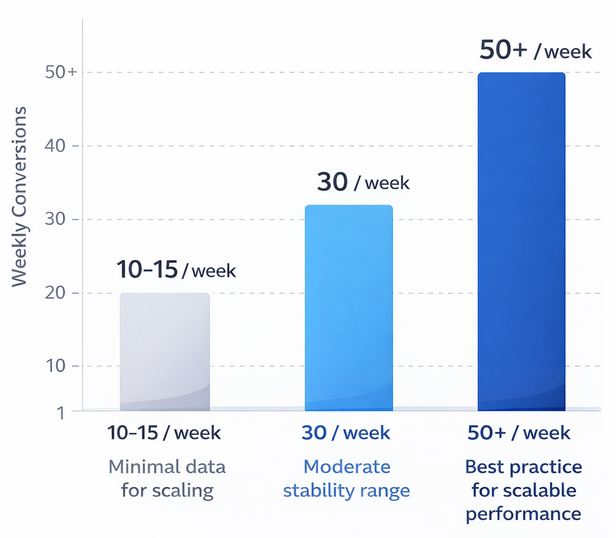
Weekly conversion volume benchmarks for audience scalability
Data from paid media studies indicates that ad sets generating at least 50 conversions per week are significantly more likely to maintain stable cost per acquisition when budgets increase, compared to ad sets operating below that threshold.
Balanced Intent and Breadth
Audiences that are too broad often lack intent, while audiences that are too narrow cap growth. Scalable audiences sit in the middle: they are broad enough to grow, yet still anchored by meaningful intent or behavioral signals.
For example, audiences built around first-party data combined with light interest or behavioral expansion typically outperform rigid interest-only audiences when scaling. Tests show that lightly expanded audiences can deliver 15–25% more conversion volume with comparable efficiency.
Low Sensitivity to Frequency
Frequency tolerance is a key scalability indicator. If performance drops sharply after a small number of impressions, the audience cannot absorb additional budget. Scalable audiences maintain relatively stable engagement as frequency increases gradually.
Industry benchmarks suggest that scalable audiences maintain stable conversion rates up to a frequency of approximately 3–4 before meaningful fatigue sets in, while fragile audiences show sharp declines after just 2 exposures.
Adaptability Across Creatives
Scalable audiences respond well to multiple creatives, formats, and messages. If an audience only performs with a single creative angle, scaling becomes fragile and short-lived. Creative diversity allows spend to increase without saturating a single message.
Campaign data analysis shows that audiences exposed to three or more creative variations are up to 30% more likely to sustain performance during budget increases than audiences relying on a single creative.
Predictable Cost Behavior
A scalable audience shows gradual, predictable changes in cost metrics as spend increases. Sudden spikes in cost per click or cost per acquisition are often signs of saturation or weak optimization signals.
When audiences are scalable, cost increases tend to follow a smooth curve rather than sharp jumps, allowing for controlled budget expansion and easier forecasting.
Common Signs an Audience Is Not Scalable
Not all audiences are built for growth. Warning signs include:
-
Rapid performance decline after small budget increases
-
Frequency rising faster than impression volume
-
Heavy dependence on a single creative or placement
-
Unstable conversion volume week over week
Recognizing these signals early helps avoid forcing scale where it is unlikely to succeed.
How to Improve Audience Scalability
While not every audience can be fixed, scalability can often be improved by:
-
Expanding audience definitions incrementally rather than all at once
-
Prioritizing audiences with consistent conversion volume
-
Refreshing creatives regularly to reduce fatigue
-
Allowing platforms enough data to optimize before increasing budgets
Conclusion
Scalable audiences are not defined by a single metric but by a combination of size, stability, adaptability, and predictable behavior. Building campaigns around audiences that can grow without breaking performance is the foundation of sustainable paid acquisition.