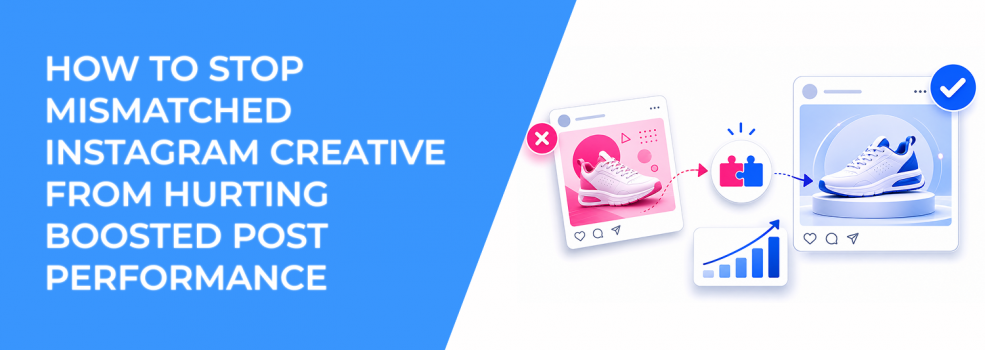
Many boosted Instagram posts fail for the same reason: the creative was designed for warm followers, not cold paid audiences.
The post may look successful organically because existing followers already understand the account, the creator, or the product. Once Meta expands delivery into broader audiences and placements, that context disappears.
This creates a hidden performance problem. Engagement may stay acceptable while CTR, conversion rate, and lead quality decline. Advertisers often blame targeting first, even though the real issue is creative mismatch.
Why organic context disappears after a post becomes an ad
Organic followers already recognize the account before they see the content. They understand the brand tone, product category, inside jokes, and posting style.
Cold paid audiences do not.
A behind-the-scenes Reel from a local fitness studio may perform well organically because followers already know the coaches and gym atmosphere. Once boosted broadly, the same Reel can feel unclear because cold users do not understand the offer, location, or reason to act.
This disconnect usually appears through signals like:
- High engagement but weak outbound clicks.
- Cheap engagement campaigns with poor lead quality.
- Strong video watch time but weak landing page conversion rate.
- High follower interaction but low sales efficiency after scaling.
The post is not necessarily bad. It simply relies too heavily on organic familiarity.
How to check whether an Instagram post is ready for paid promotion
Most advertisers choose boosted posts based on visible engagement metrics. That often leads to wasted spend because likes and comments do not always predict commercial intent.
Instead of asking “Did this perform organically?”, ask “Would a cold user immediately understand the value?”
Before boosting a post, check:
- Does the post explain the offer quickly?
Cold audiences usually decide within the first seconds whether the content deserves attention. - Is the CTA clear enough for paid traffic?
Organic followers may continue watching without direction. Paid audiences often need a more obvious next step. - Would the post still make sense outside the original audience?
Trend-based or community-specific posts often collapse during broad delivery. - Does the post create buying signals or only engagement signals?
Profile visits, saves, DMs, and product clicks usually matter more than likes alone.
This is also why many advertisers eventually need to adapt one ad concept for Reels, Stories, Feed, and Explore instead of pushing identical creative into every placement.
How placement mismatch quietly destroys boosted post performance
A boosted Instagram post rarely stays inside one placement. Meta expands delivery automatically across Feed, Stories, Explore, and Reels when optimization allows it.
Creative built for one environment can perform poorly in another.
Feed-style graphics often look cramped in Stories. Slow educational carousels may lose attention inside Reels-heavy delivery. Reels designed for followers may fail with cold audiences because the opening hook is too weak.
This is one reason boosted campaigns become unstable after scaling. The creative is not aligned with the environments where Meta starts spending budget.
Placement adaptation matters more than many advertisers realize. Comparing Feed ads vs Stories often reveals why the same promoted post behaves differently across placements.
How to make boosted Instagram posts feel native to paid audiences
The strongest boosted posts still feel like Instagram content after promotion. They do not suddenly become aggressive direct-response ads.
That does not mean the creative should stay vague. The goal is to preserve native platform behavior while improving commercial clarity.
Native-performing promoted posts usually share several traits:
- Simple creator-style framing.
- Clear focal points in the first second.
- Natural editing rhythm.
- Strong opening hooks without overproduction.
- Captions that explain value quickly.
This becomes especially important for Reels campaigns because cold users scroll faster than followers. Many advertisers improve performance simply by learning how to create Reels ads that look native.
How better audience quality improves boosted post efficiency
Creative mismatch becomes worse when targeting is too broad.
If Meta distributes the promoted post to loosely relevant users, engagement quality often drops quickly because the content already depends on missing context.
LeadEnforce helps advertisers build more precise audiences from followers of Instagram pages and Facebook groups. That allows promoted posts to reach users already connected to relevant niches, creators, or industry communities.
Better targeting does not replace creative adaptation. But stronger audience intent gives promoted posts more room to succeed during paid distribution.
Final takeaway
Boosted Instagram posts fail when advertisers treat organic engagement as proof of paid readiness.
Organic followers already understand the account context. Cold paid audiences do not. Once Meta expands delivery, creative weaknesses become easier to expose.
The fix is not boosting less content. The fix is adapting posts for cold users, placement behavior, and commercial intent before scaling budget.