
Prospecting is where most Meta ad accounts either compound efficiently or quietly waste budget.
If your top-of-funnel campaigns are unstable, overly segmented, or built around outdated targeting logic, downstream performance will always feel harder than it should. Cost per result increases, learning phases reset, and scaling becomes unpredictable.
This article breaks down how to structure Facebook prospecting campaigns so they generate consistent conversion volume and stable optimization — not just traffic spikes.
What Prospecting Campaigns Are Actually Responsible For
Prospecting is not just about reaching cold audiences. It is responsible for feeding the entire account with qualified conversion signals that make retargeting and scaling viable.
In the Meta Ads system, optimization improves when:
-
Conversion events are frequent. The algorithm requires consistent outcome data, such as purchases or qualified leads, to build predictive models. Sparse data creates unstable delivery patterns.
-
Data is statistically concentrated. When conversions are divided across too many ad sets, no single environment accumulates enough signal to optimize effectively.
-
Signals remain stable over time. Frequent structural edits, budget volatility, or audience switching interrupt the learning process.
When you fragment prospecting aggressively — isolating interests, stacking lookalikes, or duplicating near-identical audiences — you dilute signal density. The algorithm receives partial datasets instead of a unified one.
The result is unstable CPA and inconsistent performance.
If you want better conversions, structure matters more than targeting granularity.
The Core Principle: Signal Density Over Audience Micro-Control
Many advertisers structure prospecting around audience logic. They create separate ad sets for:
-
Individual interests, assuming each behavioral cluster requires its own optimization environment, even when total event volume is low.
-
Multiple lookalike percentages, such as 1%, 2%, and stacked variants, despite insufficient conversion data to justify separation.
-
Demographic splits, like age or gender segmentation without proof that those variables meaningfully impact economics.
-
Manual placement splits, even though Meta dynamically optimizes placements at scale.
This feels organized. Operationally, it spreads conversions thin.
A more effective framing is signal density per ad set.
If your weekly prospecting volume is 60 conversions and you split it across four ad sets, each receives roughly 15 events. That keeps all of them in weak learning states. Consolidate into one or two ad sets, and each receives enough data to optimize more efficiently.
If this feels counterintuitive, review When to Consolidate Campaigns. In most accounts, simplification improves stability.
Recommended Prospecting Structure (Conversion Objective)
For most performance-driven accounts, an efficient structure looks like this. 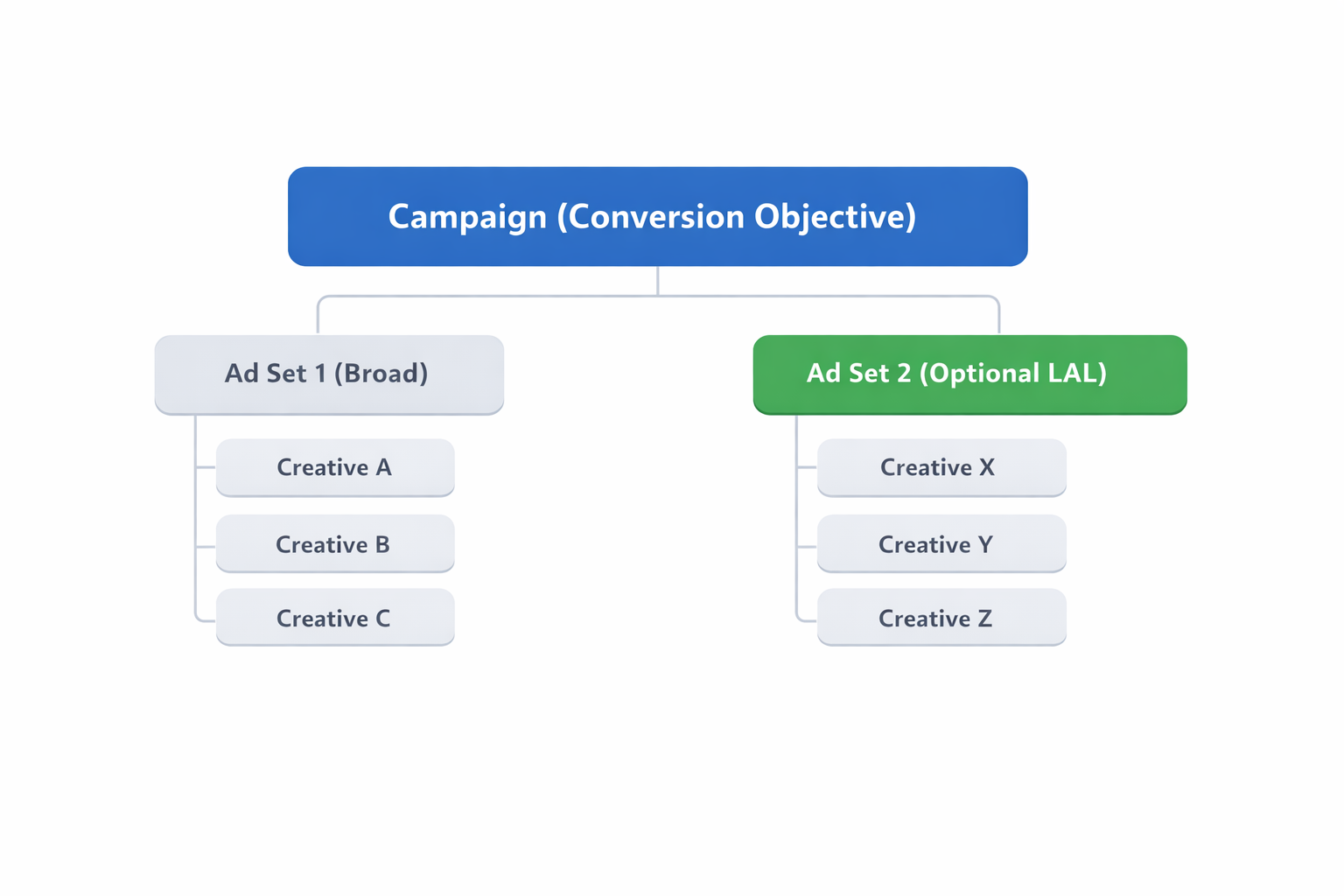
1. One Campaign per Objective
Keep prospecting conversion-focused. Avoid mixing traffic, engagement, and conversion objectives within the same campaign.
If you optimize for Purchases, keep the campaign strictly purchase-optimized. Mixing objectives fragments performance signals and introduces conflicting delivery logic.
For deeper context, see Choosing the Right Facebook Ad Objective: What Most Advertisers Get Wrong.
2. One to Two Broad Ad Sets
Instead of isolating every interest or lookalike variation, consolidate into:
-
One broad audience, with minimal targeting restrictions, allowing Meta to model patterns across the largest viable dataset.
-
An optional second structurally distinct segment, such as a purchase-based lookalike, only when event volume justifies it.
Each ad set should ideally generate at least 50 conversion events per week. If your account cannot support that threshold, additional segmentation reduces optimization stability.
If you are unsure how many ad sets are structurally justified, review How Many Ad Sets Should You Run per Campaign on Facebook?
3. Creative Differentiation Inside Ad Sets
Segmentation should happen through messaging, not audience slicing.
Within a single broad ad set, use creatives that speak to different:
-
Pain points, such as cost sensitivity versus convenience.
-
Awareness levels, from problem-aware to solution-aware users.
-
Value propositions, including speed, reliability, exclusivity, or savings.
-
Offer formats, such as bundles, free trials, guarantees, or limited-time incentives.
This allows the algorithm to match creative to behavioral signals without fragmenting the optimization environment.
Structure around communication logic, not micro-targeting logic.
When Segmentation Is Actually Justified
Consolidation improves signal density, but segmentation is sometimes necessary.
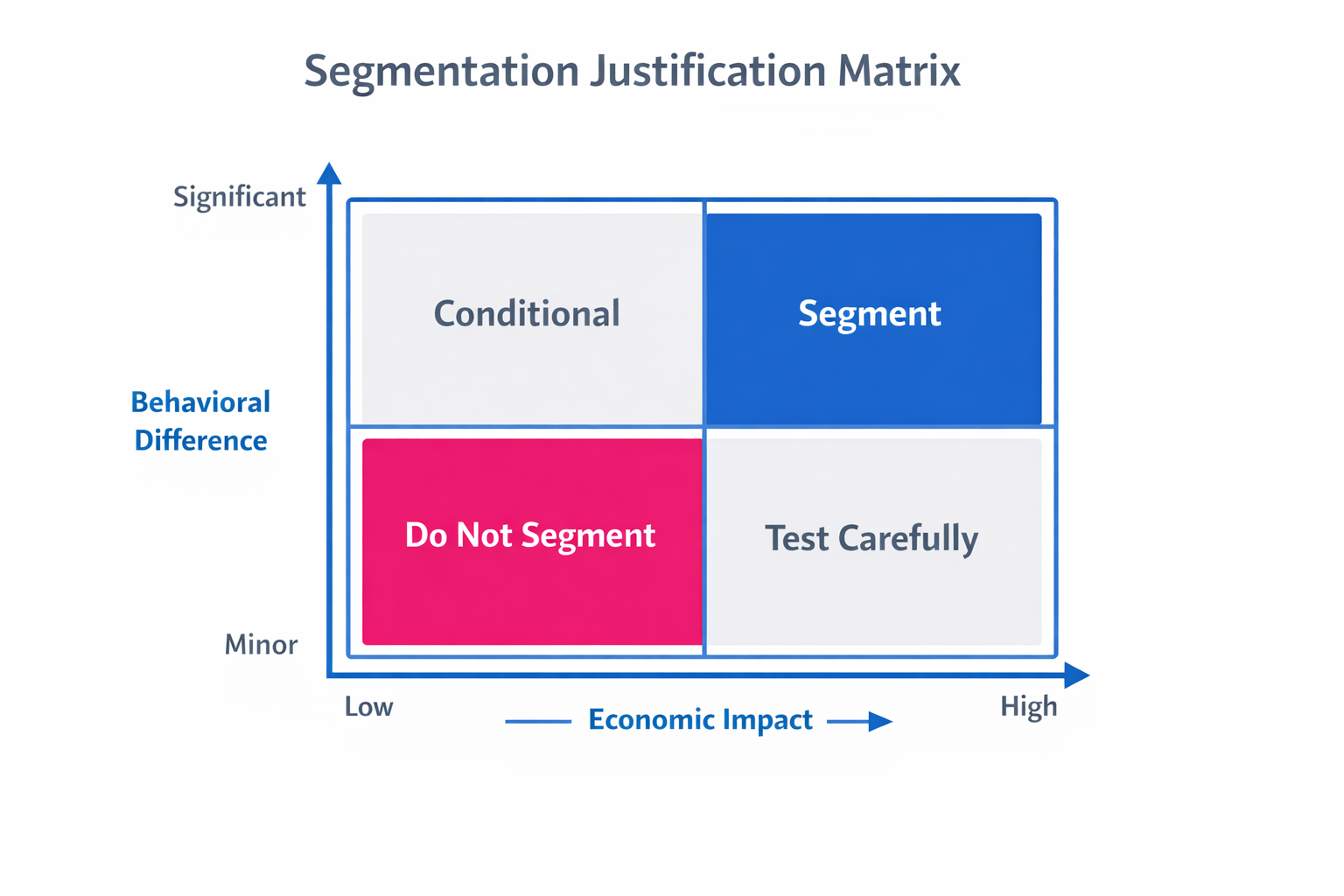
Structural separation makes sense when:
-
Business models differ significantly. For example, B2B and B2C offers require different optimization environments.
-
Conversion value varies materially. High-ticket and low-ticket products can distort ROAS modeling if blended.
-
Geographic economics differ meaningfully. Tier 1 and emerging markets often behave differently in auction dynamics.
-
Regulatory or category constraints apply. Special Ad Category rules may require isolation.
Segmentation must be economically justified, not emotionally preferred.
Budget Allocation and Prospecting Stability
Structure determines signal quality. Budget determines whether structure can function.
Common structural budget mistakes include:
-
Too many low-budget ad sets, where daily spend cannot realistically generate sufficient event volume.
-
Frequent micro-adjustments, which reset learning and destabilize delivery.
-
Equal budgets for unequal performance, preventing capital concentration in efficient segments.
-
Aggressive daily budget increases, which can destabilize optimization environments.
A stable prospecting setup typically includes:
-
Fewer ad sets with meaningful per-ad-set budgets.
-
Three to five days of structural stability before judgment.
-
Gradual scaling increments rather than abrupt increases.
-
Performance-based capital allocation.
For scaling stability principles, see The Ideal Campaign Structure for Scaling Facebook Ads Safely.
The Role of Exclusions in Prospecting Structure
Exclusions should be minimal and intentional.
Common structural errors include:
-
Over-excluding short engagement windows, reducing audience scale unnecessarily.
-
Layering overlapping exclusions, shrinking delivery pools unintentionally.
-
Changing exclusion logic during testing, disrupting learning stability.
A clean prospecting structure typically excludes:
-
Recent purchasers, within the attribution window.
-
Recent converters, to avoid duplicate optimization signals.
-
Short-term high-frequency retargeting pools, if already covered in separate campaigns.
For deeper guidance, review When to Use Custom Audiences for Retargeting vs Prospecting on Facebook.
Over-filtering often reduces efficiency more than it improves CPA.
Final Takeaway
Prospecting performance is not primarily a targeting problem. It is a signal management problem.
When you consolidate intelligently, you increase data density, stabilize learning, and give the algorithm the environment it needs to optimize for conversions.
If your prospecting campaigns feel unstable, start by simplifying structure and concentrating signal.
Better conversions usually follow disciplined architecture.