Digital advertising platforms have evolved rapidly. Algorithms now rely on larger data sets, faster learning cycles, and simplified structures to optimize delivery. While breaking campaigns into many small segments once allowed for tight control, today it often leads to limited learning, internal competition, and wasted budget.
Campaign consolidation is not about giving up control. It is about aligning structure with how modern ad platforms optimize. Knowing when to consolidate is critical to maintaining performance while scaling efficiently.
What Campaign Consolidation Means
Campaign consolidation involves merging multiple campaigns, ad sets, or audiences into fewer, broader structures. Instead of separating traffic by minor differences, budgets and data are pooled so the algorithm can optimize delivery more effectively.
Consolidation typically happens at three levels:
-
Campaign level – reducing the number of campaigns running in parallel
-
Ad set level – combining similar audiences or targeting groups
-
Ad level – focusing on fewer, higher-quality creatives
Key Signals It’s Time to Consolidate
1. Limited Learning and Frequent Resets
If many ad sets fail to exit the learning phase, consolidation is often necessary. Industry data shows that ad sets with fewer than 50 conversions per week struggle to stabilize delivery, leading to volatile cost per result and inconsistent performance.

Ad platforms like Meta require 50+ conversions per ad set each week for reliable algorithm learning — too many small segments may never reach this threshold
Consolidating ad sets increases conversion volume per learning unit, helping algorithms optimize faster and more reliably.
2. High Internal Auction Competition
Running multiple campaigns that target overlapping audiences causes them to compete against each other. This internal auction overlap can drive costs up without increasing reach.
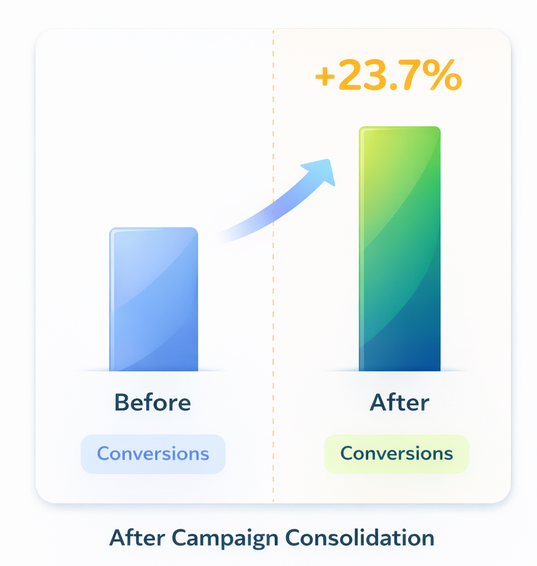
Bar chart showing conversions increased by 23.7% after campaign consolidation compared to before
Studies across large ad accounts indicate that overlapping audiences can increase CPMs by 10–20% while delivering little incremental value. Consolidation reduces self-competition and improves budget efficiency.
3. Budget Fragmentation
When budgets are split across many campaigns, none of them may receive enough spend to perform consistently. Smaller budgets limit testing, slow optimization, and increase volatility.
Accounts that consolidate budgets into fewer campaigns often see more stable cost per acquisition and smoother scaling, especially when using automated bidding and campaign budget optimization.
4. Similar Performance Across Segments
If multiple campaigns or ad sets show nearly identical performance metrics, separation may no longer be justified. When cost per conversion, conversion rate, and audience quality are similar, consolidation simplifies management without sacrificing results.
In practice, advertisers often discover that 70–80% of segmented campaigns could be merged with minimal performance impact.
When You Should Not Consolidate
Consolidation is not always the right move. Avoid consolidating when:
-
Different products or offers have significantly different margins or KPIs
-
Regions or languages require distinct messaging and budgets
-
Testing fundamentally different strategies that need isolated data
In these cases, separation protects clarity and decision-making.
How Consolidation Improves Performance
Faster Algorithm Learning
Larger data pools allow platforms to identify winning patterns faster. Consolidated structures reach statistical significance sooner, reducing the trial-and-error phase.
More Stable Results
Fewer campaigns mean fewer variables. Advertisers often see reduced day-to-day volatility and more predictable scaling after consolidation.
Easier Optimization and Reporting
Managing fewer campaigns simplifies analysis, creative testing, and budget decisions. Teams can focus on strategy instead of constant micro-adjustments.
A Practical Consolidation Checklist
Before consolidating, confirm the following:
-
Audiences significantly overlap or behave similarly
-
Campaigns share the same optimization goal
-
Budgets are too small to generate consistent weekly conversions
-
Performance differences do not justify structural complexity
If most boxes are checked, consolidation is likely the right step.
Related Articles You May Find Useful
Conclusion
Campaign consolidation is no longer an advanced tactic—it is often a necessity. As ad platforms prioritize automation and data volume, simpler structures consistently outperform fragmented ones.
The key is timing. Consolidate when complexity limits learning, inflates costs, or slows growth. Done correctly, consolidation creates cleaner data, stronger optimization, and more scalable performance.