Most teams don’t run out of creative ideas. They run out of structure.
Creative testing often turns into scattered experiments — new hooks, formats, and messages launched without a clear system. Performance looks inconsistent, and decisions rely on partial signals like CTR or early CPL.
Systematic angle testing solves a different problem: not just what works, but why it works and when it should scale.
What a Creative Angle Really Is
A creative angle is the core framing of the problem and value, not a surface-level variation.
Two ads can look nearly identical but operate on completely different angles:
-
One emphasizes cost savings, attracting price-sensitive users.
-
Another focuses on operational efficiency, pulling in decision-makers.
-
A third highlights risk reduction, resonating with late-stage buyers.
Each angle shapes the type of user entering your funnel. That’s why creative testing is directly tied to lead quality — not just engagement.
If you want to refine how messaging is structured inside an ad, read How to Structure a High-Converting Facebook Ad: Hook, Body, CTA.
Why Most Creative Testing Fails
A familiar pattern: one ad gets higher CTR and lower CPL, so it gets scaled.
Two weeks later, sales flags poor lead quality.
The issue isn’t the creative itself — it’s how testing is done.
Most tests fail because:
-
Angles are mixed with execution changes.
New visuals, copy, and formats are introduced at the same time, making results impossible to isolate. -
Decisions rely on early metrics.
CTR reacts instantly, but qualification and revenue lag behind. -
Budget shifts too early.
The algorithm reallocates spend before meaningful downstream data appears. -
Too many variations run at once.
This dilutes delivery and produces noisy results — a problem explained in Why Testing Too Many Ads at Once Hurts Your Campaign Results.
Without structure, you’re not testing angles — you’re observing random outcomes.
Step 1: Isolate the Angle
If multiple variables change at once, the test becomes useless.
To isolate the angle, keep the following constant:
-
Audience.
Use the same targeting or seed. Changing the audience changes intent. -
Ad format.
Keep layout and structure consistent so differences come from messaging. -
Offer mechanics.
Pricing, CTA, and funnel structure must remain unchanged. -
Landing experience.
Different pages introduce post-click variables that distort results.
This aligns with clean testing principles outlined in How to Run A/B Tests That Deliver Real Insights.
Step 2: Define Angles as Hypotheses
Testing random ideas creates noise. Testing hypotheses creates learning.
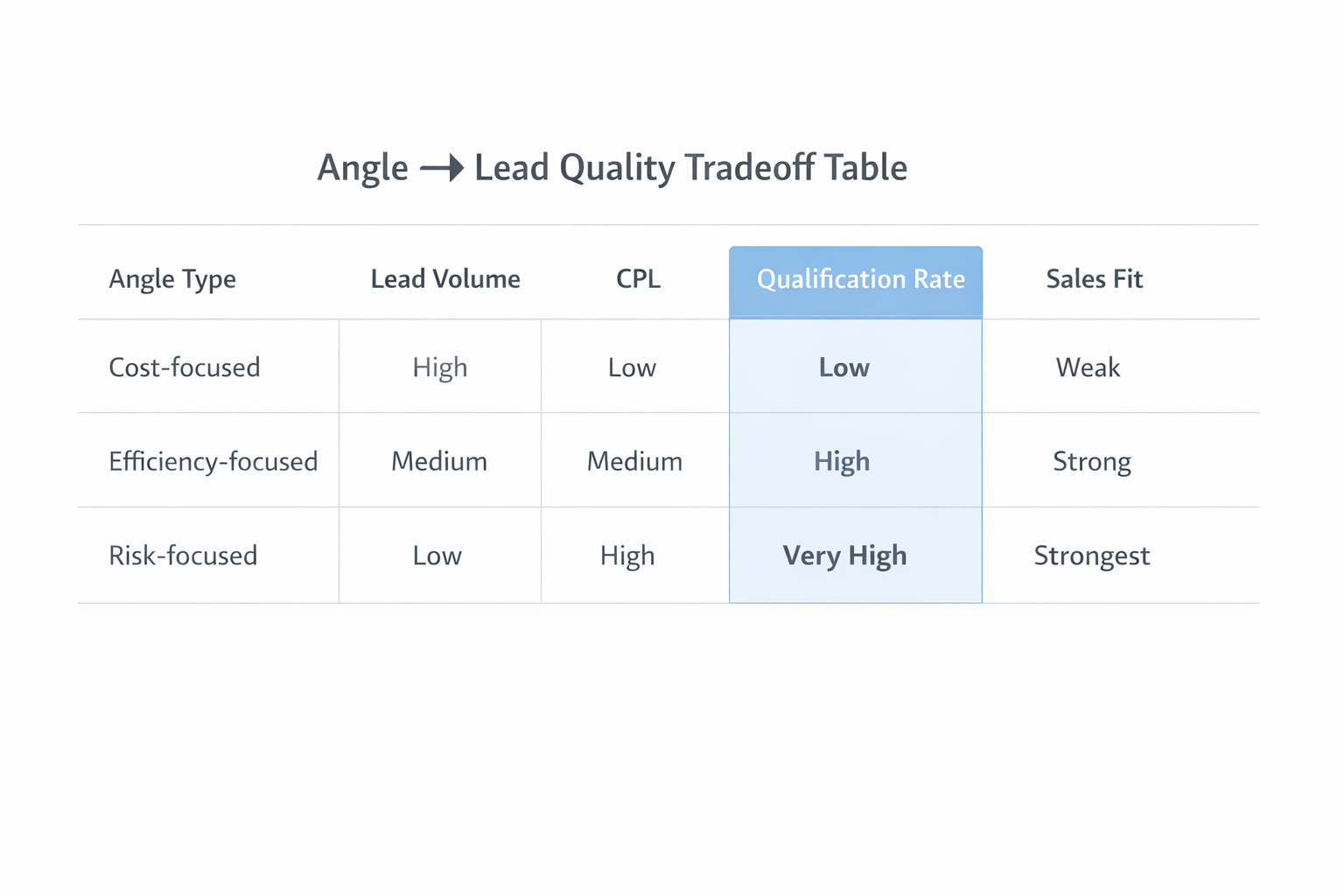
Each angle should predict a specific outcome:
-
Cost-focused angle
Expected: higher volume, lower qualification rate. -
Efficiency-focused angle
Expected: moderate volume, stronger qualification. -
Risk-focused angle
Expected: lower volume, higher close rate.
This framing prevents misinterpretation.
If an angle produces cheap leads but low acceptance rate, it’s not “bad” — it’s behaving exactly as expected.
Step 3: Use a Structure That Preserves Signal
Meta will prioritize the angle that generates fast feedback signals, not necessarily the one that drives revenue.
To avoid bias:
-
Separate angles into different ad sets when possible.
This ensures each angle gets enough delivery. -
Control budgets per angle.
Avoid letting one variation dominate too early. -
Minimize edits during testing.
Each change resets learning and introduces volatility. -
Limit the number of angles per test cycle.
2–3 angles are easier to evaluate than 6–8 competing variations.
A structured approach prevents the algorithm from “choosing for you” based on incomplete signals.
Step 4: Evaluate Using Lagging Metrics
Early metrics diagnose delivery. They don’t determine success.
Angle evaluation should focus on:
-
CPQL (Cost per Qualified Lead).
Shows whether the angle attracts the right users. -
Lead-to-opportunity rate.
Reveals alignment between messaging and real buying intent. -
Sales feedback.
Often surfaces mismatches before they appear in reports. -
Time-to-qualification.
Faster movement through the funnel usually signals stronger intent.
If you’re still optimizing around surface metrics, you’ll keep running into issues explained in Why Click-Through Rate Can Be Misleading.
Step 5: Look for Patterns, Not Winners
The goal isn’t to find one winning ad.
It’s to identify repeatable patterns across angles.
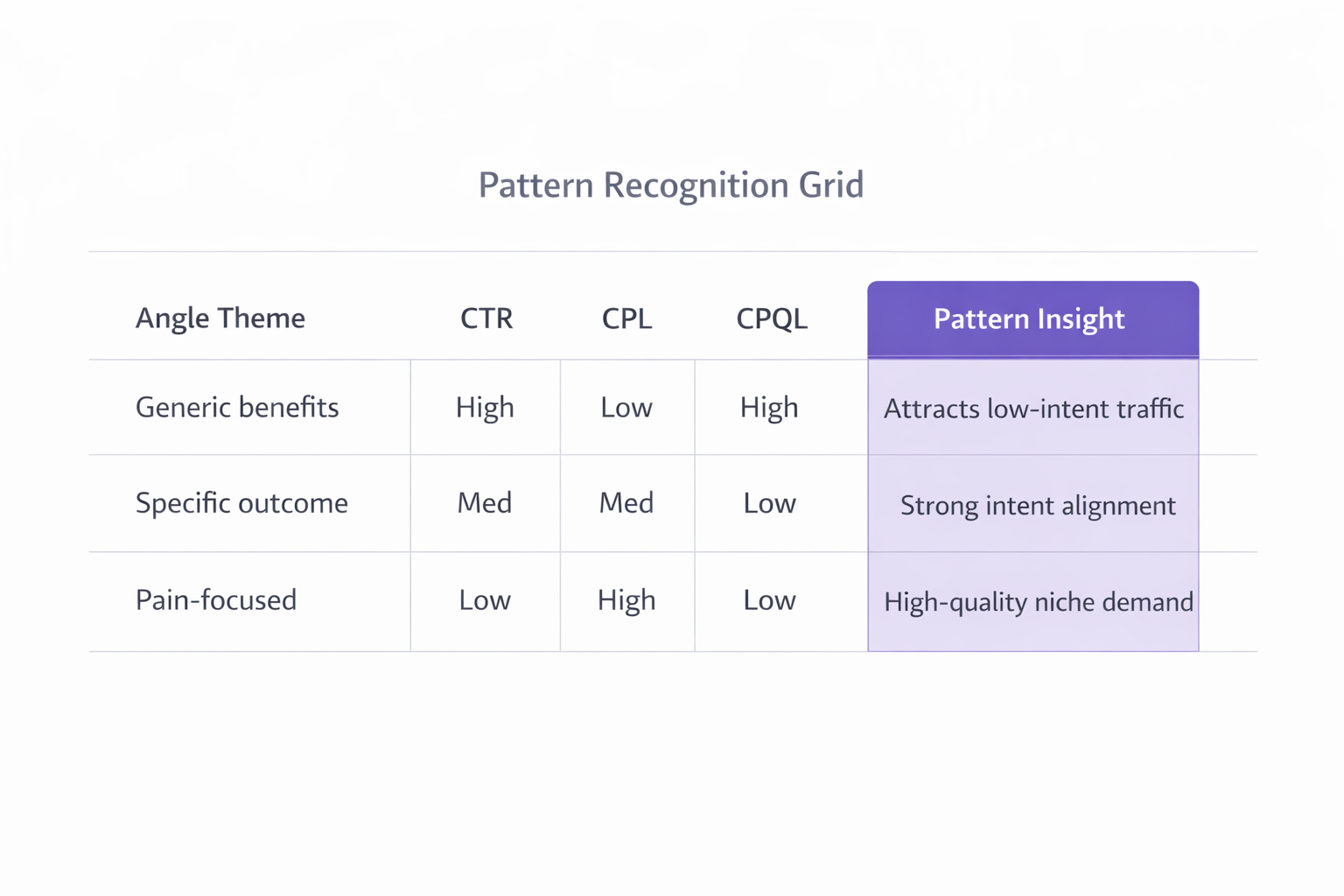
For example:
-
Angles tied to specific outcomes tend to outperform generic benefits.
-
Messaging focused on operational problems often attracts higher-quality leads.
-
Narrow, specific angles reduce volume but improve pipeline efficiency.
These patterns become the foundation for future creative development.
Step 6: Scale the Angle, Then Iterate Execution
Once an angle proves effective, don’t switch concepts immediately.
Instead:
-
Test new hooks that express the same idea.
-
Experiment with formats (video, static, carousel).
-
Refine clarity to remove ambiguity.
At this stage, you’re optimizing execution, not strategy.
To expand a winning idea efficiently, see How to Repurpose a Single Creative Into 5 Different Facebook Ad Formats.
Where Most Teams Break the System
Even with a framework, a few mistakes repeatedly show up:
-
Stopping tests too early.
Decisions are made before lead quality stabilizes. -
Chasing volume over quality.
High lead counts mask poor downstream performance. -
Mixing testing with scaling.
New angles are introduced into stable campaigns, resetting learning. -
Ignoring negative signals.
Sales rejection rates or poor pipeline progression get overlooked.
These aren’t tactical errors — they’re structural ones.
A Simple Testing Setup You Can Use
To apply this in practice:
-
Define 2–3 clear angles with hypotheses.
-
Keep audience, format, and offer constant.
-
Allocate controlled budgets per angle.
-
Run long enough to collect qualification data.
-
Evaluate based on CPQL and downstream metrics.
-
Extract patterns before launching the next test cycle.
This approach may feel slower, but it produces decisions you can trust.
Final Takeaway
Creative testing is not about generating more variations.
It’s about building a system where every test produces usable insight about your market and your buyers.
When angles are isolated, hypotheses are clear, and evaluation focuses on real outcomes, creative becomes a predictable growth lever — not a guessing process.