Click-through rate is attractive because it’s easy to understand. More clicks feel like progress. Platforms highlight CTR prominently, and reports often reward campaigns that generate attention quickly. However, digital advertising performance is rarely linear. A high CTR does not automatically mean high revenue, quality traffic, or sustainable growth.
In practice, CTR measures interest — not intent, value, or profitability.
High CTR ≠ High Conversions
One of the biggest misconceptions is assuming that clicks naturally lead to conversions.
Industry benchmarks show that:
-
Display ads can average 0.35–0.45% CTR, yet conversion rates often remain below 1%.
-
Social ads frequently see CTRs above 1%, while only 10–20% of those clicks result in meaningful on-site actions.

Comparing average click-through rates (search vs display) with typical conversion rates highlights that a high CTR does not guarantee strong conversion performance
This gap exists because CTR reflects how compelling an ad is, not how qualified the audience is. Ads with emotional hooks, curiosity-driven copy, or aggressive offers can generate clicks from users who were never close to converting.
CTR Favors Curiosity Over Intent
CTR tends to reward ads that trigger curiosity rather than readiness to act.
Examples include:
-
Broad headlines that attract attention but don’t match landing page intent
-
Sensational visuals that drive impulse clicks
-
Vague offers that generate interest without clarity
According to multiple paid media studies, campaigns optimized purely for CTR can see:
-
20–40% higher bounce rates
-
Shorter session durations compared to intent-driven campaigns
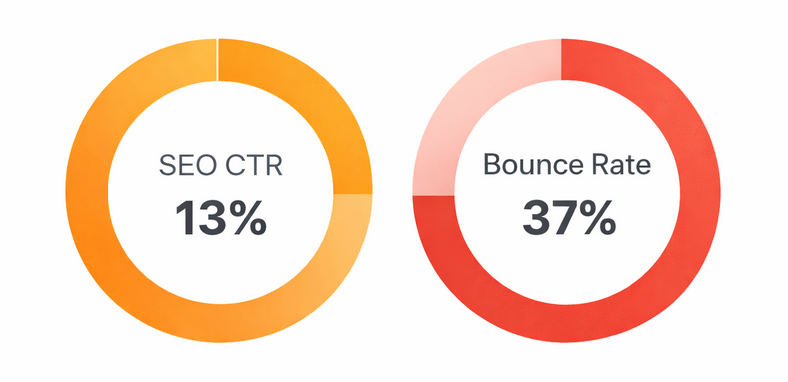
While click-through rates (e.g., SEO CTR) can be high, average bounce rates show that much of that traffic leaves without deeper engagement
This traffic inflates engagement metrics while silently draining budget.
The Algorithmic Trap
When campaigns are optimized toward CTR, ad platforms learn to serve ads to users who click frequently — not users who convert.
This creates a feedback loop:
-
High-click users see more ads
-
Conversion-ready users are deprioritized
-
Cost per click decreases, but cost per acquisition increases
Internal platform analyses have shown that optimizing for clicks can increase click volume by over 50%, while conversions grow by less than 10% or stagnate entirely.
CTR Ignores Downstream Performance
CTR says nothing about what happens after the click.
It does not account for:
-
Conversion rate
-
Cost per lead or sale
-
Lead quality
-
Lifetime value
For example:
-
Campaign A: 2.5% CTR, $1.20 CPC, 0.8% conversion rate
-
Campaign B: 0.9% CTR, $2.10 CPC, 4.2% conversion rate
Despite a lower CTR, Campaign B produces significantly more revenue per dollar spent.
When CTR Is Actually Useful
CTR isn’t useless — it’s just incomplete.
CTR works best as:
-
A creative diagnostic tool (headline, image, message resonance)
-
An early signal during A/B testing
-
A relative comparison metric between similar audiences and offers
Problems arise when CTR becomes the primary success metric instead of a supporting one.
Metrics That Matter More
To understand real performance, CTR should be viewed alongside:
-
Conversion rate
-
Cost per acquisition
-
Return on ad spend
-
Funnel drop-off points
Data-driven marketers consistently prioritize these metrics because they reflect business outcomes rather than surface-level engagement.
Conclusion: Clicks Are Not the Goal
Clicks are a means, not an outcome. High CTR can look impressive in reports while masking deeper inefficiencies in targeting, messaging, or funnel structure.
The most effective campaigns are not the ones that attract the most clicks — but the ones that attract the right people and move them to action.