Markets move faster, customer journeys span more channels, and data volumes grow every quarter. According to IBM, the volume of data created globally has been doubling roughly every two years, forcing organizations to make decisions in increasingly information-dense environments. What once felt like an exception—multiple platforms, fragmented audiences, overlapping tools—is now the baseline.
The companies that struggle are not necessarily the least talented or underfunded. More often, they are the ones trying to reduce complexity instead of learning how to operate within it.
Why Complexity Feels Like a Problem
Complexity becomes painful when it is unmanaged. Common symptoms include:
-
Slower decision-making due to unclear ownership and data overload
-
Rising operational costs caused by duplicated tools and processes
-
Inconsistent customer experiences across touchpoints
-
Teams optimizing locally instead of toward shared outcomes
A McKinsey study found that organizations with highly complex structures can experience up to 25% lower productivity compared to more aligned peers. The issue is not complexity itself, but the lack of systems designed to harness it.
Reframing Complexity as an Advantage
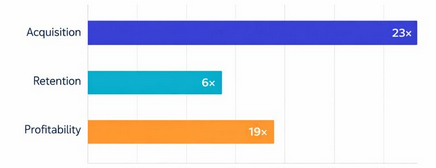
Impact of data-driven decision-making on customer acquisition, retention, and profitability
When structured correctly, complexity creates defensibility. It raises the bar for competitors and enables capabilities that simpler setups cannot easily replicate.
1. More Data Means Better Decisions
Complex environments generate richer datasets. Companies that integrate and interpret this data effectively gain sharper insights into customer behavior, timing, and intent. Research from PwC shows that data-driven organizations are three times more likely to report significant improvements in decision-making compared to less data-mature competitors.
The advantage comes not from collecting more data, but from designing clear feedback loops that turn signals into action.
2. Complexity Enables Personalization at Scale
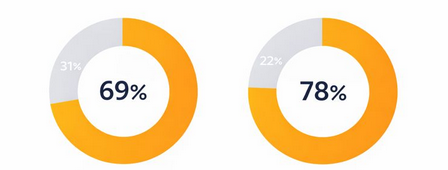
Customer preferences for personalization and business reliance on first-party data
Multiple channels, formats, and touchpoints allow businesses to meet users where they are. Salesforce reports that 73% of customers expect companies to understand their unique needs and expectations. Delivering on this expectation requires complex orchestration—but those who master it can increase conversion rates and customer lifetime value simultaneously.
3. Harder to Copy, Easier to Defend
Well-orchestrated complexity creates operational moats. Custom workflows, proprietary audience models, and integrated decision systems are difficult for competitors to reverse-engineer. What looks chaotic from the outside is often a finely tuned machine internally.
The Systems That Turn Chaos into Control
To transform complexity into an advantage, organizations need enabling systems rather than more tools.
Unified Measurement Frameworks
A single source of truth reduces friction. When performance metrics are standardized across teams and channels, complexity becomes visible and manageable. According to Gartner, companies that align measurement across departments are 1.7 times more likely to achieve their strategic goals.
Modular Processes
Instead of rigid workflows, leading organizations use modular components that can be recombined as conditions change. This approach allows teams to adapt quickly without rebuilding entire systems.
Clear Decision Ownership
In complex environments, speed depends on clarity. Defining who owns which decisions—and at what level—prevents analysis paralysis and keeps momentum high even when inputs are imperfect.
Cultural Shifts That Support Complex Systems
Technology alone is not enough. Competitive advantage emerges when culture supports complexity.
-
Teams are rewarded for learning speed, not just short-term outcomes
-
Experimentation is normalized, with controlled risk instead of rigid certainty
-
Cross-functional collaboration replaces siloed optimization
Harvard Business Review notes that organizations with strong learning cultures are 46% more likely to be first to market with new offerings, even in highly complex industries.
From Simplification to Mastery
The goal is not to eliminate complexity, but to master it. Simplification can create short-term relief, but it often limits long-term growth. Companies that embrace complexity—by designing systems, metrics, and cultures around it—unlock flexibility, resilience, and sustained performance.
In an environment where everyone faces complexity, the real advantage belongs to those who know how to use it.