Click-to-message ads need good feedback. If Meta only sees that someone started a chat, it learns to find more people who start chats.
That is not enough for sales.
The campaign may keep producing conversations because message starts are easy to track. But if purchases, bookings, or qualified leads are missing from the data, Meta has limited proof of who actually became valuable.
Core problem: Meta sees the chat before it sees the sale
A message start happens fast. A sale usually happens later.
The user may ask a question, talk to sales, receive a quote, book a call, or return to the website before buying. If those later steps are not tracked, Meta mostly sees the early action.
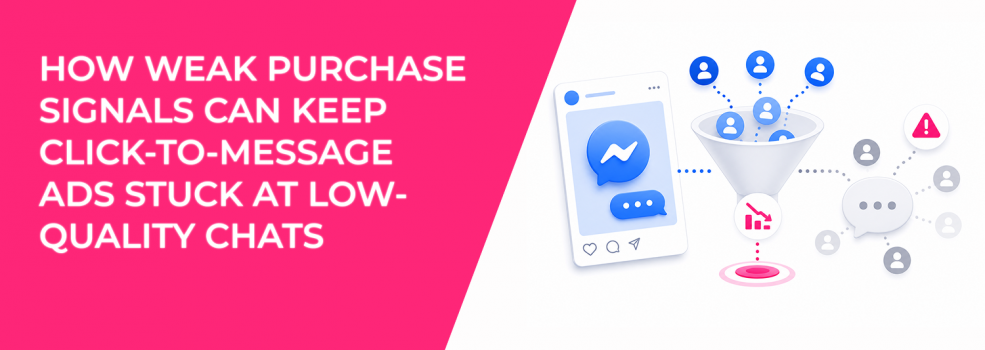
That creates a weak learning loop. The campaign teaches Meta to find users who open Messenger, not users who become customers.
This is common for service businesses, B2B offers, real estate, clinics, agencies, and high-ticket products. The final conversion often happens outside the first chat, so the ad account misses the most important signal.
Why weak signals keep low-quality chats coming
Meta follows the clearest pattern it can see. If message starts are the clearest pattern, the campaign will keep finding users who message.
The problem is that message behavior can be shallow. A person may send a message because they are curious, bored, comparing prices, or asking on behalf of someone else. Without stronger conversion data, Meta cannot easily separate those users from buyers.
That can create a loop:
- The ad gets many chats. Meta sees fast activity and keeps looking for similar users.
- Sales data is missing or delayed. The platform cannot clearly see which chats became customers.
- Low-quality conversations repeat. Delivery keeps favoring people who are easy to engage.
- Scaling increases noise. More budget creates more chats, not necessarily more buyers.
This is why scaling click-to-message ads based only on conversation volume can be risky.
Solution: track the events that show real value
The fix is to send Meta stronger signals. A message start is useful, but it is too shallow to guide a sales-focused campaign by itself.
Track events closer to revenue. That may include purchases, booked appointments, qualified leads, deposits, quote requests, or closed deals.
For e-commerce brands, proper Facebook Pixel setup and optimization is the first step. Meta needs to see actions like add to cart, initiate checkout, and purchase.
For service businesses, the important event may happen in a CRM or booking tool. In that case, the advertiser needs a way to send that data back into Meta.
Use stronger tracking before increasing spend
If the sale happens online, server-side tracking can help improve data quality. Server-side tracking for Facebook ads can reduce missed events and give Meta a cleaner view of conversions.
If the sale happens offline, use offline events. For example, upload qualified leads, booked calls, or closed deals from your CRM. This helps Meta learn which Messenger users created business value.
That is where offline events to improve Facebook targeting become useful. They connect real sales outcomes back to ad delivery.
The key is consistency. If qualified leads are uploaded once and then ignored for three months, Meta gets only partial feedback. The signal needs to be updated often enough to help the system learn.
Choose the strongest event with enough volume
Do not optimize for an event that barely happens. If you only get a few purchases per month, Meta may not have enough data to learn from.
Use the strongest reliable event available. For example, start with qualified leads if purchases are too rare. Then move closer to purchase optimization as the account collects more data.
A simple progression might look like this:
- Message start. Useful for early testing, but weak for sales quality.
- Qualified conversation. Better because it filters out poor-fit users.
- Booked appointment or checkout. Stronger because it shows real intent.
- Purchase or closed deal. Best when there is enough volume.
This gives the campaign better learning signals without starving delivery.
Check whether the campaign is learning from the wrong event
A weak-signal problem often shows up in the pattern of conversations. If Meta keeps finding users who ask one question and disappear, the campaign may be learning from message starts instead of sales actions.
Look at the gap between replies and real outcomes. If 300 conversations create only a few qualified leads, the optimization signal is probably too shallow.
This does not always mean the ads are bad. It may mean the account is not feeding Meta enough useful data.
Final takeaway
Low-quality chats often come from weak feedback. Meta cannot optimize for sales if it never sees which chats became sales.
Track beyond the first message. Send purchase, booking, qualified lead, or offline sales data back into Meta. Once the platform has better signals, click-to-message ads have a better chance of finding buyers instead of casual chatters.