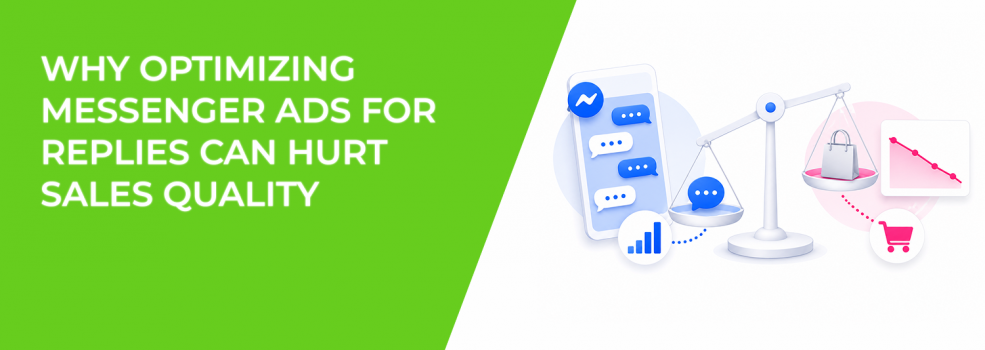
Reply optimization can create a misleading campaign.
The ad gets messages. The dashboard looks active. The cost per reply may even be low. But the sales team sees a different picture: weak-fit users, short conversations, and few real buyers.
This happens because the campaign is built to reward replies. Sales quality only improves when the reply is connected to stronger intent.
Core problem: the campaign rewards the easiest action
A reply is easy. The user does not need to fill out a form, pay, book, or commit. They only need to send a message.
Meta can find people who are likely to do that. But users who reply often are not always users who buy often.
That is why campaign objectives matter. If you optimize for replies, Meta will prioritize reply behavior. If the business wants sales, this can create a mismatch between campaign setup and business outcome.
This is exactly where Facebook ad objectives impact lead quality. The objective tells Meta what action matters most.
Why reply optimization can reduce sales quality
Reply optimization usually favors low-friction engagement. That means the campaign may attract people who want fast answers, free advice, discounts, or basic information.
For some businesses, that is fine. A restaurant, salon, or simple local offer may close customers directly inside Messenger. But for complex or higher-value offers, low-friction replies can create too much noise.
For example, a software company may get many messages asking “how much?” but few users willing to book a demo. A real estate advertiser may get casual property questions from users who are not financially ready. A clinic may get general inquiries from people outside the service area.
The issue is not Messenger itself. The issue is rewarding the reply before checking whether the reply has sales value.
Solution: make replies show real intent
The answer is not to make Messenger hard to use. The answer is to make the first reply more meaningful.
Start with the ad copy. Tell users what they are messaging about. Include the offer, use case, price range, location, or next step when relevant.
- Weak CTA: “Message us for details.”
- Better CTA: “Message us to see if your business qualifies for a free demo.”
The second version filters users before they enter Messenger. It also gives the sales team a clearer conversation to continue.
Cheap replies can raise your true CPA
A $2 reply looks good until only one out of 100 replies becomes a customer.
Cheap replies can waste budget and sales time. They also hide the real cost of acquisition. The campaign may look efficient in Ads Manager while the business pays more for every sale.
This is why advertisers should compare cost per lead versus lead value. A cheaper lead is not better if it rarely converts.
A higher-cost conversation can be more profitable when it has stronger buying intent.
Add light qualification inside Messenger
You do not need a long form inside Messenger. In fact, too many questions can reduce response rates.
Use one or two simple questions that reveal fit. For example:
- For local services: “What ZIP code are you in?”
- For B2B: “How many people are on your team?”
- For high-ticket offers: “Are you looking to start this month or later?”
- For e-commerce: “Which product are you comparing?”
These questions help qualify leads through Facebook ads without making the user feel blocked.
Make the sales handoff fast and clear
Reply quality also depends on what happens after the first message. If the business takes hours to respond, even a good lead can go cold.
Messenger users expect speed. The first response should confirm the need, ask a useful question, and point to the next step. Do not leave the user waiting while the sales team decides who should answer.
A simple handoff can work well. For example: “Thanks. Are you looking for a quote this week or just comparing options?” That question quickly separates active buyers from early browsers.
Test reply optimization against stronger outcomes
Reply optimization can still work for simple offers or businesses with strong chat sales teams. But it should be tested against better goals when sales quality is weak.
Compare campaigns by qualified conversation rate, booked call rate, close rate, CPA, and ROAS. Do not let cost per reply make the decision alone.
If one campaign gets fewer replies but more buyers, it is the better sales campaign.
Final takeaway
Messenger ads should not chase replies for their own sake. A reply only matters if it moves the person closer to buying.
If reply optimization hurts sales quality, the campaign is rewarding the wrong behavior. Make the ad more specific, add light qualification, and measure the value of each conversation instead of only the number of replies.