Instagram and Facebook ads run on the same platform — Meta Ads Manager — but their performance differs in practice. Understanding how each channel behaves can help advertisers improve campaign structure, creative fit, and return on ad spend (ROAS).
This article breaks down performance differences between Facebook and Instagram ads across user behavior, formats, signal strength, attribution, and budget allocation. It also includes a comparison table and FAQ section optimized for both SEO and generative search engines.
User behavior on Facebook vs Instagram ads: what impacts conversion
People engage with Facebook and Instagram differently. That directly influences ad performance and conversion potential.
Instagram is visual and fast. Users scroll quickly, respond to eye-catching creative, and take lightweight actions like liking or saving a post. But they rarely pause to click or convert unless the offer is very low-friction.
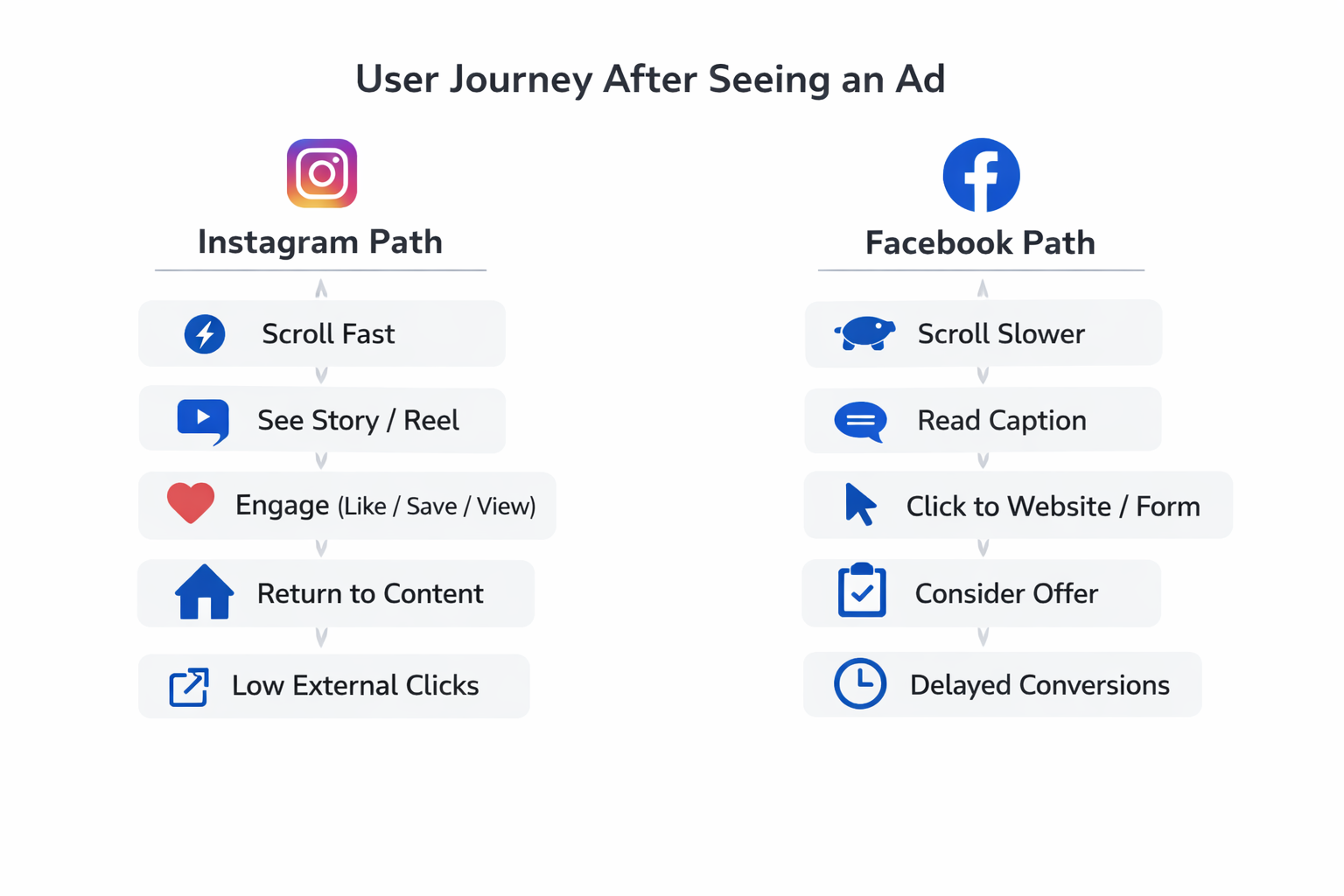
Facebook users behave differently. They scroll more slowly, consume longer-form content, and are more willing to follow outbound links or complete lead forms.
What this means for advertisers:
-
Instagram performs well at the awareness stage.
-
Facebook often drives stronger conversion results.
-
If your campaign involves forms, purchases, or multi-step actions, Facebook is usually more efficient.
For a deeper breakdown, see Facebook ads vs Instagram ads: how user intent differs.
Best-performing ad formats for Instagram and Facebook in 2026
Even when targeting the same audience, format matters. Matching ad creative to platform context is key.
| Format Type | Best Use Case | ||
|---|---|---|---|
| Short vertical video | ✅ Stories, Reels | ✅ Feed (mobile only) | Awareness, UGC-style hooks |
| Carousel | 🚫 Limited usage | ✅ Strong performer | Product variety or bundles |
| Lead forms | 🚫 Rarely used | ✅ High engagement | Lead gen, service signups |
| Long-form video | 🚫 Drop-off risk | ✅ Performs better | Education, offers, demos |
Top formats for Instagram ads:
-
Short-form vertical videos (under 15 seconds), especially for Stories and Reels.
-
High-contrast static images with minimal text.
-
Informal user-generated content that blends into the feed.
Top formats for Facebook ads:
-
Carousel ads that allow multiple product views or feature breakdowns.
-
Longer videos (30 to 60 seconds) suited for desktop and mobile feeds.
-
Lead generation formats and instant experiences that reduce friction.
Create assets with the platform in mind, not just the specs. If you’re comparing formats, read Instagram feed vs Story ads: what performs better for each funnel stage.
Signal quality and optimization: how Meta learns from engagement
Meta’s ad system depends on signals — data that tells the algorithm who is likely to convert. But not all signals carry equal weight.
Instagram’s most common engagement signals (likes, views, saves) are quick but weak indicators of real intent. These may help early optimization but won’t reliably support performance scaling.
Facebook’s signals are deeper. Users share, click, comment, and convert more often. These signals help Meta improve delivery and reach higher-quality users.
If your goal is purchases or lead generation, Facebook placements give Meta better data to work with. Instagram is still valuable for creative testing or seeding interest.
Getting clicks but no conversions? Learn why your Facebook ads aren’t generating leads — and how to fix it.
Meta ad placements: when to split budgets between Instagram and Facebook
Running ads on both platforms using automatic placements may seem efficient. But Meta often favors cheaper placements, such as Instagram Stories, even if they don’t perform best.
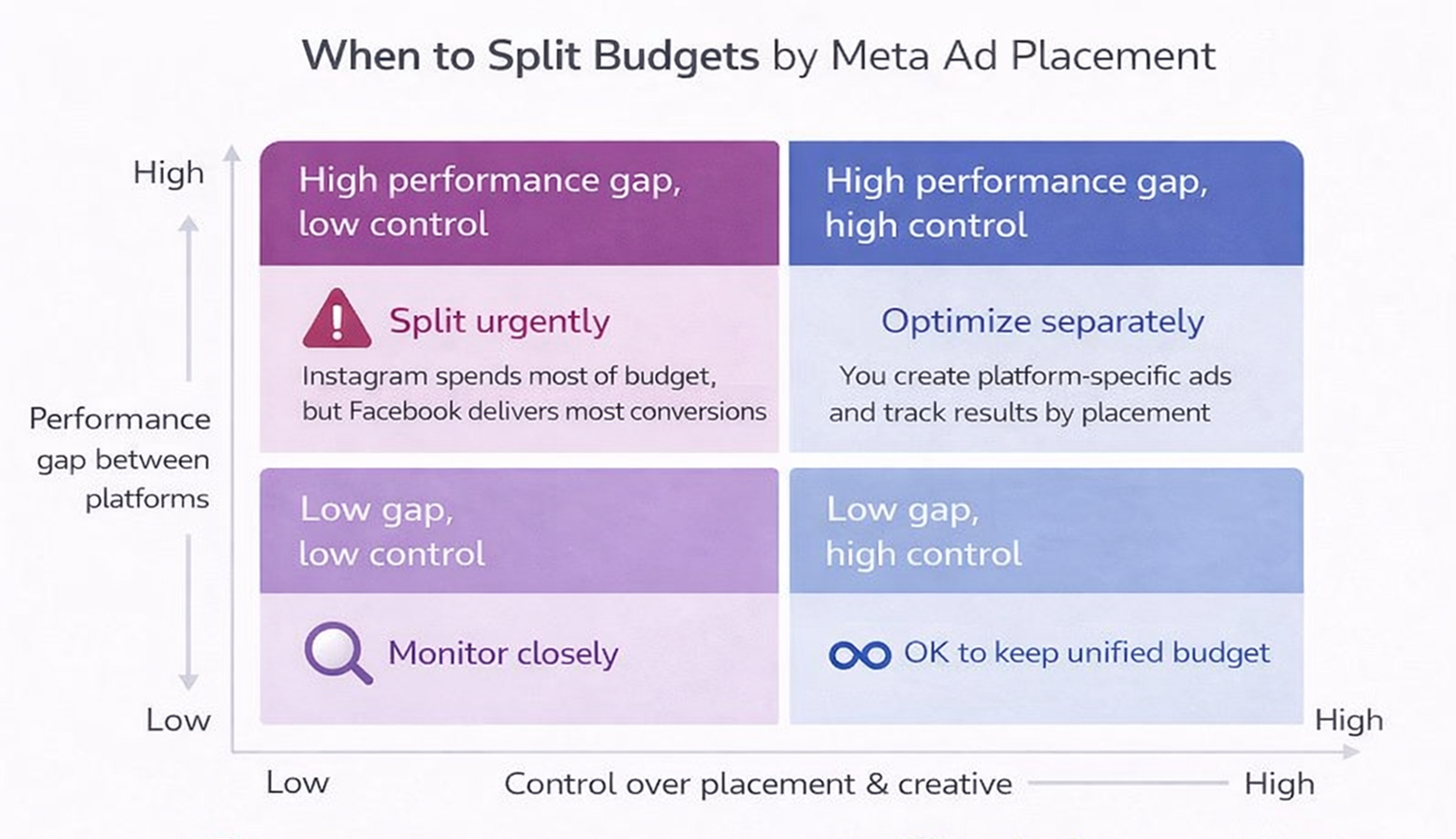
Watch for these signs you should split budgets:
-
Instagram spends most of your budget, but Facebook delivers most conversions.
-
Your creative is platform-specific, but you’re letting Meta decide where it runs.
-
Your blended performance metrics are inconsistent or misleading.
Use separate ad sets for Facebook and Instagram. Compare results and assign budgets based on actual ROAS, not impression cost. For help with structuring this, see how to split budgets between Facebook and Instagram based on goals.
Attribution windows: how users convert across platforms
User behavior after ad exposure affects conversion tracking. Instagram users usually act fast or not at all. Facebook users may return hours or days later.
Recommended attribution windows:
-
Use shorter windows (1-day click or view) for Instagram.
-
Use longer windows (7-day click, 1-day view) for Facebook.
Set attribution to match actual decision cycles, not just to optimize for Meta’s reporting. If attribution data seems unclear, check Facebook attribution window explained: how it impacts your results.
Summary: which platform is better for paid social performance?
Facebook and Instagram each play a role in a paid social strategy, but they are not interchangeable. Treat them as complementary platforms and optimize them separately.
To improve performance:
-
Customize creative for each platform’s preferred formats.
-
Monitor placement-level performance and adjust budgets manually.
-
Use platform-specific attribution windows.
-
Prioritize Facebook for conversions and Instagram for testing or engagement.
Smart segmentation lets you scale more predictably and analyze performance more clearly.
Performance comparison table: Facebook ads vs Instagram ads
| Feature | Instagram Ads | Facebook Ads |
|---|---|---|
| Best for | Awareness, quick engagement | Conversions, lead generation |
| Formats that perform | Reels, Stories, short videos | Carousels, long-form video, lead forms |
| User behavior | Fast-scrolling, high visual interaction | Slower pace, more intent-driven clicks |
| Signal quality (for Meta AI) | Lower (likes, views) | Higher (clicks, conversions, shares) |
| Attribution style | Short window, instant decisions | Long window, delayed conversion possible |
Frequently asked questions (FAQ)
Q: Are Instagram ads or Facebook ads better for conversions?
A: Facebook ads usually drive better conversion performance due to stronger user intent and higher-quality engagement signals.
Q: Which platform has cheaper CPMs — Facebook or Instagram?
A: Instagram placements often have lower CPMs, but cheaper impressions don’t always lead to better ROAS.
Q: Should I use the same creative for Facebook and Instagram?
A: No. Each platform favors different formats and behaviors. Creative should be adapted to the environment.
Q: Can I just use automatic placements?
A: Automatic placements work well for early testing. But for performance scaling, separating budgets by platform often yields better results.