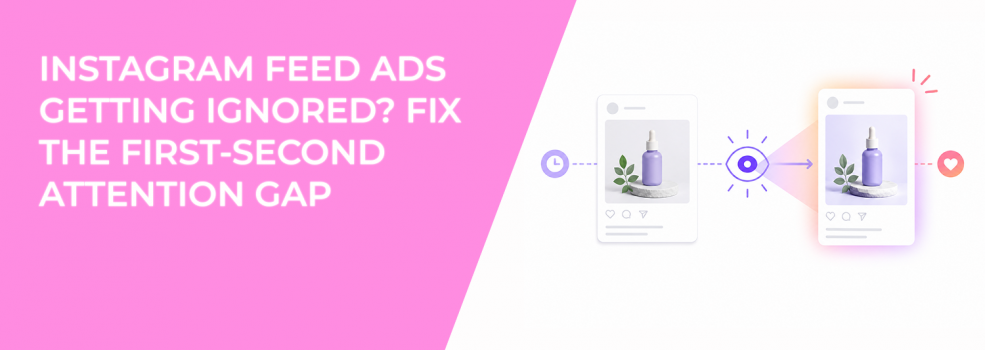
Instagram feed ads often fail before users understand the offer. The ad receives an impression, but the user scrolls past before the product, message, or CTA enters their attention.
This creates a hidden performance problem. Ads Manager may show reach and delivery, but CTR stays weak, CPC rises, and the campaign struggles to produce qualified traffic. The budget is being spent on visibility that never becomes real attention.
The first second decides whether the user gives the ad a chance.
Why Instagram feed ads lose attention so quickly
Instagram users scan the feed at high speed. They are not reading every post carefully. They are filtering visual patterns.
If the ad does not create a clear visual signal right away, the user treats it like background content. This is especially common when the creative has a small product, weak contrast, or too many competing elements.
A feed ad does not need to look loud. It needs to be easy to understand while the thumb is still moving.
The campaign signals that show an attention gap
A first-second attention problem usually appears before conversion data looks useful. The earliest warning sign is weak outbound click activity compared with impressions.
You may see:
- CTR drops while CPM stays normal.
The ad is entering auctions, but users are not reacting to it. - CPC rises without a major targeting change.
Meta keeps buying impressions, but fewer users click. - Engagement is shallow.
The ad may get likes, but it does not generate enough qualified visits. - Feed performs worse than other placements.
This usually means the ad cannot compete in a fast-scroll environment.
These signals often get misread as targeting problems. Sometimes the audience is fine. The creative simply fails to stop the scroll.
Why weak first-second attention increases wasted spend
Meta delivery depends on predicted action rates. If users ignore the ad, the platform receives weak engagement signals. Over time, that can make delivery less efficient.
For lead generation campaigns, the damage is even bigger. A weak first-second hook reduces the number of users who reach the landing page or lead form. That limits learning data and makes CPA harder to stabilize.
This is why attention mechanics matter to performance marketers. The first second affects click volume, lead volume, and the quality of the data Meta uses to optimize delivery.
How to fix the first-second attention gap
The fix is usually visual clarity, not heavier design.
Start by making one element dominate the frame. That can be the product, the result, the problem, or the clearest visual proof. If the user needs to search the image to understand what matters, the ad is already too slow.
Use stronger contrast around the focal point. A product on a similar-colored background may look polished in a mockup, but it disappears inside the feed. Clear separation helps the eye land faster.
Reduce anything that does not support the first message. Extra labels, badges, icons, and decorative shapes create processing friction. Each added element competes for attention.
This is where scroll-stopping ad creative principles become useful. The goal is not to shock the user. The goal is to make the ad readable before the scroll continues.
You can also review how to earn attention in the first three seconds and study why users stop scrolling to improve creative diagnostics.
When audience quality makes the problem worse or better
Cold broad audiences give weak creative less room for error. If users do not already recognize the product category or pain point, the visual hook must work harder.
High-intent audiences can improve response because the user already has some relevant context. For example, advertisers can use LeadEnforce to build audiences from Facebook groups and Instagram accounts. That can improve signal quality when the creative already has a clear hook.
For example, a SaaS brand can target people connected to sales or productivity communities, so a dashboard screenshot or workflow pain point feels familiar faster. A skincare brand can build audiences from beauty-focused Instagram accounts, making a close-up product visual easier to recognize in the feed.
Still, better targeting does not replace attention. If the ad is visually unclear, even relevant users may scroll past it.
Final takeaway
An Instagram feed ad does not fail only when users dislike the offer. It can fail because users never notice the offer quickly enough.
If impressions are coming in but clicks are weak, audit the first second before changing the campaign structure. Make the main visual easier to notice, easier to understand, and faster to process.