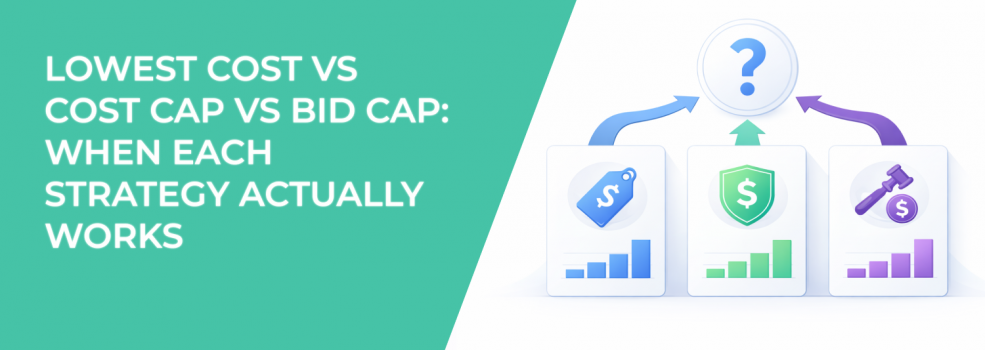
Meta provides three primary bidding strategies for conversion campaigns: Lowest Cost, Cost Cap, and Bid Cap. The interface presents them as simple configuration options, but the operational impact is much deeper. The bidding model determines how your campaign competes in Meta’s ad auction, which ultimately decides whether impressions and conversions are even possible.
Many advertisers adjust bid strategies only when CPA rises. A more productive approach is to understand how each strategy changes the way the delivery system participates in auctions. Once you see the mechanics behind it, the performance differences become much easier to diagnose.
How Meta’s Auction Interprets Your Bid Strategy
Every impression on Facebook and Instagram is allocated through an auction. When multiple advertisers target the same user, the system evaluates several signals before selecting which ad appears.
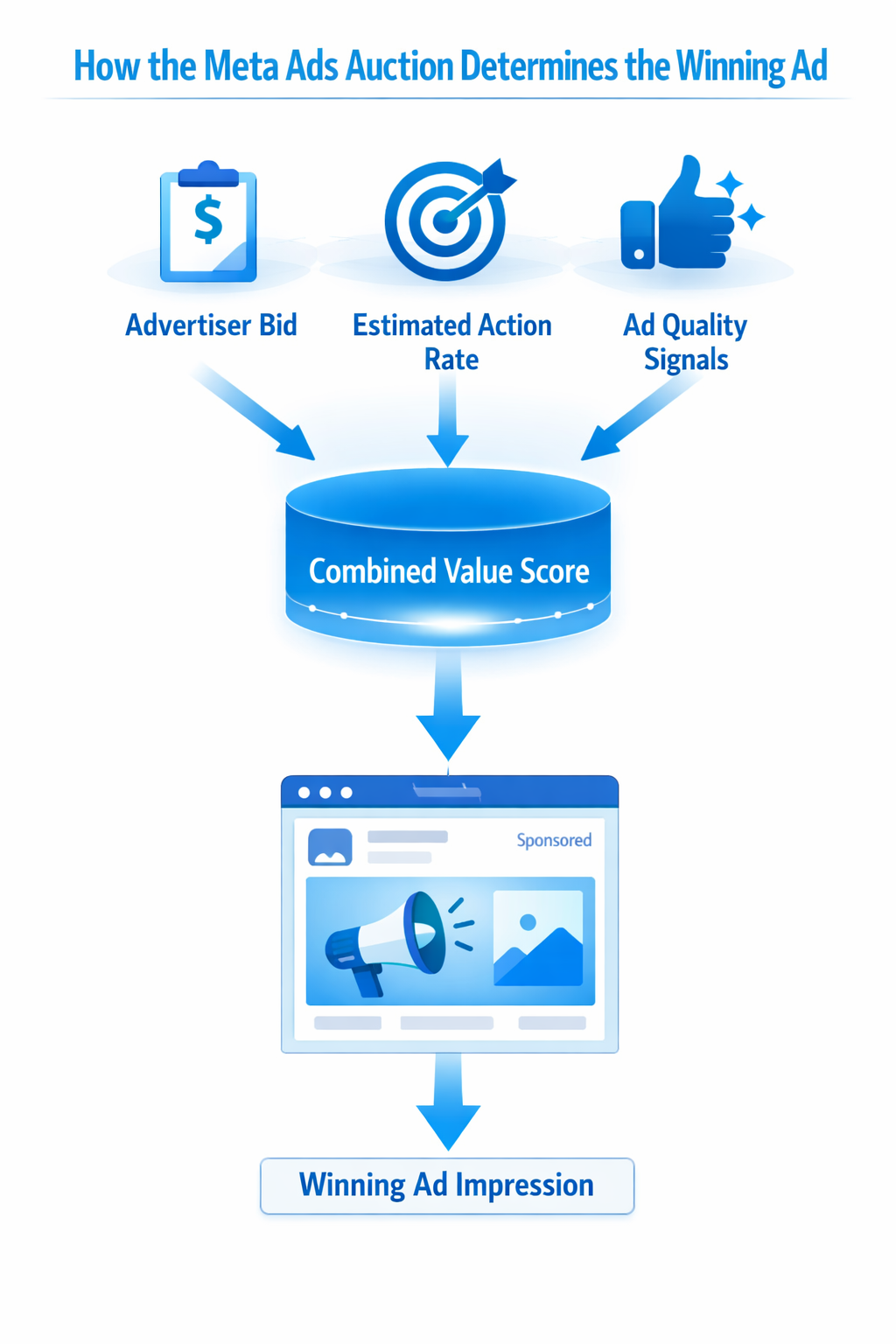
Three components drive that decision:
-
Advertiser bid.
This reflects the maximum value Meta estimates you are willing to pay for the optimization event, such as a purchase or lead. -
Estimated action rate.
The algorithm predicts how likely the user is to complete the desired action after seeing the ad. -
Ad quality signals.
Engagement patterns, negative feedback, and historical performance influence how competitive the ad becomes.
These signals combine into a total value score. The ad with the highest predicted value wins the auction, which means the highest monetary bid does not automatically guarantee delivery.
Bid strategies influence how flexible Meta can be when calculating those bids. Some strategies allow the system to adapt to changing auction prices, while others restrict how aggressively the campaign can compete.
Lowest Cost: Maximum Delivery Flexibility
Lowest Cost is Meta’s default strategy because it allows the algorithm to operate with almost no bidding restrictions. Instead of targeting a specific CPA, the system attempts to generate the highest possible number of conversions within the campaign budget.
How Lowest Cost Works
With Lowest Cost, Meta dynamically adjusts bids for every auction. When the algorithm identifies a user who appears highly likely to convert, it may bid more aggressively to secure the impression. If the predicted conversion probability is low, the bid decreases or the system skips the auction entirely.
Because there is no strict cost ceiling, the algorithm can explore a wide range of opportunities. Some impressions may be expensive, but they are balanced by cheaper conversions elsewhere.
Situations Where Lowest Cost Works Best
Lowest Cost performs well when campaigns still need data and exploration.
Common scenarios include:
-
Launching new campaigns.
Early learning requires the system to test many auction conditions. Restrictive bidding can prevent the algorithm from gathering enough signals. -
Running large prospecting audiences.
Broad audiences contain many different auction price ranges. Flexible bidding allows the system to locate efficient segments. -
Testing creatives or offers.
When multiple ads compete in the same ad set, Lowest Cost helps Meta shift delivery toward the creatives producing stronger engagement.
These campaigns often rely heavily on strong audience structures. For example, advertisers frequently build seed audiences using engagement signals or customer data, then allow Lowest Cost campaigns to expand delivery. If you want to see how those audiences are created, the guide on how to create high-converting Facebook custom audiences explains the process in detail.
The Tradeoff
Lowest Cost prioritizes conversion volume, not price consistency. CPA may fluctuate as the algorithm searches for new opportunities. Once campaigns mature and conversion patterns stabilize, many advertisers introduce cost constraints to maintain predictable acquisition costs.
Cost Cap: Balancing Efficiency and Delivery
Cost Cap attempts to keep the average cost per conversion close to a target value while still allowing Meta to compete in most auctions. Instead of limiting every individual bid, the system monitors overall campaign performance relative to the defined cap.
How Cost Cap Works
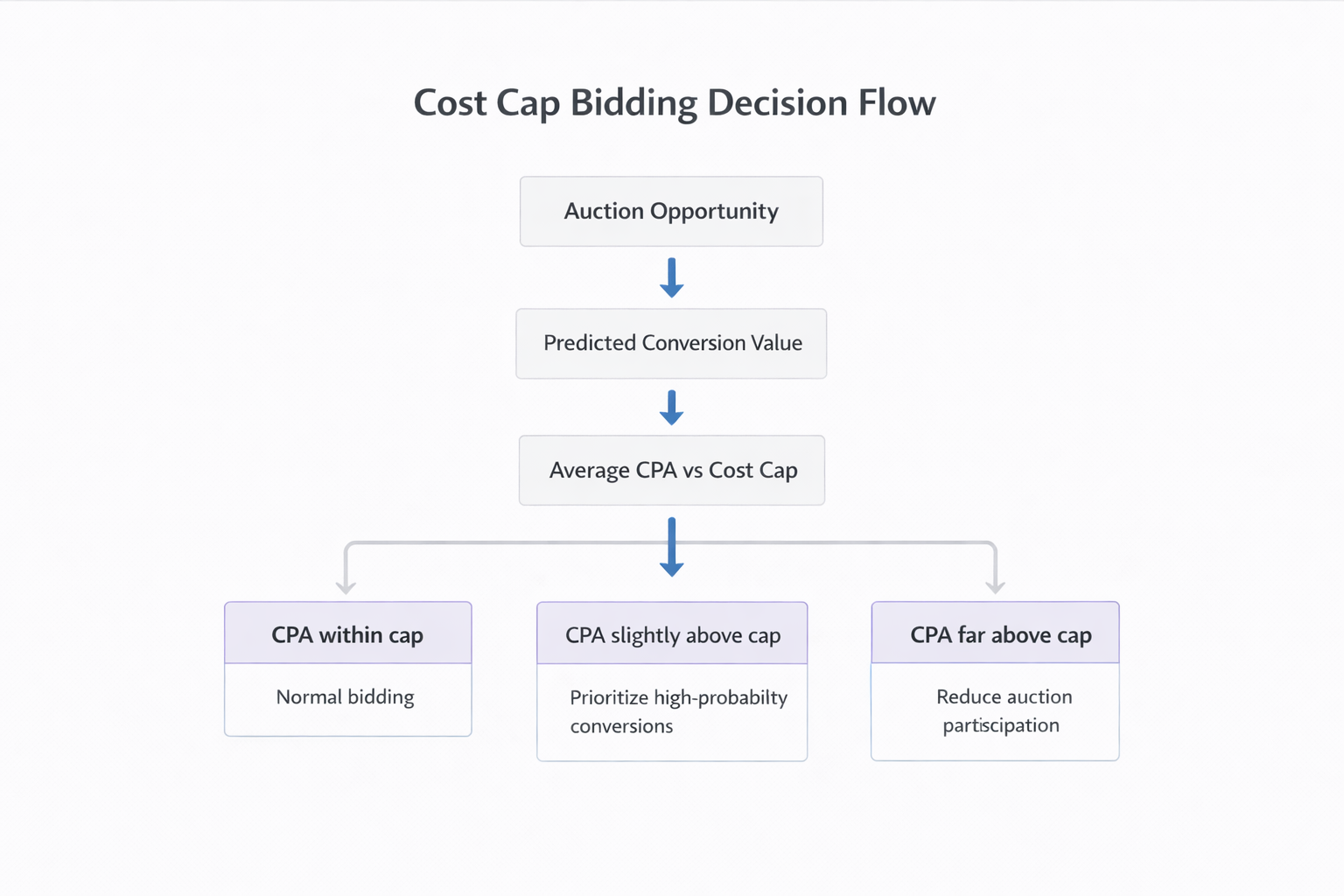
When Cost Cap is active, Meta continues bidding dynamically across auctions. At the same time, the system evaluates the campaign’s average CPA.
If the average cost begins to exceed the cap, the algorithm gradually adjusts delivery. It may prioritize impressions with stronger predicted conversion signals or reduce participation in more expensive auctions.
However, the system can temporarily exceed the cap if it predicts that future conversions will rebalance the average cost.
When Cost Cap Is Most Useful
Cost Cap usually performs best once campaigns already have predictable conversion data.
Typical examples include:
-
Scaling campaigns that already generate stable conversions.
Cost Cap helps maintain acquisition efficiency while budgets increase. -
Lead generation with strict CPL targets.
Businesses with fixed economics often use Cost Cap to keep acquisition costs within acceptable limits. -
Retargeting audiences with clear purchase intent.
Warm audiences tend to convert more consistently, making cost targets easier to maintain.
Retargeting strategies often rely on engagement-based audiences or previous site visitors. If you are structuring those audiences, it helps to understand the difference between warm, cold, and custom audiences in Meta Ads, which is explained here:
The Complete Guide to Warm, Cold, and Custom Audiences in Meta Ads.
A Common Cost Cap Mistake
Setting the cap too low is one of the most frequent causes of delivery issues. If the target CPA is below the realistic auction price, the campaign simply cannot compete in enough auctions to generate conversions.
Bid Cap: Maximum Price Control
Bid Cap introduces the strictest bidding model. Instead of controlling the average CPA, advertisers define the maximum bid Meta can submit for any single auction.
This creates a hard limit on how aggressively the system can compete.
How Bid Cap Changes Delivery
When an impression becomes available, Meta evaluates whether the predicted winning bid falls within the defined cap. If the estimated auction price exceeds the limit, the campaign does not participate in that auction.
This significantly reduces the number of eligible impressions. If auction competition rises, delivery can decline quickly because the campaign is priced out of many opportunities.
Situations Where Bid Cap Can Work
Bid Cap works best when advertisers already understand the typical auction price range for their campaigns.
Examples include:
-
Large campaigns with extensive historical data.
Advertisers can estimate typical winning bids and set caps slightly above that range. -
Highly competitive industries.
Bid Cap prevents sudden spikes in acquisition costs during periods of intense competition. -
Strict profitability models.
Businesses operating with tight margins sometimes prefer predictable cost ceilings.
In mature accounts, Bid Cap often appears alongside lookalike expansion campaigns that scale proven audiences. If you are building those audiences, the guide on how to build lookalike audiences that actually convert explains how seed quality influences scaling performance.
Choosing the Right Strategy for Each Campaign Stage
Bid strategies tend to work best when they align with the maturity of the campaign and the amount of available data.
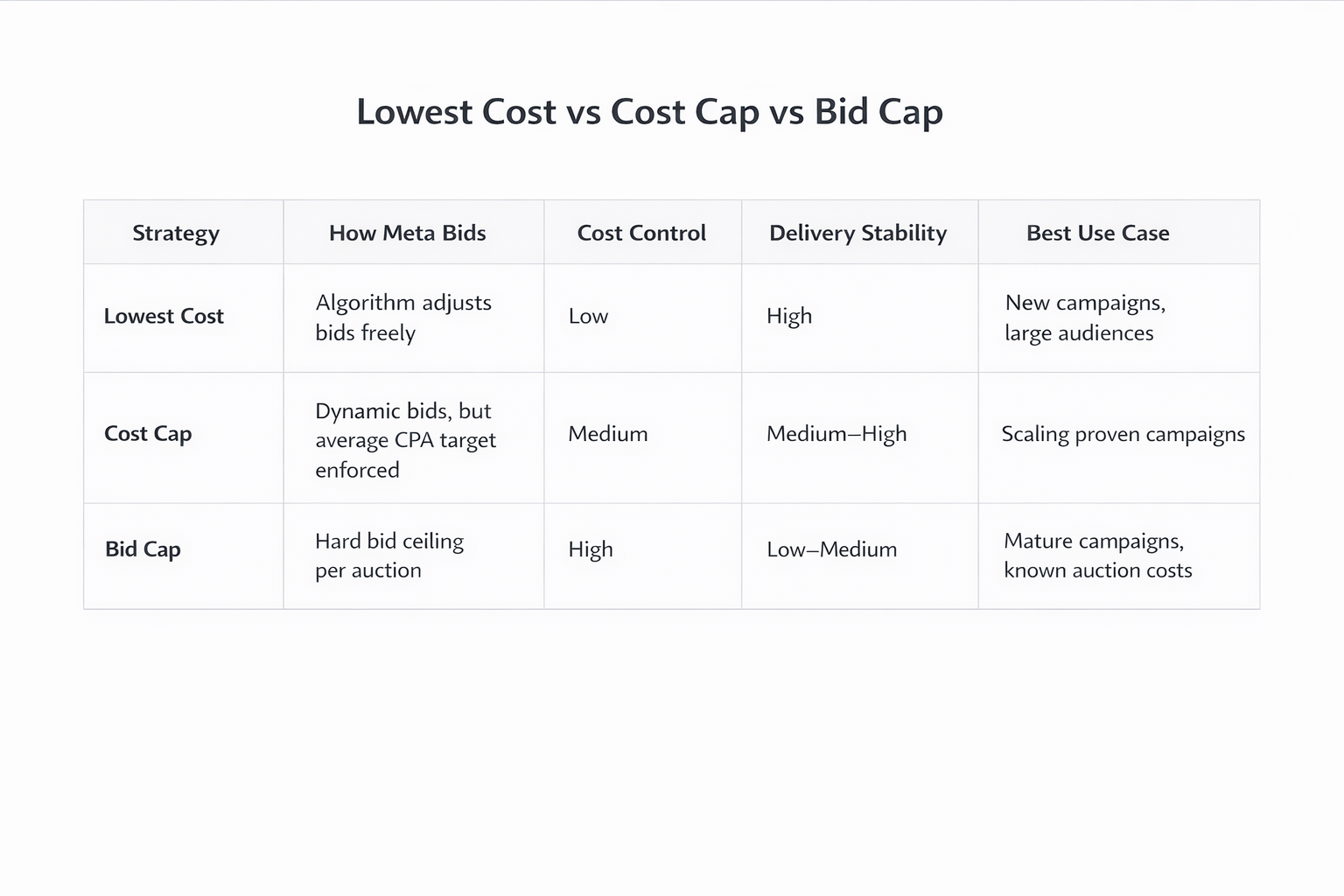
A practical framework looks like this:
-
Early-stage campaigns — Lowest Cost.
The algorithm needs flexibility to explore the auction and gather conversion signals. -
Growth-stage campaigns — Cost Cap.
Once performance stabilizes, introducing a cost target helps maintain efficiency during scaling. -
Mature campaigns — Bid Cap (optional).
Strict caps can work when historical auction data reveals realistic bid ranges.
These strategies work alongside strong audience structures. If you are refining targeting, the Ultimate Guide to Facebook Audience Targeting explains how different audience types influence campaign performance.
The Practical Takeaway
Lowest Cost, Cost Cap, and Bid Cap are not simply cost-control settings. Each strategy defines how freely your campaign can compete in Meta’s ad auction.
-
Lowest Cost maximizes delivery flexibility and conversion volume.
-
Cost Cap keeps average acquisition cost near a target while preserving delivery stability.
-
Bid Cap enforces strict price limits but requires accurate knowledge of auction conditions.
When campaigns suddenly lose delivery or fail to scale, the problem often lies in the bidding strategy rather than the audience or creative. In many cases, the campaign is simply not allowed to compete in the auctions where conversions are happening.
Before rebuilding targeting or launching new creatives, it is often worth checking the bidding model. That single setting can determine whether the campaign participates in thousands of auctions — or almost none at all.