
Marketing budgets are under more pressure than ever. At the same time, the expectations for growth haven’t eased.
That tension is now the baseline for marketers. Whether you're managing paid acquisition, organic growth, or lifecycle campaigns, you're likely being asked to deliver more without spending more.
This is why marketing efficiency has become a strategic priority. But efficiency isn’t just about spending less. It’s about how you operate. It’s how your systems convert budget, time, and effort into measurable outcomes.
Efficiency is no longer a constraint. It's a differentiator.
What Marketing Efficiency Really Means
At a basic level, marketing efficiency is the ability to produce better outcomes with the same or fewer inputs. But in a performance-driven environment, the idea goes deeper.
Efficient marketing is not reactive. It’s proactive, structured, and designed to uncover what’s working and scale that. It’s also a way to eliminate drag: misaligned teams, underperforming channels, unclear goals.
In practice, marketing efficiency requires:
-
Clear performance visibility across every major channel and funnel stage, from awareness to retention.
-
Cross-functional alignment between strategy, execution, and measurement, so campaigns support business outcomes, not vanity metrics.
-
Consistent systems and feedback loops, so learnings improve over time rather than being lost in fragmented tools or teams.
If you're focused on efficiency, you're not just spending smarter. You're thinking smarter about what you do and why it matters.
Step 1: Audit Before You Optimize
Too often, marketing teams rush into “efficiency” by cutting tactics or halting campaigns. That can be costly if you don’t know where waste is coming from.
The better move is to step back and audit where your money and time go, and what you're getting in return. This is the same principle discussed in How to Improve Campaign Performance Without Increasing Budget, where small structural fixes often outperform aggressive optimization changes.
Some inefficiencies are easy to spot:
When you zoom out and review your system, certain patterns show up.
-
High content volume with minimal business impact. If your team is producing a steady stream of blogs, social posts, or videos, but none of it contributes to leads or sales, you're investing in motion, not traction.
-
Misaligned paid budgets. Paid and organic efforts often overlap in targeting, geography, or messaging, leading to budget cannibalization and inflated costs.
-
A narrow focus on top-of-funnel acquisition. Many teams spend the bulk of their budget on bringing users in, but overlook monetization and retention efforts that could dramatically increase LTV.
-
Testing without real learning. It’s common to see experiments run across ads, emails, or landing pages without systems in place to gather, share, and act on results.
This kind of audit often reveals fewer problems than expected, but bigger ones. Fixing them delivers much higher ROI than surface-level optimization.
Step 2: Shift Budget and Focus Toward Impact
Once you've identified what isn't working, you can shift time and resources toward higher-leverage activities. This often means moving away from what’s easy to measure, and investing more in what drives long-term growth.
Marketing leaders who operate with constrained budgets tend to rebalance their mix, not cut it entirely.
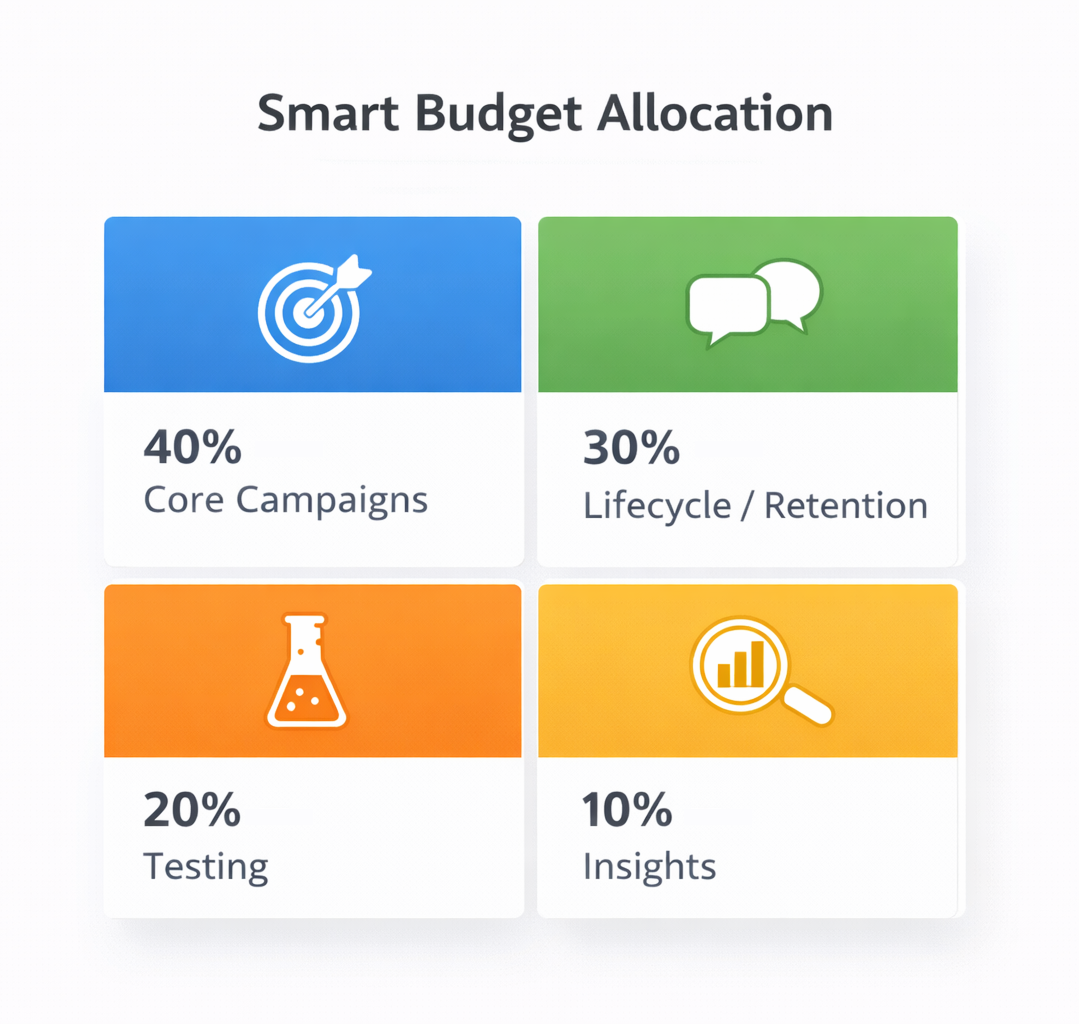
These areas tend to deliver stronger ROI when done correctly:
Let’s look at a few underutilized levers that contribute more than they cost.
-
Customer research. A handful of deep, structured interviews with recent buyers can expose the real drivers behind purchasing decisions, helping you improve messaging, offers, and positioning.
-
Lifecycle improvements. A properly sequenced email or SMS onboarding flow can increase retention, reduce support tickets, and create new revenue, especially for subscription-based products.
-
Content repurposing. Instead of starting from scratch each time, break a single long-form asset into ad snippets, blog posts, short-form video, or case studies.
-
Focused creative testing. Don’t just test headlines and button colors. Run experiments with entirely different value propositions or user mindsets to learn what really resonates.
This approach aligns closely with the principles outlined in What Facebook Advertisers Get Wrong About Cost Efficiency, where waste often comes from misallocation, not insufficient budget.
Step 3: Align Teams Around a Shared Goal
Efficiency gets lost when every team works toward a different target. This happens often: content teams optimize for impressions, paid media teams chase ROAS, product marketing focuses on feature engagement, and nobody’s quite sure what moved the needle.
If your teams are working in silos, it’s almost guaranteed that budget is being wasted.
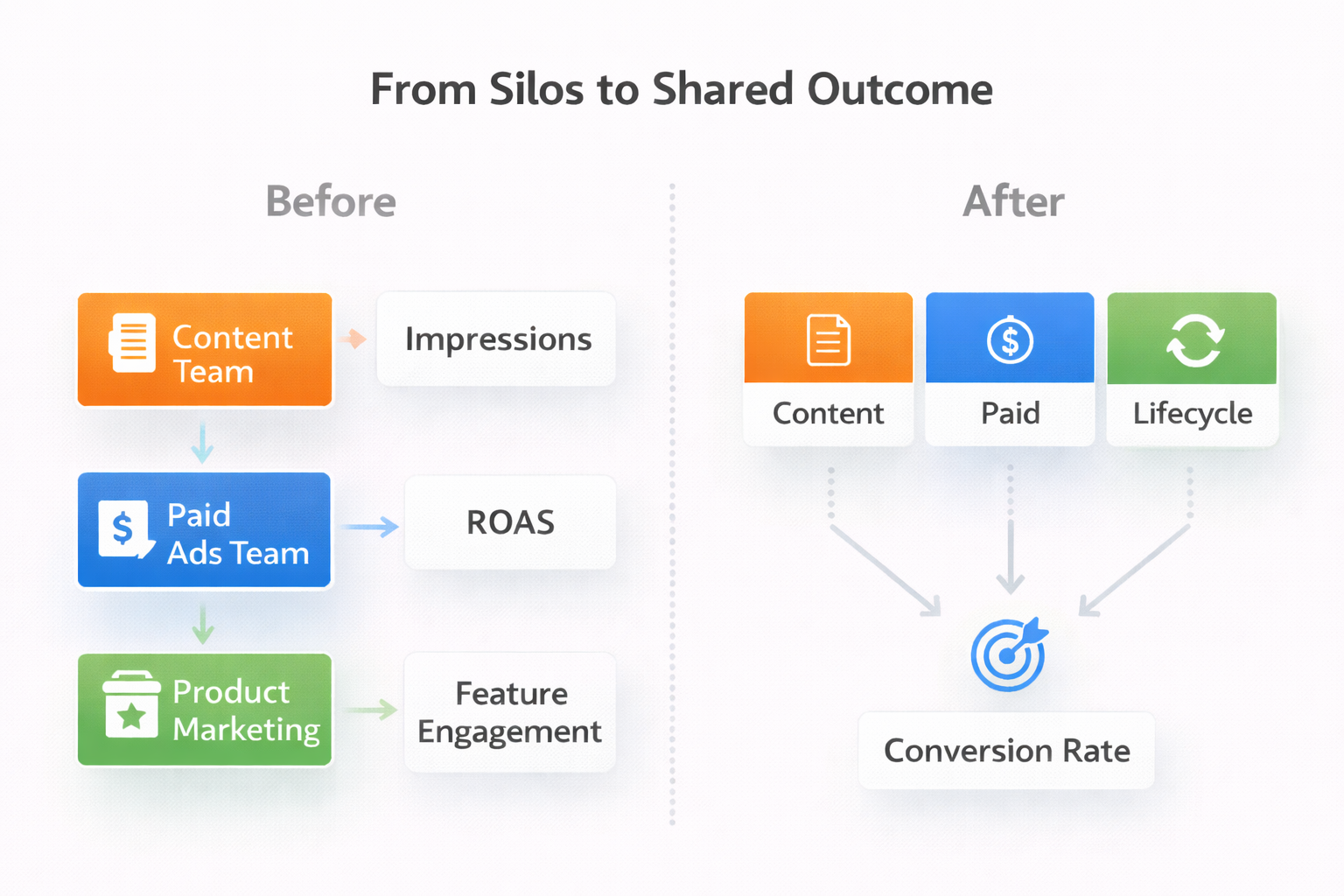
The fix is simple in theory, but hard in practice: align everyone around one primary outcome for a defined time period.
For example, unify the org around:
Shared goals shift the way teams make decisions and measure success.
-
Improving trial-to-paid conversion rate. Content focuses on education, paid focuses on bottom-funnel intent, lifecycle teams optimize onboarding flows.
-
Increasing LTV for existing users. This shifts attention from acquisition to retention, opening up budget for remarketing and product-led content.
-
Reducing acquisition cost across core segments. Teams rethink targeting strategies and double down on what’s already working.
This type of alignment is critical in preventing the inefficiencies described in Over-Segmentation in Facebook Ads: Why Too Many Campaigns Kill Efficiency.
Step 4: Fix the Feedback Loops
Efficiency breaks down when you can’t see clearly. And in most marketing operations, feedback loops are either delayed, shallow, or siloed.
The result is predictable: teams make decisions based on platform dashboards or top-line KPIs without context.
Improve the quality of the signals you use:
It’s not just about more data. It’s about better data, surfaced sooner.
-
Use first-party tracking consistently. Platform attribution often hides what happens after the click. UTM tracking, custom events, and CRM integration give you visibility across the journey.
-
Create insights at the segment level. Knowing overall ROAS means little if you don’t know which audience, device, or message drove it.
-
Loop in qualitative data regularly. Surveys, heatmaps, and support conversations often explain performance shifts better than dashboards.
These principles are explored in depth in Marketing Metrics That Actually Drive Decisions, which emphasizes signal quality over metric volume.
Step 5: Make Your Creative Work Harder
Most brands treat creative like a volume problem. More ads, more versions, more assets. But volume without strategy burns time and budget.
Great creative is one of the highest-leverage tools in modern marketing. But it has to be built for clarity and intent, not just aesthetics.
High-efficiency creative has a few things in common:
It’s not about how polished it looks. It’s about how precisely it speaks to the right customer, at the right stage.
-
It maps directly to the problem the user is trying to solve. Strong creative reframes the user’s situation and shows a clear path forward.
-
It guides attention with intention. Design prioritizes readability and action, not decoration.
-
It’s modular and repurposable. One strong concept can power multiple formats without additional production cost.
This thinking aligns with Why Simpler Campaign Setups Lead to Stronger Performance, where creative clarity often outperforms complexity.
Final Thought: Efficiency Is a Long Game
Marketing efficiency isn’t a short-term fix. It’s a strategic mindset. It’s what happens when teams get clear on what matters, cut what doesn’t, and build systems that improve over time.
It takes more than optimization. It takes alignment, insight, and discipline.
The most efficient marketers aren’t doing less. They’re doing less of the wrong things. And they’re learning faster with every campaign they run.
