Instagram ad goals should not be chosen by habit.
They should be chosen by funnel stage.
A cold user who has never heard of your brand may need profile evaluation. A warm user comparing options may need a landing page. A high-intent user with a specific question may need a message thread.
Instagram Ad Tools commonly frame ad creation around practical goals such as profile visits, website visits, and messages. Those goals become more useful when they are mapped to the funnel instead of selected randomly.
The Problem
The problem is that many advertisers choose Instagram goals without a funnel map.
They pick profile visits because the profile matters.
They pick website clicks because traffic feels measurable.
They pick messages because DMs feel close to sales.
But without funnel context, the goal is a guess.
That guess can attract the wrong behavior, weaken campaign learning, and make results harder to interpret.
Why This Problem Hurts Performance
When goals do not match the funnel, users are pushed into the wrong next step.
Cold users may be asked to buy too soon. Warm users may be kept in soft engagement too long. High-intent users may be sent to generic pages when they need a direct answer.
This hurts CPC, CPA, CAC, ROAS, lead quality, and conversion rate.
It also hurts scaling. A campaign that performs at low spend may weaken when expanded because the goal is not connected to a clear buyer stage.
For B2B lead generation, this can create unqualified pipeline. For ecommerce, it can create traffic without purchase intent. For agencies, it can create reports full of activity but light on business value.
Common Scenarios Where This Happens
A startup launches a new product and immediately optimizes for website clicks. Users are curious, but they need brand context first.
A consulting firm chooses profile visits for an audience that already knows the founder. Those users may be ready for a booking page or message prompt instead.
An ecommerce brand chooses website clicks for users who keep commenting with sizing questions. A message or guided product path may work better.
A local business chooses messages for a cold audience with no clear offer. The inbox fills with vague questions instead of qualified booking intent.
A B2B team uses the same Instagram goal for all audiences: cold prospects, warm engagers, retargeting pools, and existing leads.
Why the Problem Happens
This happens because Instagram goal selection is often treated as a platform setting rather than a funnel strategy.
The interface asks for a goal, so the team picks one. But the funnel asks a deeper question:
What does this audience need next?
Another cause is weak ICP and audience definition. If the audience is not clearly segmented, it is difficult to know whether users are cold, warm, or high-intent.
The third cause is measuring too narrowly. If profile visits are judged like purchases, they look weak. If clicks are judged without conversion quality, they look stronger than they are. If messages are judged only by volume, quality gets ignored.
The Solution
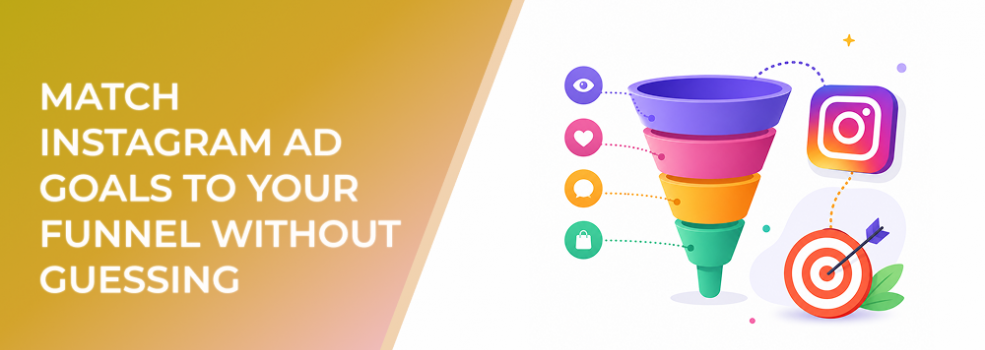
The solution is to map Instagram goals to funnel stages before launch.
Top of funnel: profile visits and soft website visits
At the top of the funnel, users need context.
They need to understand the brand, category, problem, or promise.
Use profile visits when the Instagram profile acts as the trust layer. This is useful for creators, consultants, local businesses, visual brands, restaurants, coaches, and early-stage companies.
Use website visits only if the destination is educational, low-friction, and aligned with the ad. A blog post, guide, product explainer, or event page can work better than a hard sales page.
Middle of funnel: website clicks and comparison paths
In the middle of the funnel, users are evaluating.
They may need product details, proof, pricing, demos, testimonials, use cases, or comparisons.
Website clicks often fit here because the landing page can carry more information than an Instagram post.
The page should not be generic. It should match the ad’s promise and give users a clear next step.
Bottom of funnel: messages, bookings, lead forms, and direct purchase paths
At the bottom of the funnel, users are closer to action.
Use messages when the conversion depends on fit, reassurance, price, availability, or qualification.
Use website clicks when the user can self-serve through a product page, booking flow, quote page, trial signup, or checkout.
The goal should reduce friction, not add another step.
Retargeting: match the goal to observed behavior
Retargeting should not use one default goal.
Users who visited the profile but did not click may need trust or proof.
Users who clicked the website but did not convert may need comparison or objection handling.
Users who messaged but did not book may need follow-up, urgency, or a clearer offer.
Let the previous behavior guide the next goal.
How LeadEnforce Helps
LeadEnforce helps when funnel-based goal selection requires more intentional audience inputs.
A funnel map is stronger when the audience source reflects intent. For example, followers of relevant Instagram profiles may be useful for awareness or consideration tests. Members of niche Facebook groups may indicate active problem interest. LinkedIn-derived professional data can support B2B funnel campaigns where role, industry, or company fit matters. Custom social-profile audiences can help advertisers test segments built from existing external or community data.
LeadEnforce’s feature pages describe building audiences from Instagram profile followers, Facebook group members, LinkedIn job-title, industry, and company data, and social profile links.
That supports a more practical workflow:
First, map the funnel stage.
Second, choose the Instagram goal.
Third, choose an audience source that matches the stage.
Fourth, evaluate the result by the metric that fits that stage.
LeadEnforce does not replace goal strategy, creative quality, landing page quality, or tracking. It helps reduce targeting guesswork so each funnel-stage test starts with a more relevant audience hypothesis.
Risks and Considerations
Do not over-segment the funnel so much that campaigns become too small to learn.
A very narrow audience may produce unstable data. A broad audience may produce mixed intent. The right balance depends on budget, market size, offer complexity, and testing maturity.
Do not assume every funnel stage needs a separate campaign immediately. Smaller advertisers may start with one or two key stages and expand as data improves.
Also avoid using funnel labels as assumptions. A user from a competitor audience may still be cold to your brand. A website visitor may still be early-stage. A message starter may not be qualified.
Measure behavior, not just stage labels.
Prerequisites and Dependencies
You need a clear ICP and offer.
You also need to define funnel stages in practical terms:
What does a cold user know?
What does a warm user need?
What makes someone high-intent?
What disqualifies a lead?
If using LeadEnforce, you need relevant source communities, Instagram profiles, LinkedIn criteria, or custom profile data that map to the ICP and funnel stage.
You also need destinations and workflows ready: profile, landing page, product page, booking flow, message response process, and reporting metrics.
Practical Recommendations
Create a simple funnel-goal matrix.
Top of funnel: profile visits or educational website visits.
Middle of funnel: website clicks to proof, comparison, product, or lead-magnet pages.
Bottom of funnel: messages, booking pages, quote requests, product pages, or direct conversion paths.
Retargeting: choose the next goal based on the user’s previous behavior.
Then pair each stage with a relevant audience hypothesis. Do not test a funnel goal against an audience that has no reason to take that action.
Use LeadEnforce when you need source-based audiences that better reflect community interest, competitor affinity, professional fit, or custom social-profile intent.
Final Takeaway
Instagram ad goals work best when they are mapped to the funnel.
Profile visits help users evaluate. Website clicks help users learn, compare, or convert off-platform. Messages help users resolve questions before action.
Stop guessing. Match the goal to the funnel stage, the audience’s readiness, the offer’s complexity, and the metric that proves progress.
To build more relevant funnel-stage audiences for Instagram ad tests, join the free 7-day LeadEnforce trial period.
Related LeadEnforce Articles
- How to Match Instagram Business Account Goals to Facebook Ad Objectives — Helps connect Instagram goal language with broader Meta campaign objective thinking.
- Improve Instagram Ads Targeting by Testing for Customer Fit Instead of Reach — Supports funnel-stage testing by prioritizing fit over raw reach.
- Choose Instagram Ads Destinations Based on Real User Behavior — Helps align funnel stage with the right post-click destination.
- Boosted Post or Full Ad? How to Choose Based on Campaign Goals — Useful for deciding when a simple boost is enough and when the funnel requires a structured campaign.