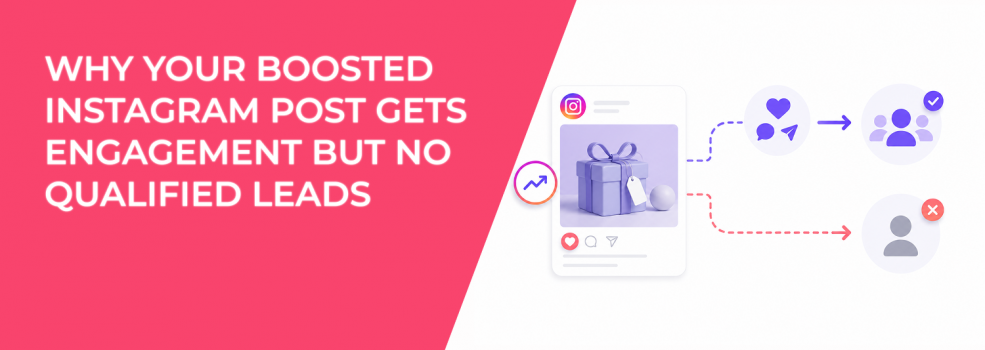
A boosted Instagram post can look successful inside the app and still fail in the funnel.
The post gets likes. Profile visits increase. Comments start coming in. CPC may even look cheap enough to keep the boost running.
Then sales reviews the leads and finds a different story. The users are curious, but not serious. They ask basic questions, ignore follow-ups, or have no budget. That is the gap between engagement and qualified demand.
Cheap engagement often comes from low-buying-intent users
Instagram engagement is not the same as purchase intent. Some users like posts because the creative is attractive, funny, relatable, or familiar. That does not mean they are close to booking a call, requesting a quote, or buying.
This matters because boosted posts are often built around content that already earned organic engagement. That content may be good at stopping the scroll, but weak at filtering buyers. A behind-the-scenes video may attract attention, while a comparison post or offer-focused post may attract fewer users but better prospects.
For performance marketers, this creates a reporting trap. The cost per engagement looks efficient, but the cost per qualified lead rises once sales quality is reviewed. The campaign is not truly cheap if most interactions cannot move into pipeline.
This is why teams should separate lead quality vs lead volume before judging a boosted post. A boost that generates 80 weak leads can waste more budget than a campaign that generates 12 strong ones.
The boosted post may be optimized around the wrong signal
A post that earns strong organic engagement gives Meta a clear signal: people are likely to interact with it. When you boost that post, the system can continue finding users who behave like engagers.
That can work for awareness. It can also hurt lead generation.
The problem is not that engagement is useless. The problem is that engagement can become the loudest signal in the campaign. If the audience is broad, Meta may find the easiest users to reach and interact with the post, not the users most likely to convert later.
Watch for this pattern:
- High likes with low profile quality. Users interact with the post, but their profiles do not match your buyer type, location, or use case.
- Cheap clicks with poor landing page behavior. CPC looks fine, but users leave the landing page quickly or do not start the form.
- Many comments with weak intent. People ask questions already answered in the post, showing curiosity rather than buying readiness.
- Low CPL with poor sales acceptance. Forms come in, but sales rejects them because the leads are unqualified.
This is where clicks don’t equal demand. A person can click because the post is interesting, not because the offer solves an active problem.
Qualified leads need friction that filters the right people
Many advertisers remove too much friction from boosted posts. They use broad copy, soft CTAs, and wide audiences because they want more reach. That usually increases interaction, but it also lowers intent.
A lead-focused post should make the user self-select. The copy should say who the offer is for, what problem it solves, and what action comes next. This does not need to sound aggressive. It just needs to be clear enough that the wrong users feel less motivated to click.
For example, “Need help with your ads?” is too broad for a B2B agency. “Running Meta ads but getting low-quality leads from form fills?” attracts a narrower user with a more specific pain. That type of copy may reduce total engagement, but it can raise lead quality.
The same logic applies to creative. A broad lifestyle image can earn likes from people outside the buying audience. A problem-specific carousel, short explainer, or customer use case can reduce vanity engagement and pull in users who recognize the pain.
Poor lead quality inflates CPA after the first conversion
The biggest cost problem often appears after the form submission. A boosted post may generate a low cost per lead, but the true CPA increases when you calculate qualified appointments, opportunities, or purchases.
This is common for service businesses, SaaS trials, agencies, coaches, and local providers. The boosted post creates easy entries into the funnel, but the sales team spends time sorting weak fits. That labor cost is real, even if Ads Manager does not show it.
A simple way to check this is to compare three numbers: cost per lead, cost per qualified lead, and cost per closed customer. If CPL is falling while qualified lead rate is falling faster, the boost is not improving performance. It is moving waste deeper into the funnel.
Fix the post by changing the signal you feed the campaign
The fastest fix is not always a new creative. Start by changing the signal quality around the boost.
Narrow the audience around users who already show commercial intent. That can include Instagram engagers who interacted with product posts, website visitors, CRM contacts, or users who follow relevant niche accounts. Avoid treating all followers or all engagers as equal.
The post itself should also qualify the click. Mention price range, service area, business type, timeline, or main use case when those details matter. A clear qualifier can reduce lead volume, but it protects sales time and CPA.
If the post still gets engagement without qualified action, stop boosting it for leads. Use it as a warm-up asset instead. Then retarget engaged users with a stronger offer, proof point, or lead magnet.
This is how advertisers optimize for quality, not just volume. They do not chase the cheapest interaction. They build the campaign around the next valuable action.
Treat engagement as a clue, not the result
Engagement tells you that people noticed the post. It does not prove that the audience is ready to buy.
A boosted Instagram post should be judged by the role it plays. If the goal is awareness, engagement can be useful. If the goal is qualified leads, you need to inspect who engaged, what they did next, and whether they match the buyer profile.
The better move is to use engagement as an early signal, then filter it with audience quality, post-click behavior, and sales feedback. That keeps boosted posts from becoming cheap attention with expensive follow-up.