Most advertisers think budget allocation is a scaling decision. In practice, it is an optimization decision first.
How you distribute spend across campaigns and ad sets directly affects signal density, learning stability, auction competitiveness, and ultimately cost per result. If your allocation structure is fragmented or misaligned with the algorithm’s learning mechanics, performance suffers long before you increase spend.
This article breaks down how Meta Ads budget allocation actually influences optimization — and how to structure budgets in a way that improves prediction accuracy instead of weakening it.
The 50-Event Rule and Why It Matters
Meta recommends generating roughly 50 optimization events per week per ad set. This threshold reflects the minimum statistical volume required for the delivery system to model behavior reliably.
At lower volumes, the system lacks confidence. It cannot accurately distinguish high-probability conversions from noise. As a result:
-
CPA fluctuates unpredictably, even if CPM and CTR look stable.
-
Delivery becomes inconsistent, with sudden dips or spikes.
-
Learning resets occur more frequently after minor edits.
For example, if you generate 100 purchases per week and divide them across five ad sets, each receives around 20 events. That volume is insufficient for stable optimization.
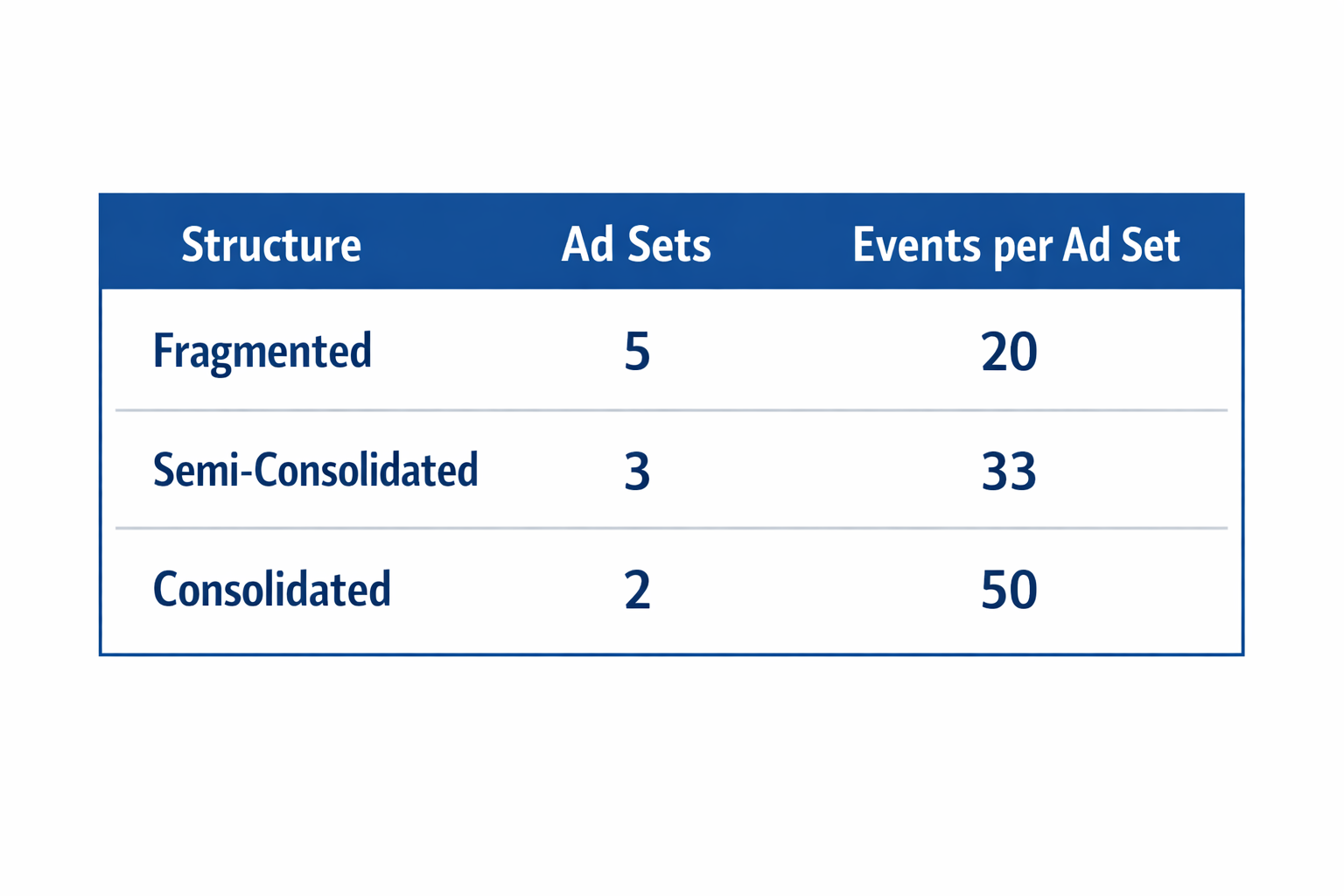
If you instead consolidate into two ad sets, each can receive roughly 50 events. The model gains signal depth, volatility decreases, and performance typically stabilizes without increasing total spend.
If unstable learning phases are a recurring issue, review How to Optimize Facebook Campaigns for Faster Learning Phase Exit. It explains the structural adjustments that improve learning stability without inflating spend.
The key takeaway is simple: budget fragmentation creates artificial learning problems.
Campaign Budget vs Ad Set Budget: Strategic Tradeoffs
Meta provides two primary allocation structures:
-
Campaign Budget Optimization (CBO).
-
Ad Set Budget Optimization (ABO).
Both can work effectively, but they distribute control and flexibility differently.
For a detailed breakdown, see The Difference Between Campaign Budget Optimization and Ad Set Budgets.
Campaign Budget Optimization (CBO)
Under CBO, the campaign distributes budget dynamically across ad sets based on predicted performance.
This structure works best when:
-
Ad sets share the same objective and optimization event.
-
There is measurable performance variance between audiences.
-
You want the system to allocate spend based on probability rather than manual assumptions.
CBO improves capital efficiency because budget automatically flows toward higher-performing segments. However, it can suppress exploration. Smaller audiences may receive limited spend if early signals are weak.
Ad Set Budget Optimization (ABO)
With ABO, you manually control spend at the ad set level.
This is useful when:
-
You are testing clearly differentiated audience hypotheses.
-
You need guaranteed budget exposure per segment.
-
You want strict isolation between bid strategies.
The tradeoff is rigidity. Budget does not automatically shift toward outperforming segments.
The structural decision is not automation versus control. It is about where optimization flexibility should exist.
Consolidation vs Segmentation: The Signal Density Balance
Many accounts suffer from over-segmentation. Advertisers split by age, placement, device, interest cluster, and lookalike percentage. The intention is precision. The outcome is diluted data and internal competition.
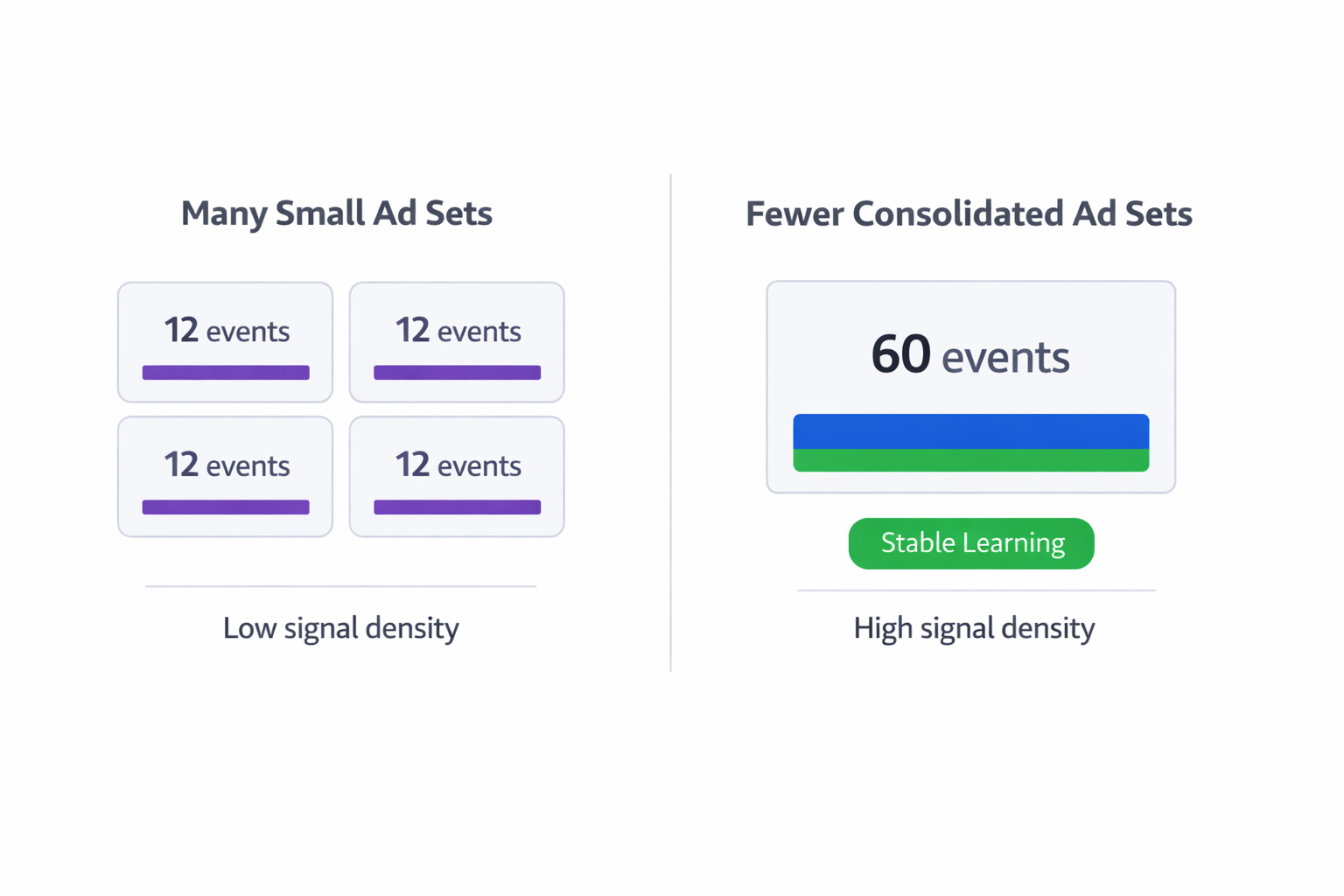
Segmentation improves performance only when differences are structural and persistent.
You should segment when:
-
Audiences respond differently in a statistically meaningful way.
-
Creative messaging materially changes between segments.
-
Bid strategy or optimization logic requires isolation.
You should consolidate when:
-
Performance variance is minimal.
-
Audiences overlap significantly.
-
Individual ad sets struggle to reach event thresholds.
If you suspect internal competition is inflating costs, review Why Audience Overlap Is Killing Your Facebook Ad Performance to diagnose overlap-related inefficiencies.
A consolidated structure improves:
-
Event volume per ad set.
-
Learning stability.
-
Budget fluidity within campaigns.
Before adding another ad set, ask whether it truly changes optimization logic. If it does not, consolidation usually improves results.
How Budget Allocation Impacts Creative Testing
Creative testing often fails because budget structure prevents fair learning.
If you launch multiple creatives inside a low-budget ad set, each receives limited impression depth. The algorithm cannot confidently rank them. Early performance variance becomes exaggerated and misleading.
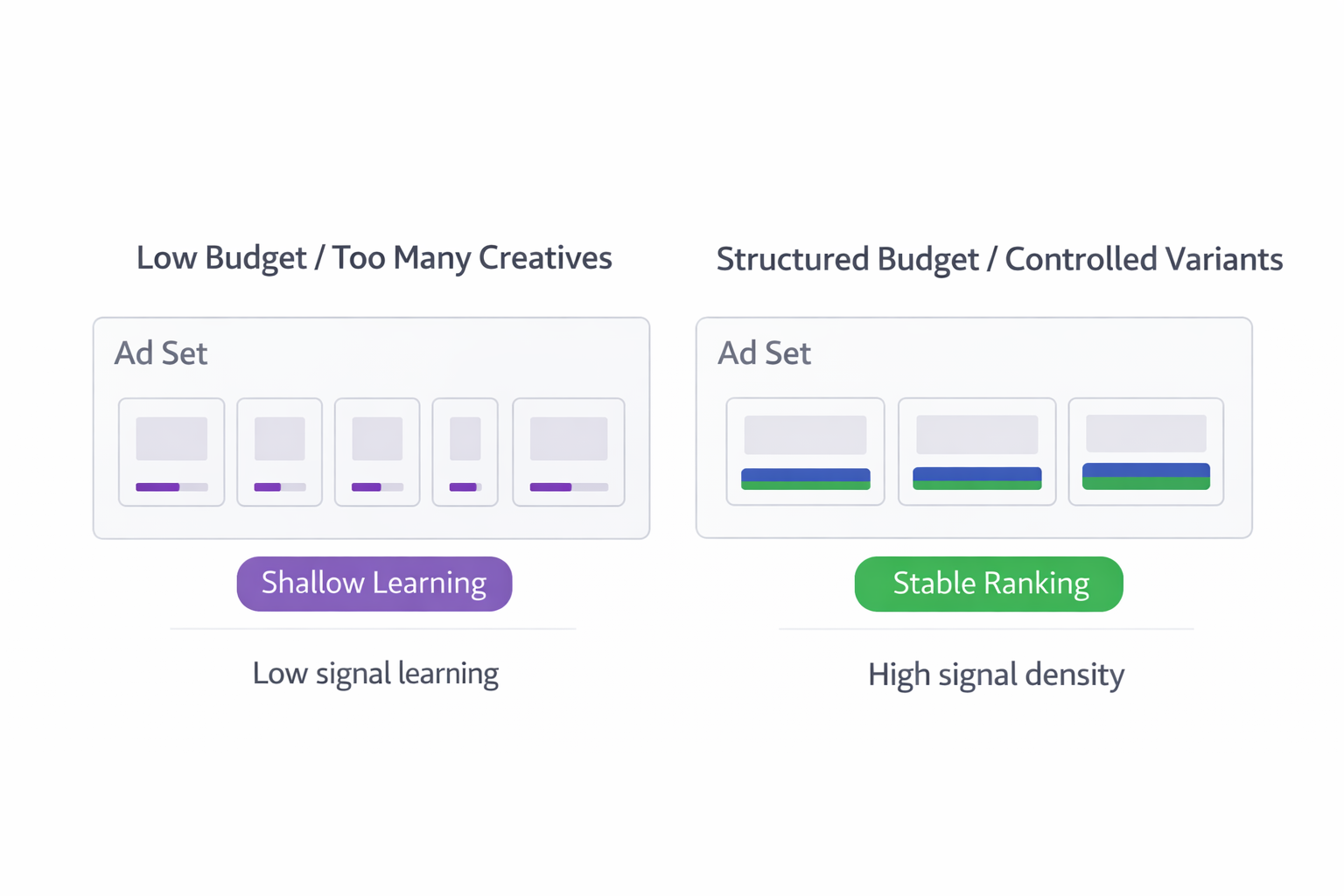
To avoid this:
-
Limit creatives per ad set during structured tests.
Three to five variants provide enough diversity without fragmenting impression share. -
Align daily budget with your CPA target.
If your target CPA is $50, a $30 daily budget cannot generate stable learning. Budget must realistically support multiple conversions. -
Avoid frequent structural edits mid-test.
Large budget changes or audience edits can reset learning and distort results.
For deeper guidance on structured experimentation, review How to Run A/B Tests That Deliver Real Insights.
Budget allocation and creative testing are inseparable. Insufficient signal depth leads to false negatives and premature creative rotation.
Scaling Without Breaking Optimization
When performance stabilizes, scaling introduces a new allocation challenge.
Aggressive scaling can:
-
Expand delivery into lower-quality audience pockets.
-
Increase frequency too quickly.
-
Destabilize CPA due to sudden signal shifts.
A more stable approach includes:
-
Increasing budgets incrementally instead of duplicating ad sets.
-
Monitoring frequency alongside CPA.
-
Maintaining event volume above stability thresholds.
For structural guidance on safe expansion, review Scaling Ads Safely: Avoid Common Campaign Mistakes.
Duplicating winning ad sets often fragments data and reintroduces internal competition. Vertical scaling inside existing learning units typically preserves stability better than horizontal duplication.
Final Perspective
Budget allocation is not about control. It is about statistical stability.
When budget fragments, signal weakens. When signal weakens, prediction accuracy declines. When prediction declines, cost per result rises.
If your Meta account feels volatile, examine budget distribution before rewriting creatives or rebuilding audiences. In many cases, structural consolidation alone restores stability.
The most efficient accounts are not the most complex. They are structured to give the algorithm concentrated, consistent data to make confident decisions.
That is what better optimization actually requires.