Meta does not optimize your campaigns based on what you think works. It optimizes based on the data it receives.
When campaigns underperform, the issue is often not targeting or creatives. It is missing, weak, or fragmented data sources that prevent the algorithm from learning properly.
If your data inputs are incomplete, your results will be inconsistent.
What data sources in Meta actually are
Data sources are the systems that send behavioral signals into Meta. These signals tell the platform what users are doing before and after they interact with your ads.
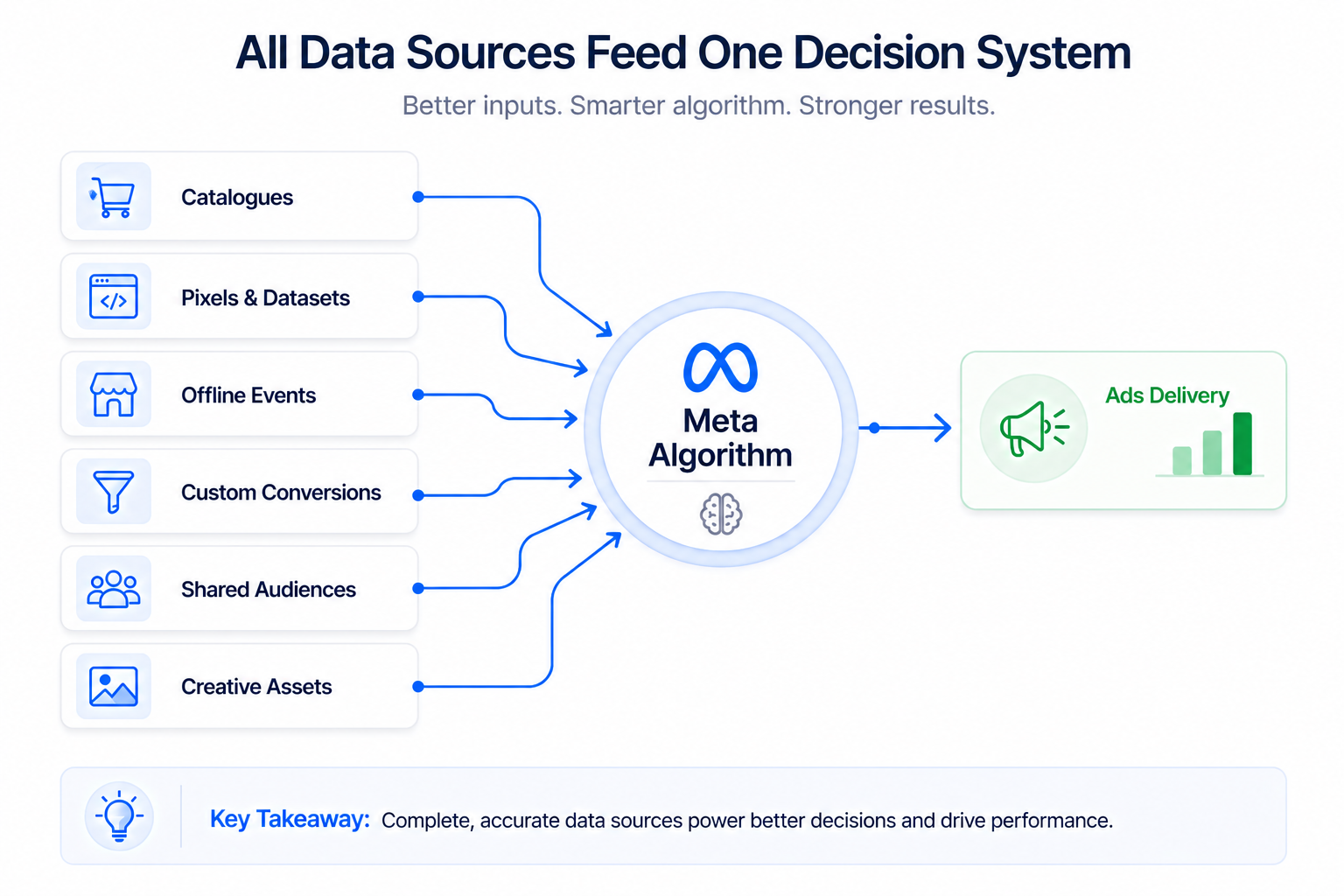
In a business portfolio, data sources include several interconnected components:
- Catalogues. Product data used for dynamic ads and commerce features.
- Datasets and pixels. Event tracking from websites, apps, or offline systems.
- Offline event sets. Data from in-store purchases or CRM systems.
- Custom conversions. Filtered events that define meaningful actions.
- Shared audiences. Audience segments that can be used across accounts.
- Creative assets. Media tied to campaign execution.
Each of these plays a different role, but they all feed into one system — Meta’s delivery algorithm.
Why data sources directly affect ad performance
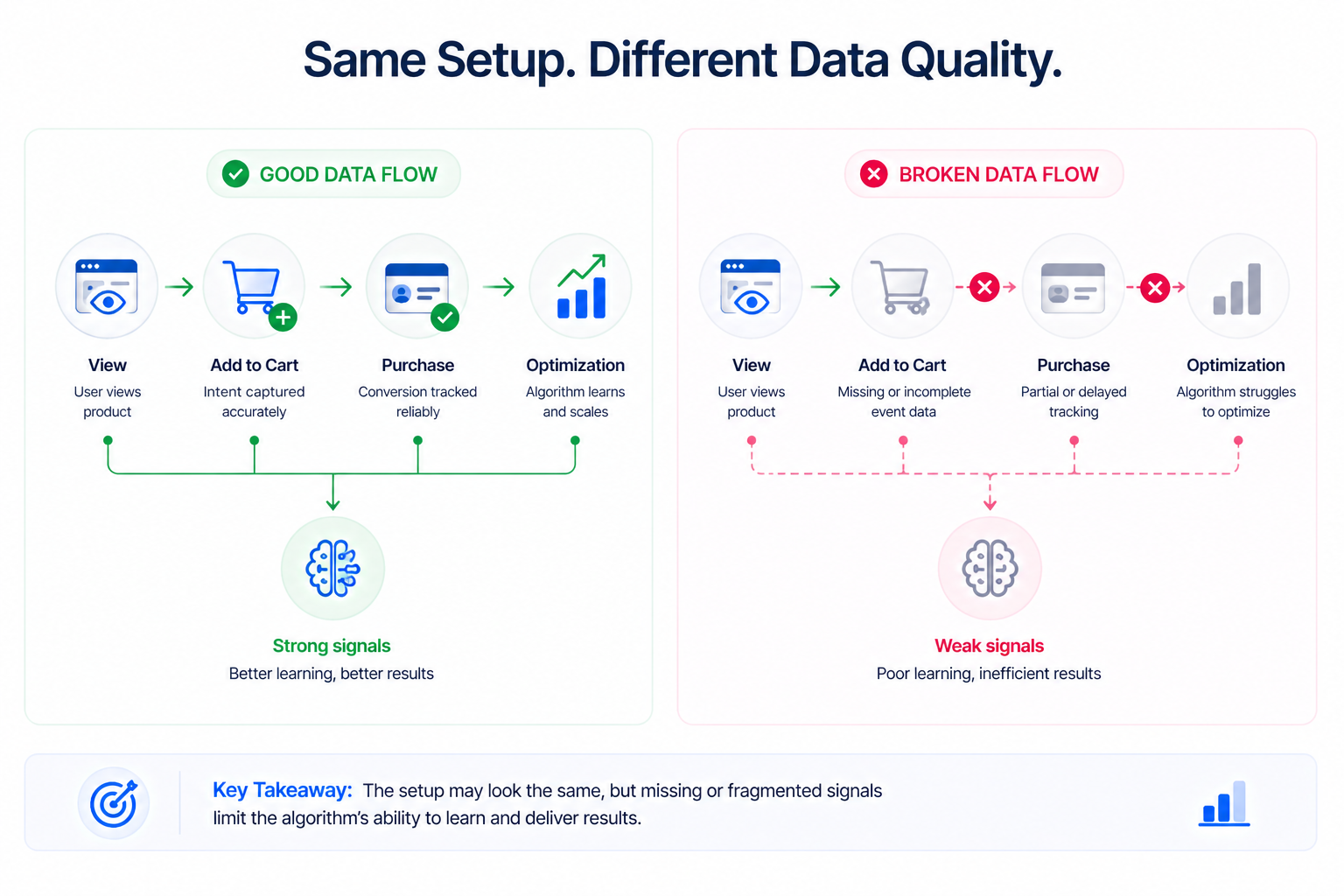
Meta’s algorithm relies on patterns. Those patterns come from events such as page views, add-to-cart actions, and purchases.
If these signals are incomplete or poorly structured, the algorithm cannot identify high-intent users effectively.
This creates three common issues:
- Weak optimization. Meta cannot prioritize users who are more likely to convert.
- Poor audience expansion. Lookalikes and broad targeting become less accurate.
- Inefficient spend allocation. Budget spreads across lower-quality impressions.
In Ads Manager, this often looks like stable traffic but weak business outcomes. If you see clicks without revenue, it usually points to a signal issue rather than a creative problem — a pattern explained in Why Your Ads Get Clicks But No Sales: Fixing the Audience Misalignment
The role of catalogues in data flow
Catalogues are not just product storage. They connect user behavior to what people actually see in your ads.
When properly linked to event data, Meta can match users with the most relevant products based on their actions. This allows the system to adjust delivery in real time and prioritize items that are more likely to convert.
That is what makes dynamic ads effective.
If this connection is missing, Meta cannot link behavior to products. Ads still run, but product matching becomes weaker, and performance drops.
Custom conversions: turning raw data into signals that matter
Not all conversions have the same value, but Meta treats them equally unless you define otherwise.
Custom conversions let you narrow the signal by focusing on actions that actually matter, such as higher-value purchases or specific product categories. This helps the algorithm prioritize quality over volume.
With clearer signals, Meta can optimize for better outcomes, not just more conversions.
Shared audiences and data portability
Shared audiences let you use the same data across multiple ad accounts or partners, which is useful in agency or multi-brand setups.
However, control stays with the original owner. The audience cannot be re-shared, and if it is deleted, campaigns using it may stop.
Because of this, shared audiences work best when ownership is stable and clearly managed.
Typical scenarios where this applies
Data source issues rarely appear as obvious errors. They show up as subtle performance inefficiencies that compound over time.
Here are the most common real-world scenarios:
- Incomplete or inconsistent pixel tracking.
Some events fire correctly, while others are missing or duplicated. For example, purchases may be tracked, but add-to-cart events are not. This breaks the progression logic Meta uses to predict conversions, so the algorithm cannot build a reliable path from interest to purchase. - Disconnected datasets and catalogues.
Dynamic ads run, but product-level personalization does not work properly. You may see ads delivering, but the same products are repeatedly shown regardless of user behavior. This usually indicates that event data is not properly feeding into the catalog. - Overly broad conversion signals.
All purchases are treated equally, even though some are low-value or irrelevant. This causes Meta to optimize for volume instead of quality, which often leads to rising CPA and lower profitability. - Fragmented data across multiple ad accounts.
Different accounts track separate parts of the funnel, such as traffic in one account and conversions in another. This prevents the algorithm from seeing the full picture, which weakens optimization. - Low event volume in early-stage campaigns.
New campaigns or businesses often lack enough data for Meta to learn effectively. In these cases, the algorithm struggles to stabilize delivery, which leads to volatile results and slow scaling. - Offline conversions not integrated.
Businesses that close sales offline, such as service providers or B2B teams, often fail to upload conversion data. As a result, Meta optimizes for leads instead of actual revenue, which reduces lead quality over time.
All of these scenarios create the same outcome: the algorithm operates with incomplete information, which leads to inefficient delivery.
Risks and considerations
Working with data sources requires careful planning.
- Over-reliance on one data source.
If one signal fails, performance drops sharply. - Low event volume.
Small datasets limit algorithm learning. - Poor data quality.
Incorrect or inconsistent tracking reduces accuracy. - Privacy and platform limitations.
Data availability may vary depending on user consent and platform rules.
Data is only valuable if it is reliable and relevant.
Prerequisites and dependencies
To get value from data sources, several elements must be aligned.
- A clearly defined conversion goal.
- Proper event tracking across the funnel.
- Consistent product or service structure.
- Sufficient data volume for optimization.
- Clean campaign structure and objectives.
Without these, even well-configured data sources will not deliver strong results.
Practical recommendations
Start by auditing your data flow, not just your campaigns.
Ask yourself:
- Are all key events tracked consistently?
- Is your catalog connected to your dataset?
- Are you optimizing for meaningful conversions or generic ones?
Then refine your signals.
Instead of optimizing for all purchases, define high-value actions using custom conversions. This gives the algorithm clearer direction.
Next, simplify your structure. Avoid splitting data across multiple disconnected systems. Keep catalogs, pixels, and ad accounts aligned. If you are unsure whether your tracking setup is reliable, start with How to Create Facebook Pixel and Track Conversions.
Finally, connect data quality with audience strategy.
Even the best audiences will underperform if the system cannot learn from their behavior. Many advertisers try to fix performance by changing targeting, while the real issue sits in the data layer. This pattern is explained in Why Your Facebook Ads Strategy Isn’t Working (And How to Fix It)
Final takeaway
Meta’s performance depends on the quality of the data you feed into it.
If your data sources are incomplete or misaligned, the algorithm cannot optimize effectively, no matter how strong your creatives or targeting are.
Better inputs lead to better delivery. That is where real performance improvements begin.