Most lead generation campaigns don’t fail because of targeting or creative. They fail because the system is trained to produce more leads, not better leads.
If your optimization goal is volume, the platform will aggressively pursue the cheapest conversions available. That usually means low-intent users, accidental submissions, or audiences that never convert downstream.
This is the exact tradeoff explained in Lead Quality vs Lead Volume: What Facebook Advertisers Need to Know — strong CPL metrics don’t guarantee revenue.
Shifting toward value-based optimization changes how the algorithm evaluates users, bids in auctions, and allocates spend. The difference is structural, not cosmetic.
Why Volume Optimization Breaks Lead Quality
You’ll often see this pattern in Ads Manager:
-
Cost per lead drops.
-
Conversion volume increases.
-
Sales team reports declining close rates within a week.
This isn’t a coincidence. It’s a direct result of how the delivery system prioritizes outcomes.
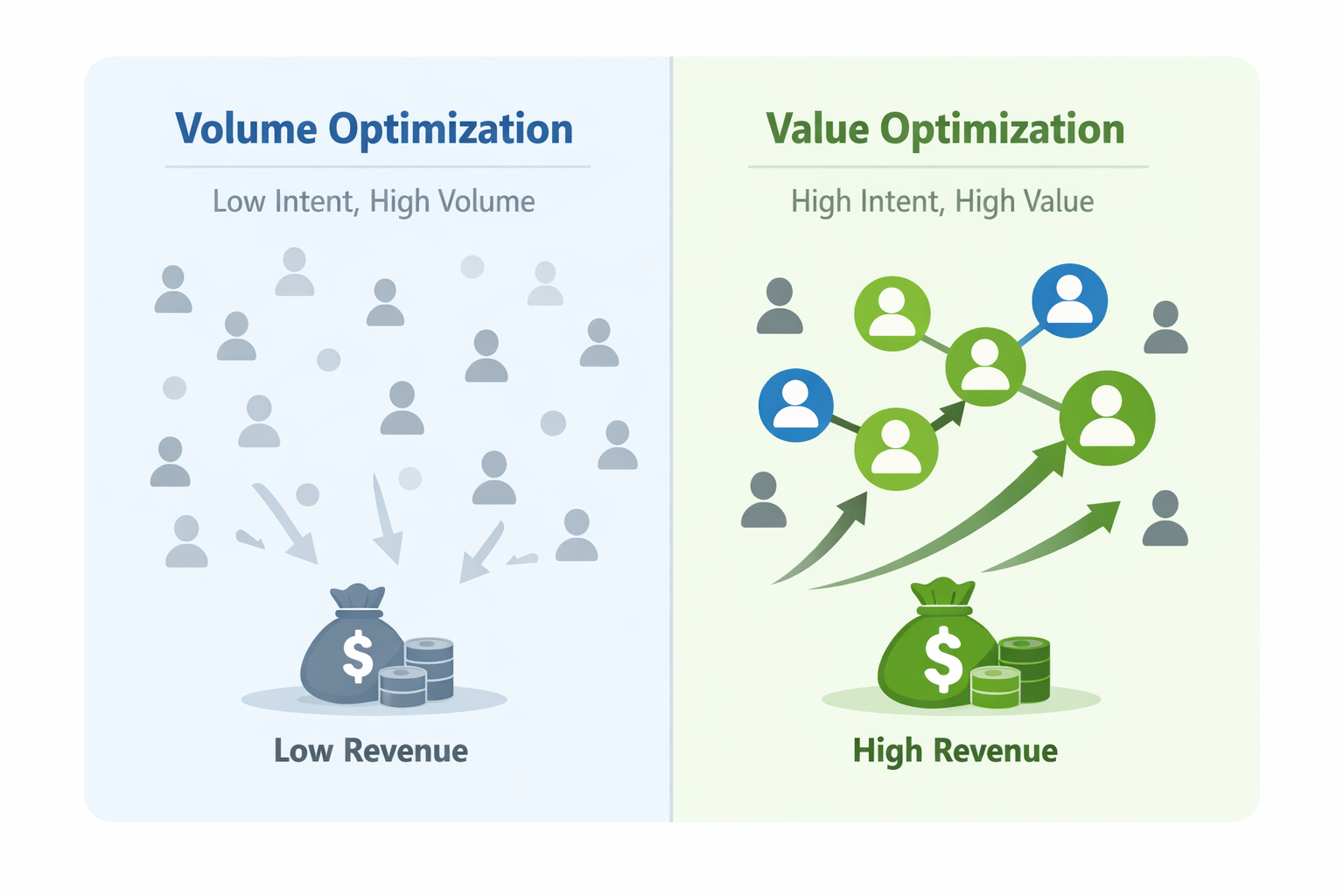
When optimizing for leads:
-
The algorithm identifies users who are most likely to submit a form, not become customers.
-
It clusters behavioral signals around low-friction actions — quick clicks, short sessions, broad interest groups.
-
Over time, delivery shifts toward segments that convert easily but lack purchase intent.
A common signal is lead submission time dropping sharply. If users are converting within seconds of landing, you’re likely attracting low-consideration traffic.
This pattern is also covered in What Causes Facebook Lead Ads to Fail (Even When Metrics Look Good) — where surface-level success hides deeper inefficiency.
How Value Optimization Changes Delivery Behavior
When you introduce value signals, the system no longer treats every lead equally.
Instead of asking:
“Who is most likely to submit a form?”
The system starts asking:
“Which users generate the highest downstream value?”
This changes three core mechanisms.
Auction Bidding Logic
With value signals, bids are adjusted based on expected return — not just conversion probability.
-
High-intent users receive more aggressive bids, even if they are expensive to reach.
-
Low-value segments are deprioritized, even if they convert cheaply.
You’ll often see CPM increase during this shift. That’s not inefficiency — it’s the cost of accessing better inventory.
Audience Expansion Behavior
In volume optimization, expansion drifts toward broad, low-cost segments.
With value optimization:
-
Expansion follows high-value behavioral clusters.
-
Lookalike modeling becomes more selective.
-
Cheap but low-quality inventory is filtered out over time.
This is the same principle behind How to Implement Facebook’s Value-Based Lookalike Audiences for Maximum Impact — better inputs produce better expansion.
Learning Phase Signal Weighting
The algorithm prioritizes outcomes differently when value is introduced.
-
A single high-value lead can outweigh multiple low-quality ones.
-
Sparse but meaningful conversions guide delivery more effectively than noisy events.
This reduces instability and improves consistency.
What “Value” Actually Means in Practice
Value must be measurable. Otherwise, the system cannot optimize for it.
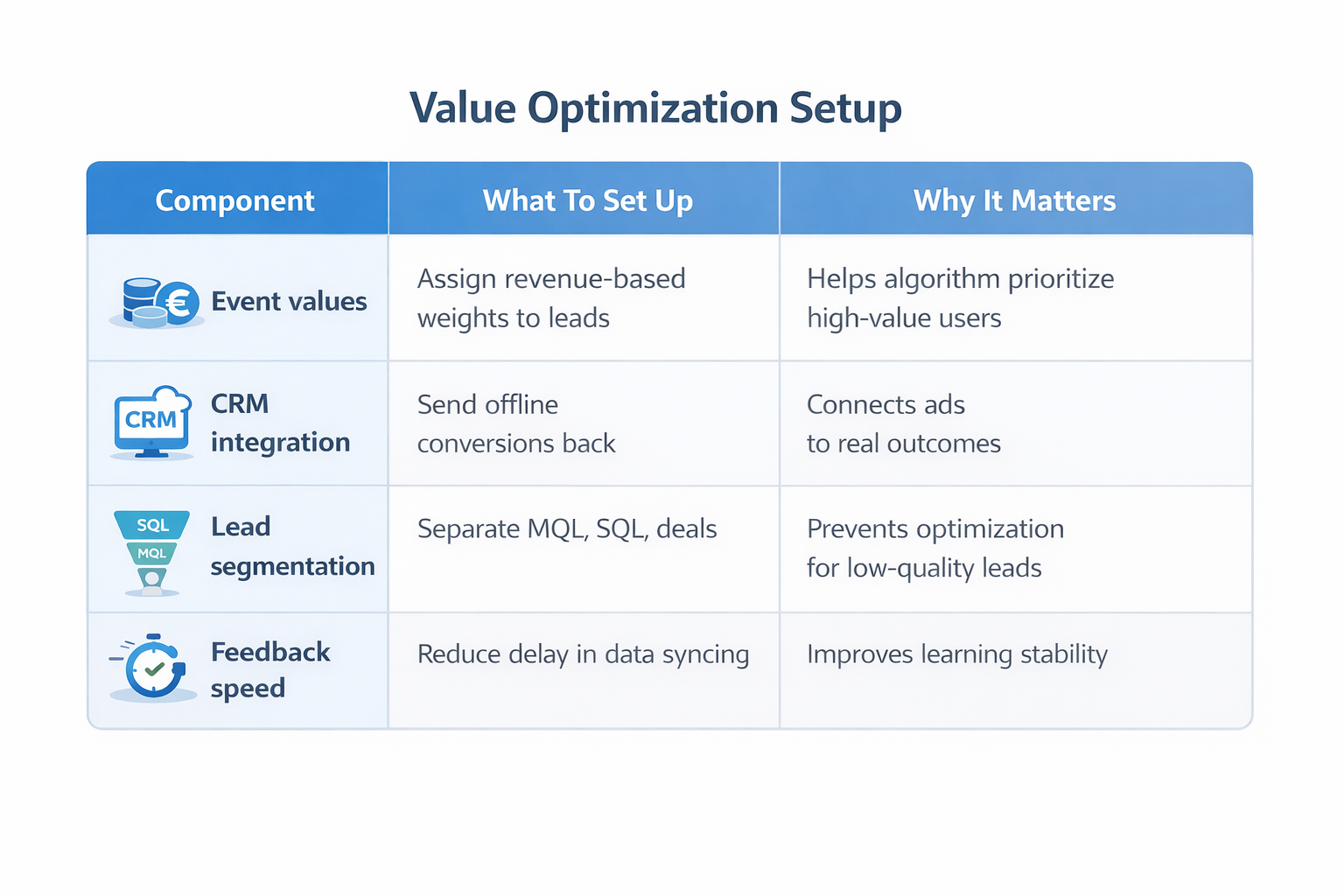
Assign Monetary Values to Lead Events
Not all leads contribute equally to revenue.
-
Qualified demo request — high value.
-
Basic form fill — lower value.
-
Returning user conversion — higher value than cold traffic.
Even rough estimates improve optimization quality.
Use CRM Feedback Loops
Front-end events alone are incomplete.
A stronger setup includes:
-
Sending offline conversions (closed deals).
-
Matching leads to revenue outcomes.
-
Feeding this data back regularly.
This connects ad delivery directly to business results.
Segment Lead Quality Explicitly
Avoid using a single “lead” event.
Instead:
-
MQL
-
SQL
-
Opportunity
Each stage should carry a different value weight.
Common Mistakes When Switching to Value Optimization
Treating Value as Static
If all leads have the same value, nothing changes. The system needs contrast.
Feeding Delayed or Incomplete Data
If CRM signals arrive too late:
-
Learning breaks.
-
Attribution weakens.
-
Performance becomes inconsistent.
Scaling Too Early
Value optimization needs enough high-quality signals first.
Scaling too early causes the system to drift back into low-quality segments — the same issue explained in The Science of Scaling Facebook Ads Without Killing Performance.
Diagnostic Signals That Indicate You’re Optimizing for Value Correctly
Look for:
-
Higher CPM with stable or improving ROI.
-
Lower lead volume but higher close rate.
-
Longer conversion paths.
-
More stable frequency distribution.
If revenue improves while lead count drops, the system is working correctly.
When Volume Optimization Still Makes Sense
Volume optimization is still useful when:
-
You need initial data quickly.
-
CRM integration is not ready.
-
You’re testing new offers.
Think of it as a data collection phase — not a long-term strategy.
Practical Shift: Moving From Volume to Value
-
Start with volume to gather baseline data.
-
Segment leads by quality.
-
Assign relative values.
-
Integrate CRM feedback.
-
Shift optimization gradually.
This prevents performance instability.
Final Takeaway
Optimizing for volume teaches the system to find the easiest conversions. Optimizing for value teaches it to find the right ones.
If your campaigns generate leads but not revenue, the issue isn’t targeting or scale.
It’s the optimization signal.