When advertisers first implement the Conversion API (CAPI), a common question appears almost immediately: does Meta prioritize server-side events over Pixel events?
The short answer is no — Meta does not inherently trust one source more than the other. What actually matters is signal consistency, deduplication accuracy, and event completeness.
In practice, campaigns perform better when Pixel and Conversion API work together, not when one replaces the other.
Understanding why requires looking at how Meta’s optimization system evaluates conversion signals.
How Meta Uses Conversion Signals
Meta’s ad delivery system constantly predicts which users are most likely to complete the selected conversion event. The model relies on historical signals to make those predictions.
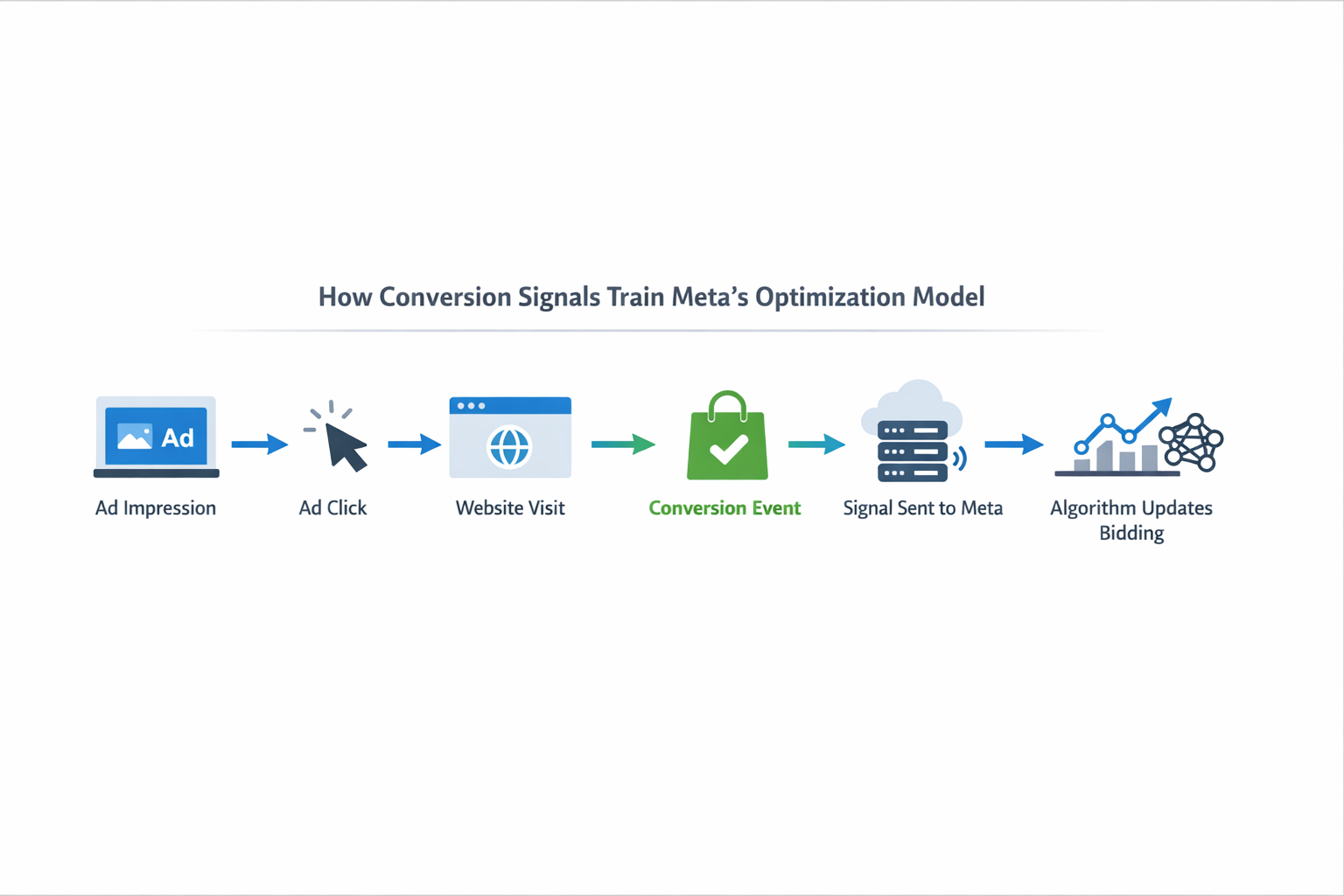
A simplified signal flow typically looks like this:
Ad impression → click → website interaction → conversion event → model update.
Each confirmed event contributes to the system’s ability to identify similar users in future auctions.
Several characteristics determine whether the signal becomes useful for optimization:
-
Event accuracy.
The system must reliably detect when the conversion actually happened. If events fire inconsistently or duplicate frequently, the model starts discounting them. -
Attribution reliability.
Meta attempts to link the conversion event back to the ad interaction that influenced it. When attribution fails, the platform loses visibility into which users convert after seeing an ad. -
Signal continuity over time.
Optimization improves when similar events appear repeatedly under consistent conditions. Sporadic or missing signals make the model unstable.
Both the Pixel and Conversion API feed data into this same learning process.
The difference lies in how the signals reach Meta’s systems.
What the Meta Pixel Actually Does
The Meta Pixel is a browser-based tracking script installed on a website.
When a user performs an action such as viewing a product or submitting a lead form, the browser sends an event directly to Meta.
Typical characteristics of Pixel events include:
-
Client-side execution.
The browser triggers the event when a user loads a page or clicks a tracked element. -
Immediate transmission.
Data reaches Meta within milliseconds because the event originates inside the browser session. -
Automatic user identifiers.
Cookies and browser data help Meta match the event to an existing user profile.
In stable environments, Pixel tracking works reliably. However, several modern factors weaken browser-based signals.
These include:
-
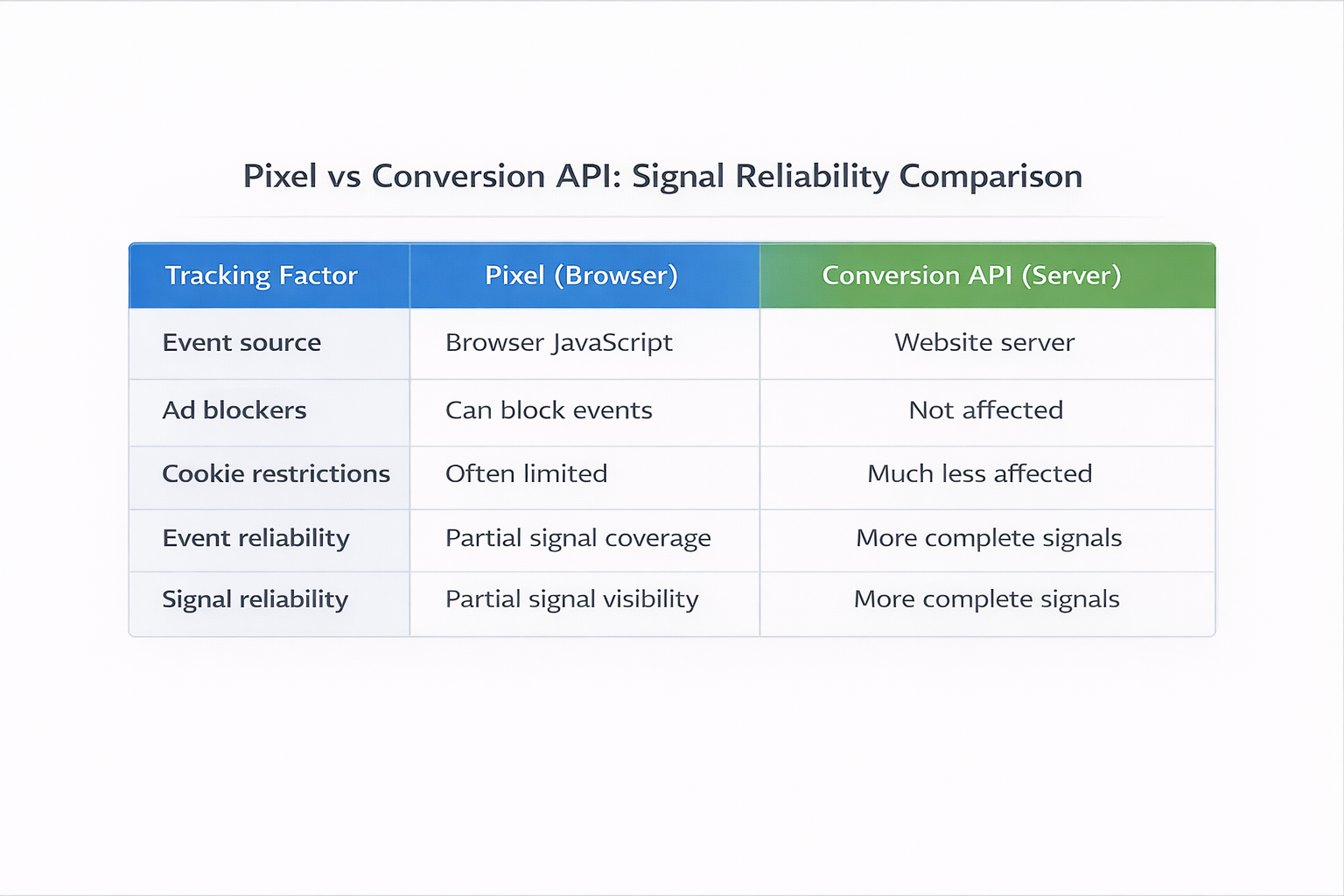
Ad blockers preventing scripts from firing.
Some users block the Pixel entirely. -
Browser privacy restrictions.
Safari and Firefox limit cookie lifetimes, which can break attribution chains. -
Tracking interruptions during page loads.
Slow scripts or redirect flows can prevent events from firing.
When these disruptions accumulate, campaigns may show a familiar pattern inside Ads Manager:
-
recorded conversions decrease,
-
cost per result rises,
-
and the learning phase resets more frequently.
The issue often appears as a performance problem even though the underlying cause is signal loss.
These limitations are one of the reasons advertisers increasingly experiment with privacy-resilient audience strategies, such as those discussed in How to Build Privacy-Safe Facebook Audiences Without Cookies.
What the Conversion API Changes
The Conversion API sends the same conversion events from the server instead of the browser.
Instead of relying on a JavaScript script in the user’s browser, the website’s backend sends the event directly to Meta after the conversion occurs.
This architecture solves several tracking weaknesses.
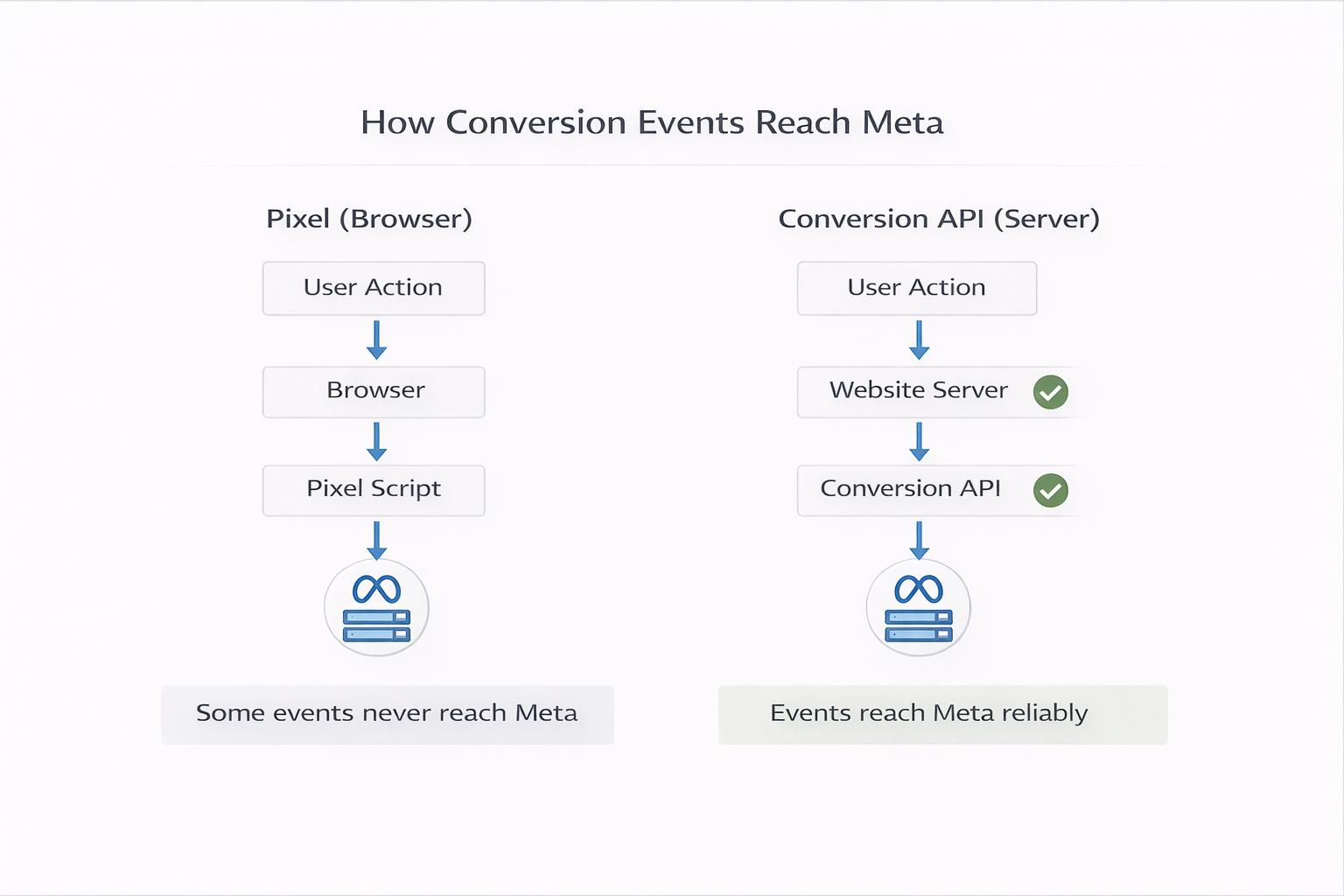
Server-side events are not affected by:
-
ad blockers that prevent Pixel scripts from loading;
-
browser restrictions on cookies;
-
interruptions caused by page navigation.
For example, when a purchase occurs on a checkout confirmation page, the server can immediately send the purchase event to Meta even if the browser blocks scripts.
In Ads Manager, advertisers often notice the difference quickly.
A campaign that previously recorded 70–80% of actual purchases may suddenly report 90–95% of them once server-side events are implemented.
The improvement comes from signal completeness, not from Meta preferring CAPI over Pixel.
Why Meta Recommends Using Both Together
Many advertisers assume that once the Conversion API is installed, the Pixel becomes unnecessary.
Meta’s documentation recommends the opposite approach: send events through both channels and deduplicate them.
The reason is data matching.
Each channel provides different types of identifiers.
Pixel events often include:
-
browser cookies;
-
session behavior;
-
click identifiers.
Conversion API events often include:
-
hashed email or phone data;
-
server-side order IDs;
-
CRM identifiers.
When Meta receives both versions of the same event, the platform can merge the information and build a stronger user match.
This improves attribution accuracy and model learning.
Better attribution also improves how Meta builds and expands audiences over time — the same mechanics that power systems like Lookalike Audiences.
Deduplication ensures that the system counts only one conversion.
Typically, the event includes a shared identifier such as:
-
event_id; -
order number;
-
or transaction ID.
If Meta receives two events with the same identifier, the system merges them and records a single conversion.
Without deduplication, duplicate events distort campaign results and confuse optimization.
When Pixel Signals Become Unreliable
Many advertisers discover tracking problems only after performance deteriorates.
A typical pattern appears in Ads Manager:
-
the number of recorded conversions drops suddenly;
-
cost per conversion increases;
-
but revenue inside the CRM remains stable.
This mismatch indicates that the optimization model is missing conversion signals.
Several operational situations frequently cause this.
Browser Privacy Restrictions
Safari’s Intelligent Tracking Prevention often deletes tracking cookies within 24 hours. When a user converts later, Meta cannot connect the purchase to the ad interaction.
Campaigns targeting mobile traffic usually feel this effect first.
Script Execution Failures
Pixel events rely on JavaScript firing correctly on the page.
Events can fail when:
-
checkout pages load slowly;
-
redirects interrupt the tracking script;
-
tag managers trigger events incorrectly.
The advertiser may never see the error unless the events are audited.
Ad Blockers
Some browser extensions prevent third-party tracking scripts entirely.
When this happens, the Pixel event never fires. The conversion still happens, but the platform cannot record it.
Each of these problems produces the same outcome:
Meta’s algorithm receives fewer confirmed conversions than actually occur.
When the model loses conversion signals, it becomes harder for the system to identify high-intent users — especially when building retargeting or custom audiences described in the Facebook Custom Audiences Guide: Everything You Need to Know.
When Conversion API Signals Become Unreliable
Although server-side tracking solves many browser issues, CAPI events can also fail under certain conditions.
The most common problems appear during implementation.
Missing User Data Parameters
Server events match users more accurately when they include identifiers such as:
-
hashed email;
-
phone number;
-
IP address;
-
user agent.
If these fields are missing, the event still records a conversion but the attribution match rate drops.
Ads Manager may show high event volume but poor attribution accuracy.
Incorrect Deduplication Setup
When Pixel and CAPI events share no common identifier, Meta counts them as separate conversions.
Campaign dashboards suddenly show inflated conversion numbers.
In severe cases, the model may overestimate performance and scale into low-quality traffic.
Delayed Server Events
Server integrations sometimes send events minutes or hours after the conversion.
This delay weakens the real-time feedback loop used by Meta’s bidding system.
Fast signal feedback helps the model adjust auction bids quickly. Delayed events slow that learning cycle.
What Actually Determines Signal Trust
Meta does not assign inherent priority to Pixel or Conversion API events.
Instead, the platform evaluates signals based on several operational characteristics.
Signal Completeness
If a campaign produces 100 purchases but only 60 events reach Meta, the algorithm learns from an incomplete dataset.
Server-side tracking usually improves completeness because it bypasses browser restrictions.
Match Quality
Meta’s system attempts to match the conversion event to a specific user profile.
Events containing multiple identifiers — email, phone, browser data — achieve higher match rates.
Higher match quality allows the system to attribute conversions more accurately.
Event Consistency
Optimization depends on a stable stream of similar conversion signals.
If events disappear for several hours or fluctuate unpredictably, the algorithm receives inconsistent feedback.
This often causes campaigns to re-enter the learning phase.
Deduplication Integrity
When duplicate events occur, the system misinterprets performance signals.
Incorrect deduplication can cause the model to believe that conversions are increasing faster than they actually are.
This leads to aggressive bidding behavior followed by performance instability.
A Practical Diagnostic Inside Ads Manager
If you want to determine whether your signal setup is affecting campaign performance, compare three numbers.
Inside Ads Manager or your CRM, check:
-
Actual conversions recorded in your backend.
This represents the real number of purchases or leads. -
Conversions reported inside Meta Ads Manager.
This shows how many signals the platform received. -
Event match quality in Events Manager.
Meta provides a score indicating how well events connect to users.
When Ads Manager records significantly fewer conversions than your backend, signal loss is likely.
A typical scenario might look like this:
-
CRM purchases: 120
-
Meta purchases reported: 82
-
Match quality: medium.
In this situation, improving the tracking architecture can restore optimization accuracy.
The Practical Setup Most Advertisers Use
For most advertisers, the most stable configuration is straightforward:
-
Install the Meta Pixel for browser-side events.
This captures real-time user behavior and browser identifiers. -
Implement Conversion API for server-side redundancy.
Server events recover conversions that browsers fail to report. -
Enable event deduplication using a shared event ID.
This prevents double-counting while combining signal sources. -
Send strong user identifiers in server events.
Hashing email or phone data increases attribution match rates. -
Audit event coverage regularly.
Compare backend conversions with Ads Manager reports to detect signal loss early.
When these elements work together, Meta receives a complete and reliable conversion dataset.
The Real Question Isn’t Pixel vs Conversion API
The debate between Pixel and Conversion API often misses the real issue.
Meta’s algorithm does not favor one signal source over the other. It prioritizes signals that are accurate, consistent, and attributable.
Pixel events provide fast browser-level data.
Conversion API provides stable server-side confirmation.
When both operate together with proper deduplication, the platform receives a stronger signal than either source alone.
For advertisers focused on scaling campaigns, the real objective is simple:
Give the optimization model the most complete picture of your conversions possible.
That is what Meta ultimately trusts.