Running lead generation campaigns on Meta platforms — like Facebook and Instagram — is one of the fastest ways to grow a pipeline. But many advertisers hit a wall when trying to scale.
What works at $50/day doesn’t always work at $500/day. More budget brings more problems: creative fatigue, lower-quality audiences, bidding inefficiencies, and wasted spend. Suddenly, your cost per lead (CPL) spikes, and campaign ROI drops.
This guide walks through how to scale your lead gen campaigns the right way — with structure, intent, and better signals. Whether you're running B2B lead forms, ecommerce quizzes, or high-ticket service funnels, the following strategies will help you increase volume without wrecking efficiency.
Scale budget carefully — and give the algorithm time to adapt
Meta’s algorithm doesn’t just spend more money instantly. It has to find more people to show your ad to — and that process gets shaky if your budget jumps too fast. The algorithm relies on historical performance and engagement signals. When those shift too quickly, performance suffers.
Instead of massive jumps, aim for incremental increases that preserve algorithm learning and audience relevance.
Use these scaling rules:
-
Under $100/day: Increase budget by 20% every 48 hours;
-
$100–$500/day: Increase by 10–15% every 3 days;
-
$500+ daily spend: Use Campaign Budget Optimization (CBO) and segment by audience intent or funnel stage.
Pro tip: Use automated rules in Ads Manager:
“If CPL is below $12 for 3 consecutive days, increase budget by 15%.”
For more on how to do this effectively, check out this guide on budget optimization for lead gen campaigns on Facebook.
Rethink audience targeting — layer intent signals, don’t just go broader
Scaling by “going broader” often backfires. Interest targeting is often vague, and pixel-based signals have become less reliable with tracking limitations (like iOS privacy changes).
Instead, think of audiences as signal combinations — actions that show someone is actively interested or considering a solution.
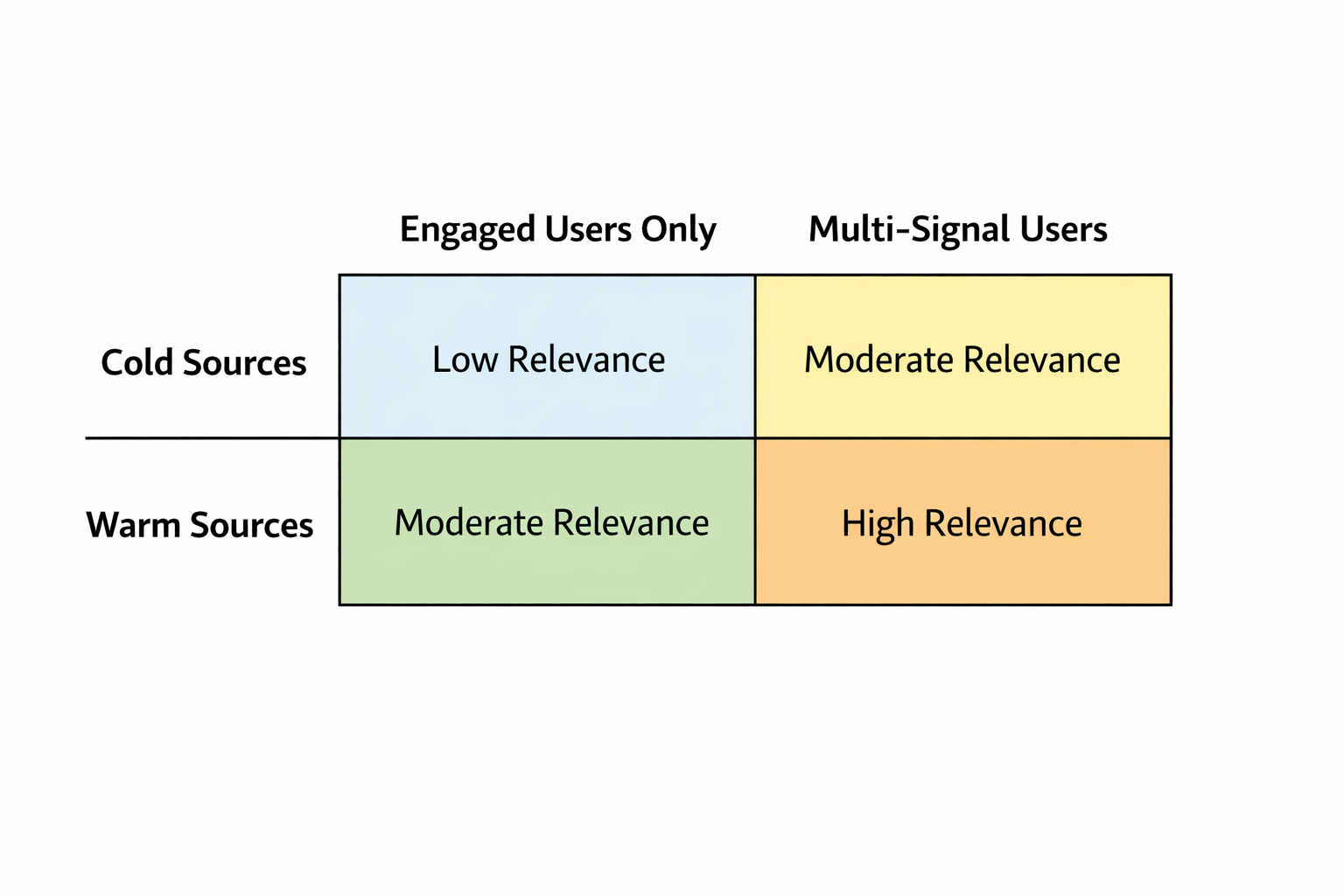
Build audiences using stacked behavior signals:
-
Users who visited key landing pages AND watched 50% of a video;
-
People who saved or commented on your content AND clicked on a previous ad;
-
Users who opened a lead form AND visited your pricing page in the same session.
You can create powerful lookalikes from these high-signal audiences, and they'll outperform audiences built from just page views or leads.
Real-world scenario:
A company targeting HR leaders found better CPLs by building custom audiences from people who engaged with their LinkedIn content and also visited a resource page — instead of relying on interest-based targeting.
If you’ve been struggling to generate leads at all, it’s worth reviewing why your Facebook ads might not be converting — and how targeting plays a role.
Target based on timing — not just who people are, but when they’re ready
Most advertisers focus only on static traits: location, interests, job titles. But timing plays a huge role in lead quality. Someone who clicked an ad yesterday is a better bet than someone who engaged a month ago.
To improve efficiency, add recency and funnel-based logic to your targeting.
Effective timing filters:
-
Retarget recent activity: Website visits, form opens, or video views in the last 3–14 days;
-
Exclude overexposed users: People who’ve seen the ad 6+ times without converting;
-
Use “lead form open but not submitted” as a warm audience segment;
-
Segment by depth of interaction: Not just “visited site,” but “visited 2+ pages” or “scrolled past 75%.”
Example strategy:
A B2B software provider segmented their middle-of-funnel audience into three layers based on recency. They then matched creative urgency (e.g., “book a demo this week”) to each layer. This cut CPL by 28% without reducing volume.
Align your creative strategy to the user’s stage in the funnel
The ad that works best for a cold audience probably won’t work for a lead that’s 90% of the way to conversion. Yet many advertisers use one-size-fits-all creative across every stage.
Think of creative as a sequence: each piece should meet the user where they are, answer what they’re thinking, and push them one step forward.
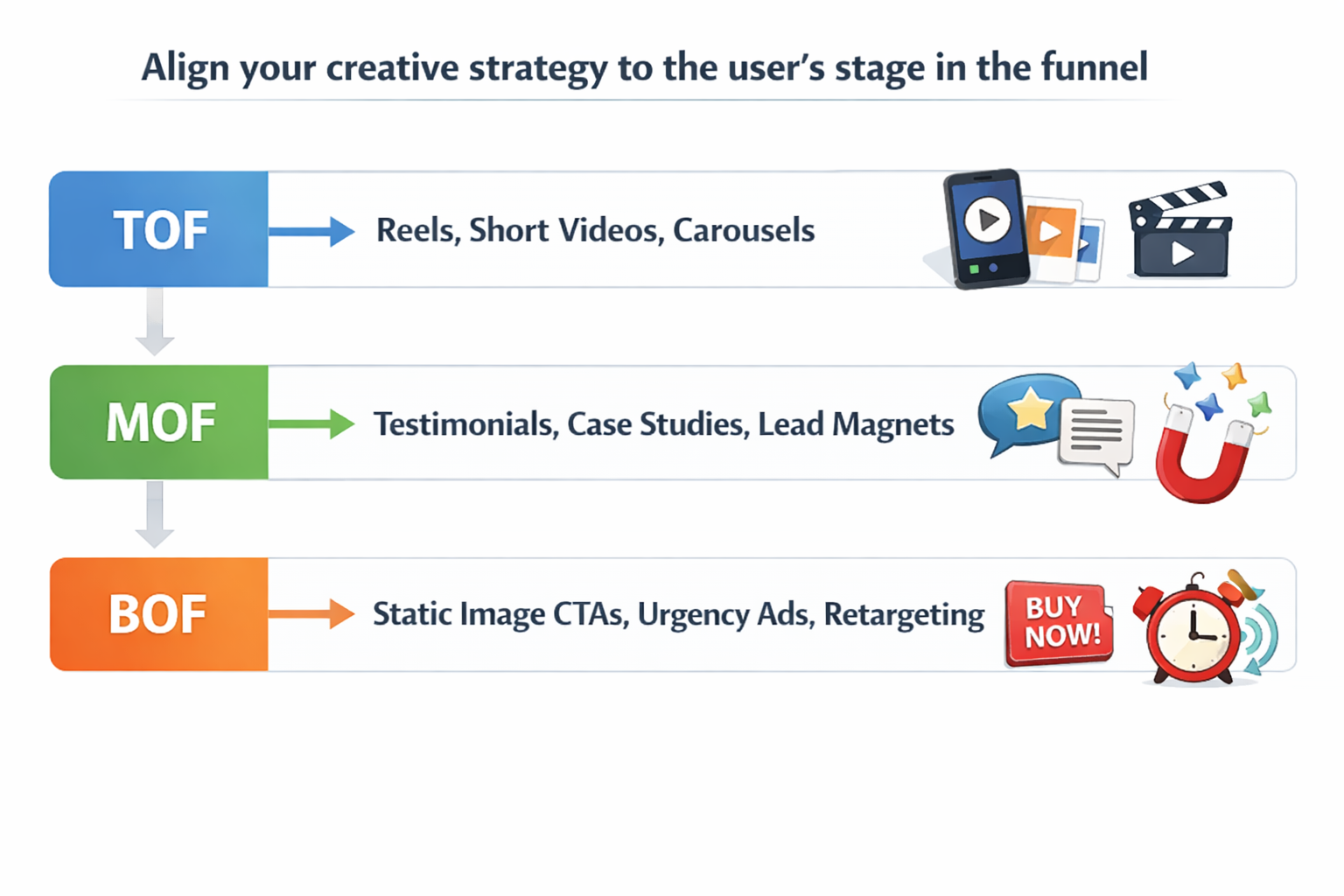
Creative by funnel stage:
-
Top of funnel (cold): Use scroll-stopping Reels, educational carousel ads, or stats-based videos to introduce the problem;
-
Middle of funnel (aware): Show authority — case studies, client results, explainers, testimonials;
-
Bottom of funnel (hot): Use urgency — deadline offers, benefit-focused reminders, one-click form access.
If you’re using Meta’s Advantage+ Lead campaigns, you can automate much of this with dynamic ad formats. Learn more in this article on leveraging Meta Advantage+ for higher quality leads.
Don’t let audience overlap drive up your CPL
When multiple ad sets target similar groups, you end up bidding against yourself. Meta tries to manage this, but the algorithm isn’t perfect — especially at scale.
Overlapping audiences can increase CPMs and fragment results, making it hard to understand which ads are truly performing.
Steps to reduce audience overlap:
-
Use clear exclusions between cold, warm, and hot audience sets;
-
Build custom audiences around behaviors — not just page views;
-
Consolidate similar audiences into one campaign with multiple creatives;
-
Check the Audience Overlap tool inside Ads Manager to identify problem areas.
Use a creative testing calendar to prevent fatigue
Even the best-performing ad wears out. Frequency increases, CTR drops, and Meta starts showing it to lower-quality segments. This is especially common when scaling budget — your creative gets burned out faster.
To keep CPL low, test and rotate creatives weekly.
Sample testing rhythm:
-
Monday: Launch 2–3 new creatives — mix formats (image, video, carousel);
-
Wednesday: Analyze top vs. bottom performers (look at CTR, CPL, frequency);
-
Friday: Pause underperformers, scale winners, and log learnings for next week.
Creative refresh examples:
-
Swap visual design but keep the headline;
-
Change the hook from “problem-focused” to “benefit-focused”;
-
Test a text-overlay image vs. UGC-style talking head.
Improve lead quality at the source — qualify before the form submit
Scaling often leads to more low-quality leads. This isn’t just a CPL problem — it hurts your sales team, your CRM data, and your conversion rate down the funnel.
If you scale without quality control, you’ll waste time and money nurturing leads who were never a good fit.
How to improve quality without hurting CPL:
-
Add one or two qualifying fields to your lead form (e.g., “Company size” or “Current marketing budget”);
-
Use quiz-style funnels that segment leads based on answers;
-
Use multi-step forms to filter casual browsers;
-
Test chat-based funnels where qualification happens before form fill (via Messenger or WhatsApp).
Don’t rely on one campaign type — scale across objectives
Many advertisers scale only one campaign — usually lead forms — and wonder why results plateau. Meta gives you multiple objectives for a reason. Different formats build different kinds of engagement and intent.
Layer other objectives around your lead campaign:
-
Traffic campaigns: Warm up users with educational content;
-
Engagement campaigns: Build social proof and retargeting pools;
-
Video view campaigns: Create low-cost audiences for MOF targeting;
-
Messenger campaigns: Use conversations to pre-qualify and convert.
Measure real conversions — not just form fills
A lead is only valuable if it turns into revenue. But many advertisers optimize for cheap form fills, without looking at what happens next.
Here’s how to track what really matters:
-
Use Meta’s 7-day click + 1-day view attribution setting;
-
Add UTM tracking to every ad — and sync lead source with your CRM;
-
Track lead-to-sale conversion rate by campaign;
-
Analyze CPL vs. cost per qualified lead or cost per booked call.
Final thoughts — scale by adding structure, not just budget
If you want to grow your lead generation results, don’t just spend more. You need a structured, performance-first strategy.
To recap:
-
Scale budget in small, algorithm-friendly steps;
-
Build audiences from layered signals, not just interests;
-
Target users based on timing and funnel position;
-
Match your creative format to the user’s awareness stage;
-
Prevent creative fatigue with weekly testing;
-
Qualify leads early to improve ROI;
-
Layer campaign objectives to strengthen the funnel;
-
Track what happens after the form — not just the front-end CPL.
Scaling becomes a lot easier — and more profitable — when you treat each part of your campaign as a system that compounds.
Don’t chase volume. Build for efficiency, then scale it.