
Signal loss refers to the growing reduction in user-level data available for ad targeting, measurement, and optimization. This happens when browsers, operating systems, and platforms restrict access to identifiers such as cookies, mobile device IDs, and precise user attributes.
As a result, advertisers receive fewer conversion signals, less accurate attribution data, and limited visibility into user journeys across channels.
Why Signal Loss Is Accelerating
Several industry-wide changes are contributing to the increase in signal loss:
-
Privacy-first browser updates: Safari and Firefox already block third-party cookies by default, while Chrome is gradually reducing cross-site tracking.
-
Mobile operating system restrictions: App Tracking Transparency (ATT) requires explicit user consent before apps can access device identifiers.
-
Stricter privacy regulations: Laws like GDPR and CCPA limit how user data can be collected, stored, and shared.
-
Walled garden ecosystems: Major platforms increasingly keep data within their own environments, reducing cross-platform visibility.

Majority of users choose to opt out of tracking, leading to widespread signal loss in digital advertising
According to industry reports, more than 60% of global web traffic now occurs in environments where third-party cookies are limited or unavailable, significantly shrinking addressable audiences.
How Signal Loss Impacts Ad Performance
Signal loss affects multiple layers of the advertising stack:
Weaker Attribution
With fewer trackable touchpoints, attribution models become less reliable. Studies show that advertisers may underreport conversions by 15–30% when relying solely on browser-based tracking.
Slower Algorithm Learning
Ad platforms rely on conversion signals to optimize delivery. When signal volume drops, algorithms take longer to exit learning phases, leading to higher CPAs and unstable performance.
Reduced Audience Precision
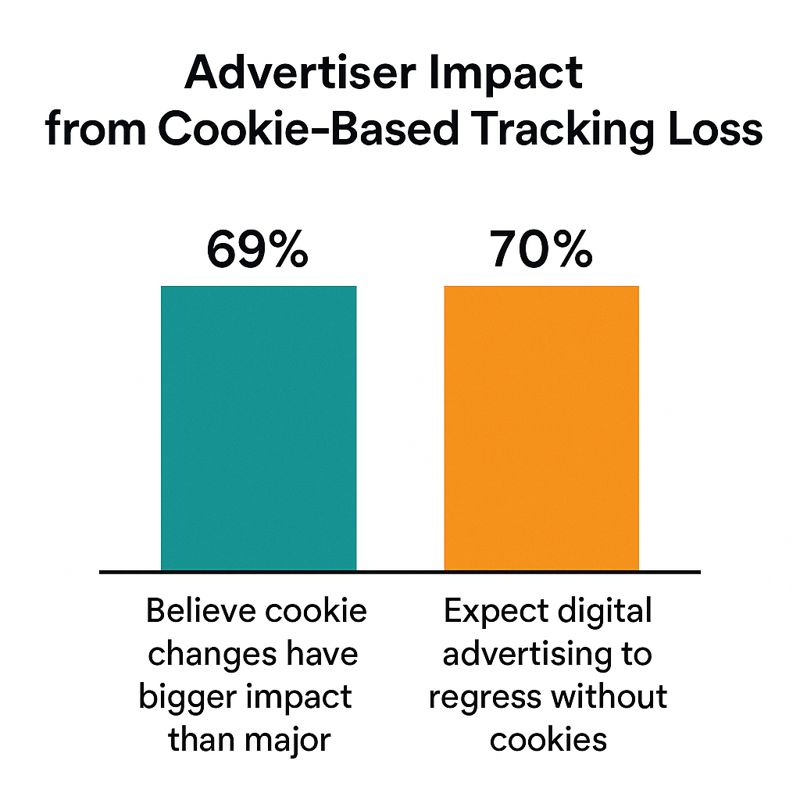
Most advertisers see cookie deprecation as a larger disruption than landmark privacy laws, with the majority expecting setbacks in advertising effectiveness
Without granular data, lookalike and retargeting audiences shrink. After the introduction of ATT, many advertisers reported retargeting audience sizes dropping by more than 40% on mobile.
Key Statistics Marketers Should Know
-
Around 75% of iOS users opt out of app-level tracking when presented with ATT prompts.
-
Brands using only client-side tracking can lose visibility into up to one-third of total conversions.
-
Advertisers who adopt privacy-friendly measurement solutions report recovery of 10–20% of previously untracked conversions.
These numbers highlight why adapting to signal loss is now a performance necessity, not just a compliance requirement.
What Marketers Can Do to Mitigate Signal Loss
While signal loss cannot be fully reversed, its impact can be significantly reduced with the right approach.
Strengthen First-Party Data Collection
First-party data is collected directly from users with consent and remains the most reliable signal source. Focus on:
-
Encouraging account creation and logins
-
Capturing email-based conversions
-
Using server-side tracking to reduce browser dependency
Shift Toward Modeled and Aggregated Measurement
Modern platforms increasingly rely on modeled conversions and aggregated event data. Instead of chasing perfect user-level attribution, evaluate performance using:
-
Incrementality testing
-
Geo-based experiments
-
Blended conversion reporting
This approach provides more stable insights even when individual signals are missing.
Optimize for Broader Signals
As granular events disappear, higher-level signals become more valuable. Optimize campaigns around:
-
Purchase or revenue events instead of micro-conversions
-
Longer attribution windows where allowed
-
Value-based bidding strategies
This helps platforms learn from fewer but more meaningful data points.
Invest in Creative and Messaging
When targeting precision declines, creative quality plays a larger role in performance. Clear value propositions, frequent creative refreshes, and message-market fit help compensate for reduced data accuracy.
Advertisers that prioritize creative testing often see more consistent results despite limited targeting signals.
Diversify Channels and Formats
Relying heavily on a single platform increases exposure to signal loss changes. Diversifying across search, contextual placements, and content-driven channels can stabilize performance and reduce dependency on user-level tracking.
Preparing for a Low-Signal Future
Signal loss is not a temporary disruption—it represents a long-term shift toward privacy-first advertising. Successful marketers will focus less on perfect attribution and more on resilient measurement frameworks, strong creative systems, and adaptive optimization strategies.
By embracing aggregated data, experimentation, and first-party relationships, advertisers can continue to grow even as traditional tracking fades.
Further Reading
For deeper insights into modern advertising performance and measurement strategies, consider these related articles:
