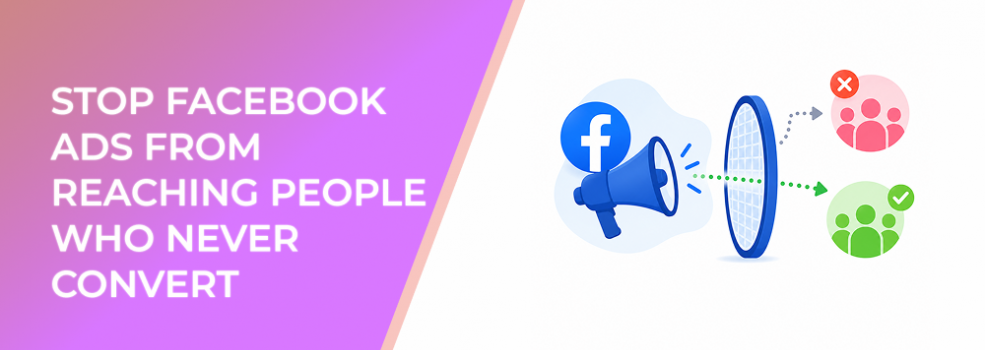
Some Facebook ad campaigns do not fail because nobody responds. They fail because the wrong people respond.
The ads get impressions. People click. Some users may even submit a form, watch a video, or visit the landing page. But they never become qualified leads, customers, booked calls, purchases, or real pipeline.
This is one of the most frustrating problems in performance marketing because the campaign can look alive while business results stay flat. The fix starts with understanding why Facebook keeps reaching people who are unlikely to convert.
The Problem
The problem is low-quality delivery.
Your campaign is spending money on people who may engage with ads but are unlikely to complete the business action that matters. These users may be curious, price-sensitive, outside your service area, unqualified, too early in the journey, or simply mismatched to your offer.
This is especially common in lead-generation campaigns. A low CPL can hide poor lead quality. A high CTR can hide weak purchase intent. A strong engagement rate can hide the fact that people are reacting to the content, not considering the offer.
The audience is not just broad. It is misaligned.
Why This Problem Hurts Performance
When Facebook ads reach people who never convert, performance degrades across the entire funnel.
At the campaign level, budget is spent on low-value impressions, clicks, and form fills. At the sales level, teams waste time following up with leads that should never have entered the funnel. At the reporting level, campaign metrics become misleading.
The most damaging effect is signal pollution.
If the campaign optimizes around shallow actions from poor-fit users, Meta may find more people like them. That can create a feedback loop: cheap engagement leads to more cheap engagement, while qualified conversions remain scarce.
The business impact shows up as rising CPA, weak ROAS, poor lead-to-sale conversion rate, higher CAC, lower sales productivity, and slower scaling.
Common Scenarios Where This Happens
A B2B campaign generates many leads, but most are students, freelancers, job seekers, or companies too small to buy.
A local business reaches people outside its realistic service area because the location targeting or creative is too loose.
An ecommerce campaign attracts discount hunters who click every offer but rarely complete purchases.
A SaaS campaign targets a broad business audience and receives leads from people without decision authority.
An agency campaign reports low CPL to the client, but the client later discovers that few leads answer calls, book meetings, or meet qualification criteria.
An affiliate campaign gets traffic from users interested in the topic, but not in the specific offer or payout-driving action.
Why the Problem Happens
This problem usually happens because the campaign is optimized for platform activity instead of business quality.
The audience may be built around weak interests. The campaign objective may reward low-friction engagement. The lead form may be too easy to complete. The creative may attract curiosity instead of intent. The landing page may not filter poor-fit users. The account may also lack clean conversion signals from qualified leads or customers.
Another common cause is poor exclusion logic. Existing customers, unqualified leads, previous low-quality form submitters, employees, competitors, or irrelevant segments may remain eligible for acquisition campaigns.
The issue can also come from audience-source mismatch. People who follow a general topic are not the same as people actively looking for a solution. People who like content are not always people who will buy.
The Solution
The solution is to define conversion quality before optimizing for volume.
Start by identifying what “never converts” means in your business. Is it someone who never buys, never books, never qualifies, never answers sales follow-up, never becomes an opportunity, or never reaches minimum order value?
Then audit your current audience against that definition. Look for patterns in poor-fit traffic:
- Which placements produce weak leads?
- Which geographies underperform?
- Which age groups, interests, or source audiences produce low quality?
- Which lead forms attract unqualified users?
- Which creative hooks generate curiosity but not conversion intent?
- Which retargeting pools include weak visitors?
Next, separate high-intent and low-intent signals.
High-intent signals might include pricing-page visits, demo requests, cart activity, competitor following, niche group participation, repeat engagement, CRM qualification, or job-role fit.
Low-intent signals might include short video views, accidental clicks, broad page likes, generic interest matches, low-quality lead forms, or shallow engagement.
Build campaigns around the high-intent signals and suppress the low-intent ones where possible.
How LeadEnforce Helps
LeadEnforce helps when advertisers need stronger audience inputs before Facebook starts spending.
Advertisers can build audiences from Facebook groups, Instagram followers, LinkedIn professional data, and custom social-profile sources, which can be more relevant than relying only on broad interest categories.
For example, a B2B lead-generation team can focus on professionals who better match role, industry, or company criteria. An ecommerce advertiser can build audiences from followers of niche product accounts instead of broad category interests. A local advertiser can use community-based sources that better reflect likely buyers.
LeadEnforce does not guarantee that every person will convert. No audience tool can do that. But it can help reduce the amount of budget spent discovering basic relevance from scratch.
The best use is to pair LeadEnforce-built audiences with strong creative filters, clean exclusions, reliable conversion tracking, and downstream lead-quality review.
Risks and Considerations
The biggest risk is assuming that audience quality alone solves conversion quality. It does not.
A campaign can still attract poor-fit users if the ad promises too much, hides pricing, avoids qualifiers, or uses a lead form that is too frictionless. A landing page that fails to explain who the offer is for can also let unqualified users through.
Another risk is excluding too aggressively. If you remove too many segments too early, you may restrict delivery and miss potential buyers.
You should also avoid judging audiences by early click metrics only. Some high-quality audiences may have higher CPC but better qualification, close rate, and CAC.
When using social or professional audience sources, ensure your workflow aligns with applicable platform rules, privacy requirements, and customer-data responsibilities.
Prerequisites and Dependencies
You need a clear definition of a qualified conversion.
For ecommerce, that might be purchase value, repeat purchase, or margin-adjusted ROAS. For B2B, it might be MQL rate, SQL rate, booked demo quality, opportunity creation, or closed-won revenue. For local services, it might be appointment completion or service-area fit.
You need a feedback loop between marketing and sales. If the sales team knows which leads never convert, that information should shape campaign exclusions, source selection, and creative language.
You need conversion tracking that is reliable enough to distinguish weak actions from valuable actions.
You also need creative that filters as well as attracts. Specific copy, pricing context, use cases, and audience qualifiers can prevent irrelevant users from clicking.
If LeadEnforce is used, you need source audiences that reflect real intent, not just category similarity.
Practical Recommendations
Audit your last 30 to 90 days of conversions and identify the audience sources that produced low-quality outcomes.
Stop optimizing only for CPL, CPC, CTR, or form volume. Add lead quality, qualification rate, booked-call rate, purchase rate, CAC, and ROAS to your review.
Create suppression audiences for known poor-fit users where your data and platform setup allow it.
Use stronger creative qualifiers. Say who the offer is for, what problem it solves, and what level of commitment is required.
Use LeadEnforce to source better prospecting audiences when your existing broad audiences are attracting too many people who never convert. Then compare results against business outcomes, not platform activity alone.
Final Takeaway
Facebook ads keep reaching people who never convert when the campaign rewards weak signals, vague audiences, and low-friction actions.
The fix is to define conversion quality, improve audience inputs, suppress poor-fit segments, and align the ad message with the people most likely to take meaningful action.
Join the free 7-day LeadEnforce trial period to build higher-intent audience sources and reduce wasted delivery in your Facebook ad campaigns.
Related LeadEnforce Articles
- Marketing Audiences vs Buying Audiences: The Real Gap — Explains why people who look like prospects may not behave like buyers.
- Retargeting vs. Broad Targeting: Which Strategy Drives Better Results? — Helps decide when to rely on warm intent versus broad discovery.
- The Role of Audience Overlap in Facebook Ads Performance — Useful for reducing wasted delivery across competing audiences.
- Why Your Target Audience Might Be Too Broad — Even If It Looks Right — Shows how apparently relevant audiences can still include too many poor-fit users.
- LeadEnforce Audiences vs. Interest Targeting: Which Drives Better Results? — Compares intent-based audience sourcing with standard interest targeting.