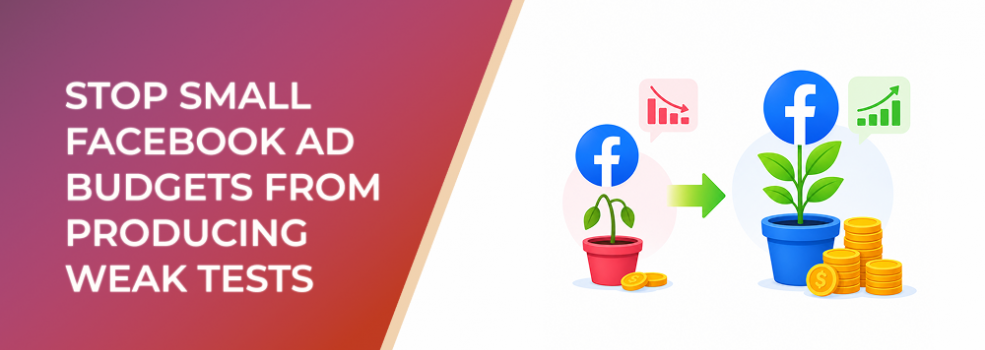
A small Facebook ad budget is not automatically a problem.
The real problem is using a small budget to run a weak test.
That happens when advertisers spread limited spend across too many audiences, creatives, objectives, or campaign questions. The campaign spends money, but the result does not tell you what to do next.
This affects SMB owners, agencies, affiliate marketers, startup teams, B2B lead-generation teams, and freelancers who need every dollar to produce learning. When the test is poorly structured, a small budget creates noise instead of insight.
The Problem
Small-budget Facebook ad tests often fail because they are asked to answer too much at once.
The advertiser wants to test the offer, the creative, the audience, the landing page, and the campaign objective in one short campaign. With limited daily spend, each variable receives too little exposure to produce a reliable signal.
The result is a campaign that technically runs but does not produce a decision.
Was the audience wrong? Was the creative weak? Was the offer unclear? Was the budget too small? Was the campaign duration too short? Was the landing page the bottleneck?
If you cannot answer those questions, the test was weak.
Why This Problem Hurts Performance
Weak tests waste money in two ways.
First, they waste direct ad spend. A small budget may not feel risky, but repeated weak tests add up quickly. Ten unclear $100 tests can waste more time and budget than one structured $1,000 test.
Second, weak tests lead to bad decisions. You may pause a good audience because the creative was poor. You may keep a bad audience because the first few clicks were cheap. You may scale a low-CPL test before checking whether those leads match your ICP.
This hurts CPC, CPA, CAC, ROAS, lead quality, conversion rate, and testing speed.
Small budgets also struggle when the optimization event is too rare. Meta has stated that performance typically stabilizes after an ad set receives around 50 optimization events within a seven-day period, which means low-budget conversion tests can take longer to produce stable signals.
That does not mean small-budget campaigns cannot work. It means they need sharper structure.
Common Scenarios Where This Happens
A startup runs three ad sets at $10 per day each, testing three audiences and three creative angles at once. After five days, none of the ad sets has enough data to evaluate.
A B2B agency tests a lead magnet against a broad audience and gets cheap leads. The sales team later reports that most leads are students, vendors, or poor-fit companies.
An ecommerce store uses a small daily budget to test five product creatives. Meta gives most delivery to one ad early, and the team assumes the other creatives failed before they had meaningful exposure.
An affiliate marketer tests a new offer with a broad interest audience. CPC looks acceptable, but downstream approval rate is weak.
A local business boosts a post to “people nearby” and judges success by engagement, even though the real goal is booked appointments.
Why the Problem Happens
Small-budget tests usually break for five reasons.
First, the hypothesis is vague. “Let’s see what happens” is not a test. It is a spend experiment without a decision rule.
Second, the budget is split too thin. A $50 daily budget across five ad sets gives each audience only $10 per day. That may not be enough to generate useful signal.
Third, too many variables change at once. If the audience, creative, offer, CTA, and placement all change together, the result becomes impossible to interpret.
Fourth, the audience is weak or too broad. Broad targeting can generate cheap activity, but cheap activity is not the same as qualified demand.
Fifth, success is measured too shallowly. CPC, CTR, engagement, and CPL matter, but they do not prove customer quality on their own.
The Solution
The solution is to make the test narrower and more intentional.
Start with one question. For example:
Does this audience produce qualified leads?
Does this offer attract buyers at an acceptable CPA?
Does this creative angle outperform our current message?
Does this Page-created ad justify a larger Ads Manager campaign?
Then isolate one primary variable.
If you are testing audience quality, keep the creative and offer consistent. If you are testing creative, keep the audience stable. If you are testing an offer, do not also change the audience and campaign objective.
Next, consolidate spend. Instead of running five weak ad sets, run one or two stronger tests. Small budgets usually perform better when they are concentrated around a clear question.
Choose metrics that match the test. For lead generation, do not stop at CPL. Review qualified lead rate, booked-call rate, sales acceptance, and pipeline contribution. For ecommerce, review CPA, conversion rate, ROAS, AOV, and purchase quality. For traffic, check landing page engagement instead of only CPC.
Finally, define decision rules before launch. Decide how much spend, time, or signal is required before pausing, iterating, or scaling.
How LeadEnforce Helps
LeadEnforce is directly useful when the small-budget test depends on audience relevance.
With limited spend, you cannot afford to waste impressions on people who are only loosely connected to the offer. LeadEnforce helps advertisers build more intentional audiences from Facebook groups, Instagram profiles, Instagram followers, Instagram engagers, LinkedIn professional data, and custom social-profile data. Its audience-building role is especially relevant when marketers need stronger inputs than broad native interests.
For example, a B2B lead-generation team can build an audience around professional or community signals that better match its ICP. An ecommerce brand can test people connected to relevant Instagram profiles or category communities. An agency can create separate audience pools for each client instead of reusing generic interest targeting.
LeadEnforce does not guarantee that a campaign will convert. It does not fix weak creative, poor offers, landing page problems, tracking issues, or sales follow-up gaps.
Its value is in reducing targeting guesswork so a small-budget test has a better chance of reaching people who already fit the market context.
Risks and Considerations
Do not make the audience too small.
A high-intent audience still needs enough size for delivery. If the audience is too narrow, frequency may rise quickly, delivery may become unstable, and the campaign may fail to collect enough signal.
Do not assume audience precision fixes everything. A relevant audience will still ignore a weak offer or confusing creative.
Also consider compliance. Audience relevance should guide message fit, not create ad copy that feels invasive or suggests sensitive personal knowledge.
Another risk is over-reading early results. Small-budget tests can guide decisions, but they should not be treated as definitive proof after only a few clicks or leads.
Prerequisites and Dependencies
A strong small-budget test needs a clear ICP, one primary hypothesis, a defined campaign objective, and a success metric connected to business value.
You also need enough audience size, a relevant offer, clear creative, and a destination that matches the ad promise.
If LeadEnforce is part of the workflow, you need relevant source communities, profiles, followers, engagers, professional segments, or social-profile data that genuinely reflect your target market.
For lead generation, make sure sales or CRM feedback is available. For ecommerce, review purchase quality and margin. For agencies, align with the client on what “good performance” means before the test starts.
Practical Recommendations
Use small budgets to answer small, clear questions.
Do not test everything at once. Pick one variable and protect the test from noise.
Consolidate spend into fewer ad sets. A concentrated test is usually easier to read than several underfunded tests.
Use LeadEnforce when audience quality is the central question. Build a high-intent audience from relevant communities, profiles, engagers, or professional signals, then compare it against a broader setup while keeping creative and offer consistent.
Review business outcomes, not just platform metrics. The best small-budget test is not always the one with the cheapest click. It is the one that tells you what to do next with more confidence.
Final Takeaway
Small Facebook ad budgets do not have to produce weak tests.
They become weak when the campaign tries to answer too many questions with too little spend. The fix is to narrow the hypothesis, concentrate budget, improve audience relevance, and judge results by business outcomes.
A small budget can still create valuable learning when every dollar is tied to a clear decision.
To build cleaner, higher-intent audience tests before your next small-budget campaign, join the free 7-day LeadEnforce trial period.
Related LeadEnforce Articles
- Campaign Optimization for Facebook Ads with Small Daily Budgets — Expands on objective selection, audience precision, and performance review when daily spend is constrained.
- A/B Testing on a Budget: Creative Testing for Small Business Ads — Useful for structuring lean tests without changing too many variables at once.
- Why Audience Quality Matters More Than Size for Facebook Ads — Reinforces why small budgets need relevance and intent, not just reach.
- How to Identify a Broken Audience Before Spending Your Budget — Helps advertisers diagnose poor targeting inputs before spending limited test budget.
- When Facebook Page Ads Reach the Wrong Audience — Shows how Page-created campaigns lose efficiency when audience selection is broad or weak.