Not every product is meant to scale with paid social. Even with a strong creative strategy and consistent testing, some offers simply stall.
The problem often isn’t your ad. It’s your target market fit. If your product doesn't align with how people buy on Facebook or Instagram, scale becomes expensive — or impossible.
Below, we’ll break down why this happens and how to spot it early.
What target market fit really means in paid social
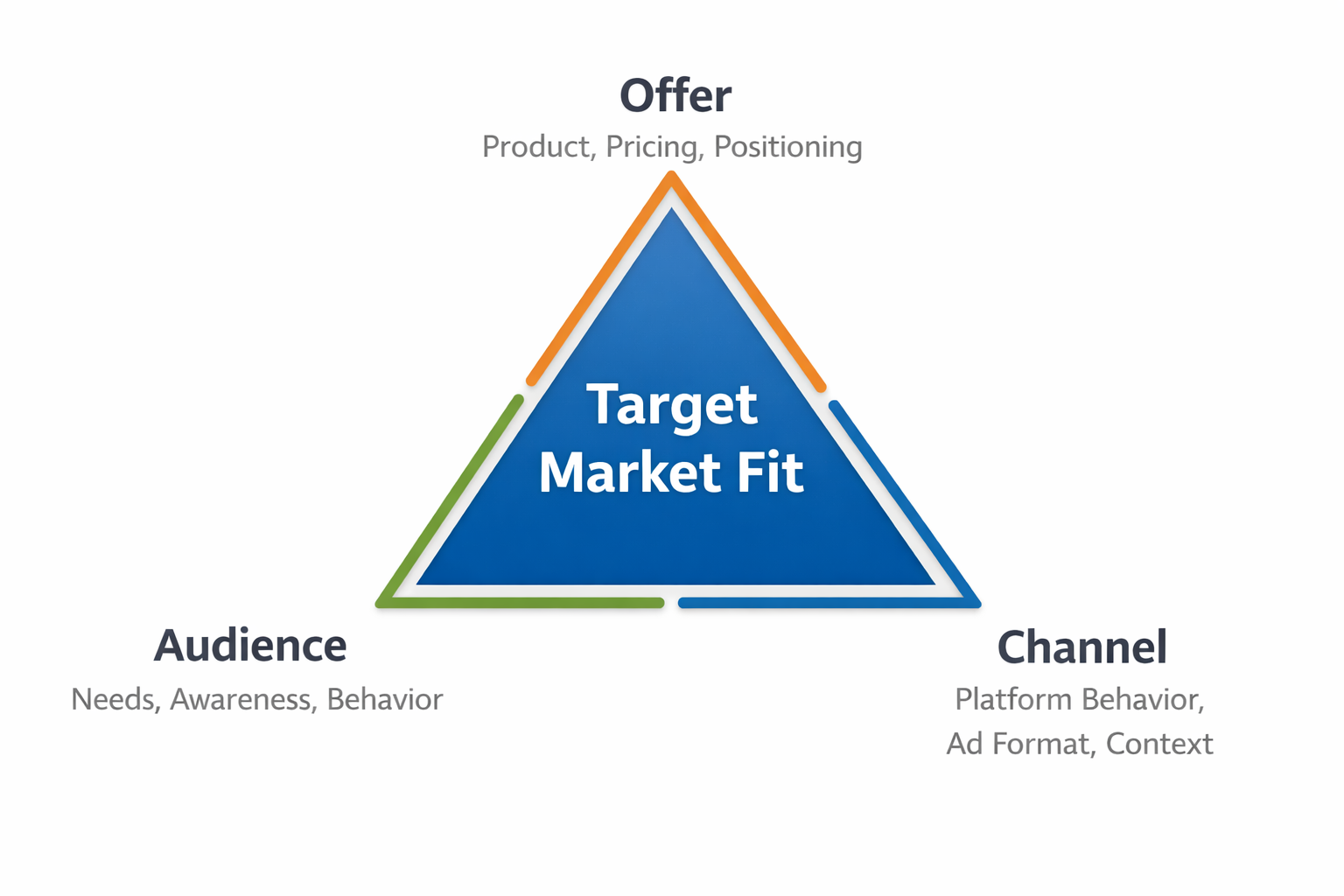
Target market fit isn't about having a "great product." It's about matching three things.
-
Your offer, including the product, price point, and positioning;
-
Your audience, including their needs, awareness level, and buying behavior;
-
Your channel, in this case, Facebook and Instagram ad environments.
If one of these is off, your performance suffers — usually in the form of high CPMs, low CTRs, or poor ROAS.
Red flags: signs your product lacks market fit for paid social
Before you scale, check for these warning signals. If they show up early, you’re likely trying to push the wrong product through the wrong door.
1. Your product requires explanation
If it needs a demo, long explanation, or multiple education steps before someone understands the value — it likely won’t work cold.
Meta ads thrive on quick, visual, impulse-friendly products. You have three seconds to earn attention. If your product needs context, you’re already behind.
Example: Technical B2B SaaS tools or complex multi-step services often struggle to acquire new customers cold.
2. Your audience isn’t on Meta to shop
Facebook and Instagram are discovery platforms. Users scroll to relax, not to research.
Products that succeed are those that feel like native content — easy to grasp, visually engaging, and emotionally relevant.
Misses the mark: Enterprise software, niche professional tools, or expensive offers that require committees or long cycles.
3. Your price point breaks the impulse
Most purchases on Meta are emotional, not rational. Products with higher price tags require more trust, research, or time.
Unless you have a well-known brand or serious proof, pushing $300+ products to cold traffic rarely converts profitably.
Exceptions exist — but usually when:
-
The brand already has authority;
-
There’s strong social proof (reviews, UGC, press);
-
You warm up users first (via lead gen or retargeting).
Common myths that mask market fit issues
Many advertisers blame creative, targeting, or budget when results stall. But these aren’t always the root problem.
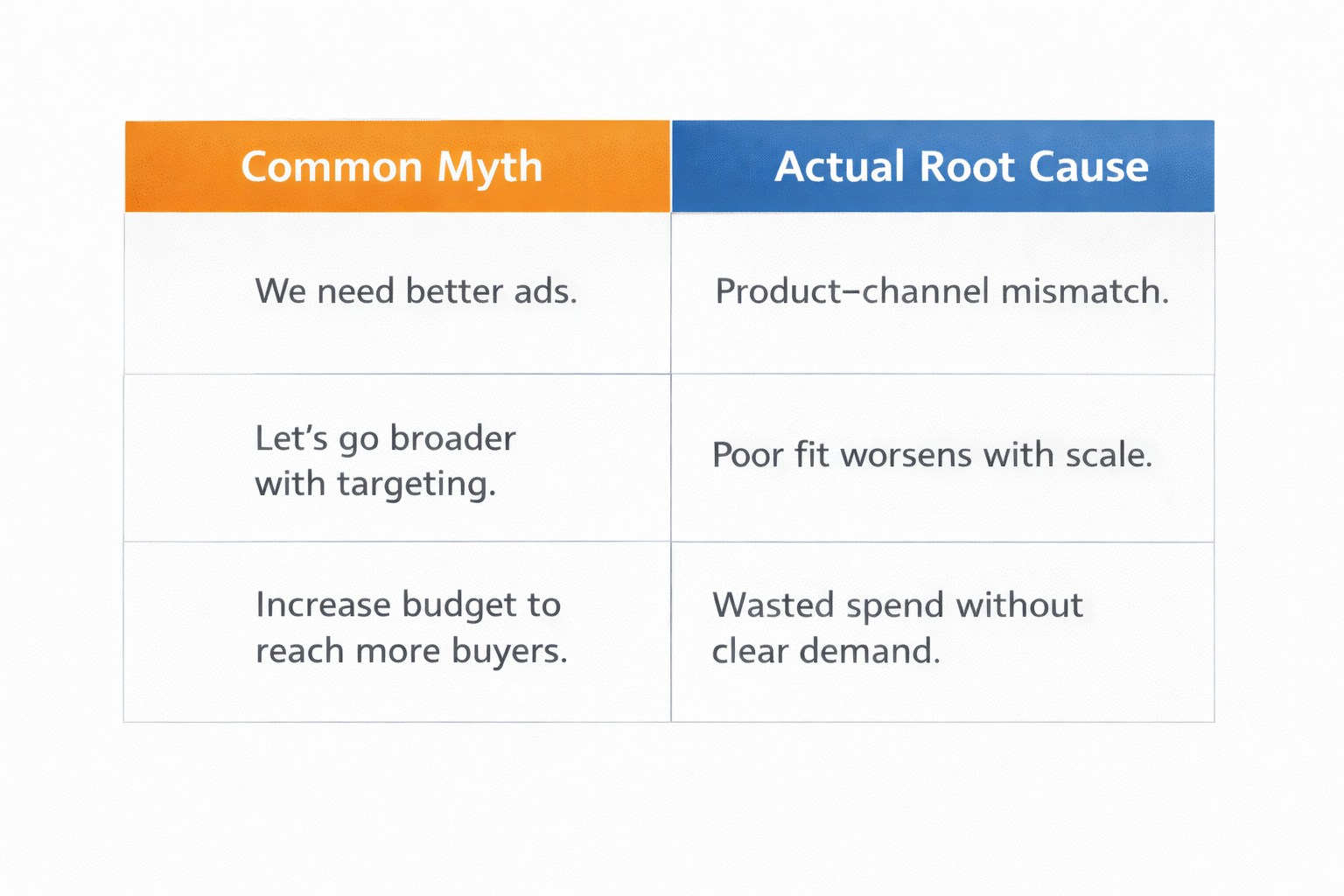
Myth 1: “We just need better ads”
Even great creative can’t fix a misaligned product–channel match. If the audience isn’t ready to buy, no hook will convert them.
Myth 2: “Let’s test broader targeting”
Broad targeting can scale what’s already working. But it will make a poor-fit product fail faster — and more expensively.
Myth 3: “Let’s increase budget to find the right buyers”
Scaling spend without market fit doesn’t increase conversions. It just increases wasted impressions and CPMs.
If these symptoms sound familiar, you’re likely dealing with a deeper issue. See: Why Your Ads Get Clicks But No Sales: Fixing the Audience Misalignment.
Products that do scale on Facebook and Instagram
Certain product types consistently perform better in paid social environments. They align well with user behavior, platform strengths, and ad formats.
High-fit product traits:
-
Visually distinctive: Unique physical appearance that grabs attention in-feed (e.g., bold apparel, clever gadgets);
-
Problem-solution clarity: You can show what the product does and who it helps in under 5 seconds;
-
Affordable and impulse-friendly: Typically under $100 with a clear and immediate value prop;
-
High perceived value: Looks more valuable than it costs (e.g., skincare bundles, smart kitchen tools);
-
Cultural or social triggers: Taps into trends, identity, humor, or values shared by a clear tribe.
Bonus fit: If your product is already being talked about in comments, forums, or niche communities — it’s much easier to convert.
Fixes: what to do if your product isn’t scaling
If you suspect a market fit issue, don’t keep burning budget. Try one of these options instead:
1. Shift the offer, not just the ad
Sometimes it’s the packaging, not the product. Test a smaller entry offer, free trial, or bundle that lowers risk.
Example: A $180 product becomes a $30 trial kit with follow-up LTV mechanics.
See: Why Some Products Don’t Scale — Even If the Ads Look Great.
2. Change your target audience
You may be targeting the wrong buyer. Use custom audiences from tools like LeadEnforce to go beyond basic interests.
Build segments from:
-
Instagram account followers of similar or adjacent brands;
-
Facebook group members with aligned interests or problems;
-
People engaging with specific competitors or influencers.
Learn more about how LeadEnforce builds better-fit audiences: How LeadEnforce Simplifies Audience Segmentation for Better Ad Results.
3. Use paid social to warm, not convert
If cold traffic isn’t working, don’t abandon Meta — just shift its role in your funnel.
Run paid content to build awareness or collect leads, then convert with email, retargeting, or even offline touchpoints.
How to test target market fit before scaling
Before spending thousands, validate early signals with small budgets. Here’s how:
Start with micro-tests:
-
Launch 3–5 creatives to cold audiences under $50/day;
-
Measure CTR, thumbstop ratio, cost per click, and add-to-cart rates;
-
Watch for comments — are people tagging friends, asking questions, or saying "I need this"?
Benchmark your funnel metrics:
If CTR is under 0.7%, or your cost per ATC is double your goal, something may be off in the product–audience–channel fit.
Use those numbers as your guide — not gut feeling.
The bottom line
You can’t scale what doesn’t fit.
Before you pour more into creative or budget, zoom out: is this the right product, for the right audience, in the right place?
That’s the only way to win long term with paid social — and the fastest way to stop wasting ad spend.