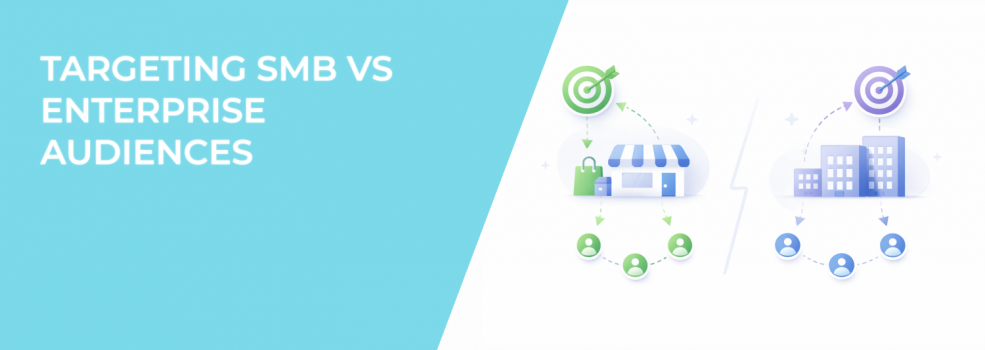
In many ad accounts, performance issues don’t come from poor targeting settings — they come from mixing fundamentally different buyers inside one system.
SMB and enterprise audiences generate different signals, move at different speeds, and respond to different messaging. When both sit in the same campaign, the algorithm consistently favors the easier path.
That usually means SMB.
If you’ve ever seen strong CPL but weak pipeline, you’ve already experienced this imbalance.
Why Platforms Naturally Drift Toward SMB Traffic
Most campaigns optimize for events like leads or conversions. The platform’s job is to maximize those events as efficiently as possible.
SMB users produce those signals faster.
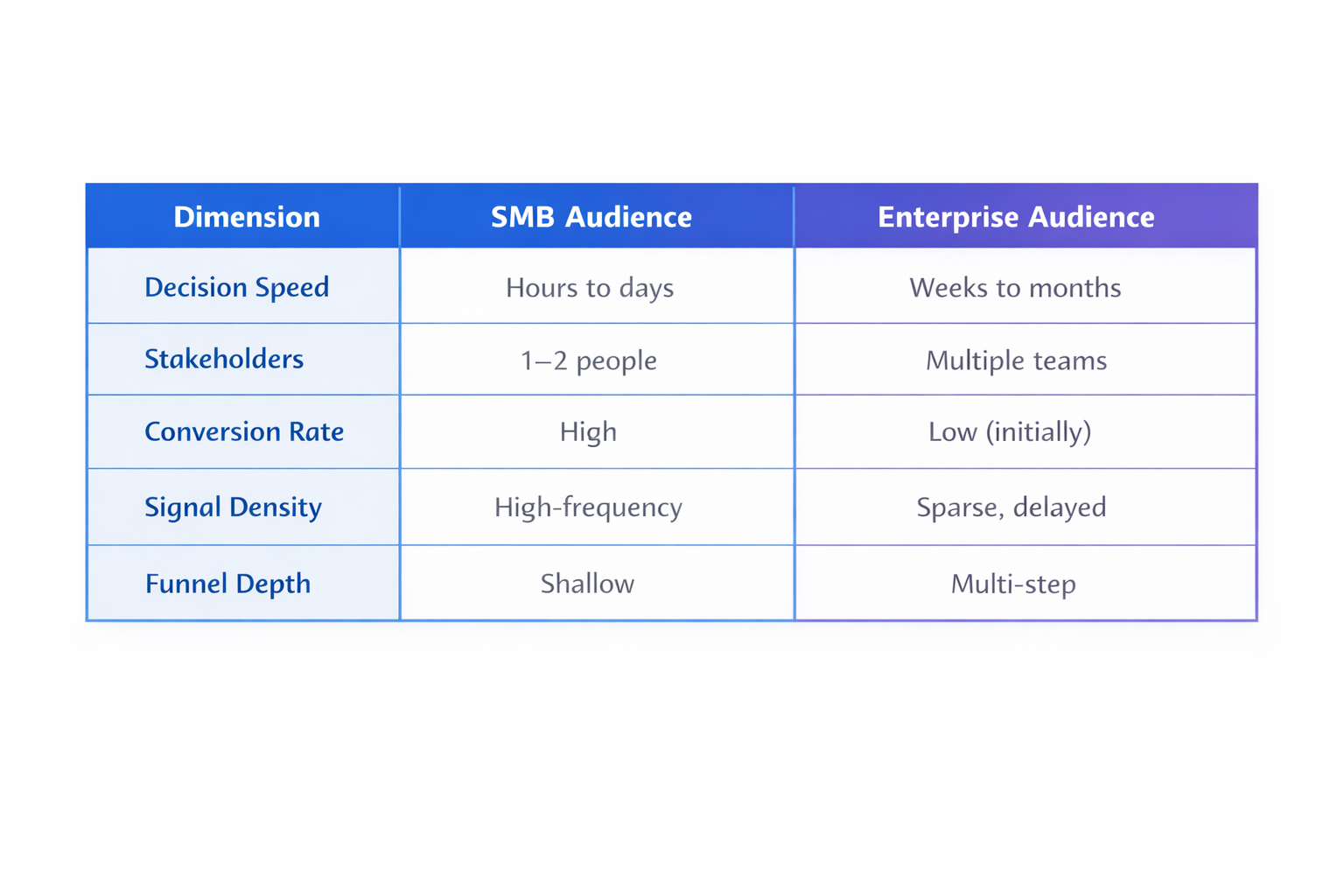
Here’s what the system actually reacts to:
-
Short conversion cycles create stronger feedback loops
SMB users often submit forms within the same session or day. That tight feedback loop allows the algorithm to quickly identify and replicate similar users. -
Higher conversion rates reduce delivery risk
With fewer decision-makers involved, SMB buyers convert more often. The platform interprets this as reliable performance and allocates more budget there. -
More frequent events stabilize optimization
When conversions happen consistently, the campaign exits learning faster and scales with fewer fluctuations.
Enterprise behavior breaks this pattern:
-
longer research phases;
-
multiple stakeholders;
-
delayed or offline conversions.
From the algorithm’s perspective, that looks like weak or inconsistent signal quality.
The Hidden Cost of SMB-Dominant Targeting
On the surface, SMB-heavy campaigns look efficient.
-
CPL decreases;
-
lead volume increases;
-
delivery stabilizes.
But downstream metrics reveal the issue.
You’ll typically see:
-
Low sales acceptance rates
Many leads don’t meet deal size or qualification criteria. -
Pipeline dilution
Even converted leads generate smaller opportunities or stall in early stages. -
Self-reinforcing optimization bias
The system keeps prioritizing SMB because those conversions validate its decisions.
This dynamic is similar to what’s described in Why Your Ads Get Clicks But No Sales: Fixing the Audience Misalignment — where strong top-of-funnel metrics hide deeper targeting issues.
Enterprise Targeting: Why It Feels Inefficient
Enterprise campaigns often get labeled as “underperforming” too early.
The issue isn’t performance — it’s signal visibility.
Here’s what actually changes:
-
Delayed attribution windows
Enterprise deals may take weeks to convert. During that time, the platform sees no confirmation signal. -
Lower observable conversion rates
Enterprise buyers often don’t submit forms immediately. They return multiple times or convert through different touchpoints. -
Fragmented user journeys
One stakeholder clicks the ad, another attends a demo, and a third signs the contract.
If you’re optimizing for immediate conversions, you’re effectively ignoring enterprise intent.
This is explained further in What Conversion Lag Means for Your Facebook Ads — where delayed signals distort how campaigns optimize.
Where Targeting Actually Breaks
Most teams try to fix this by adjusting audience filters. That rarely works. The real issue is signal design.
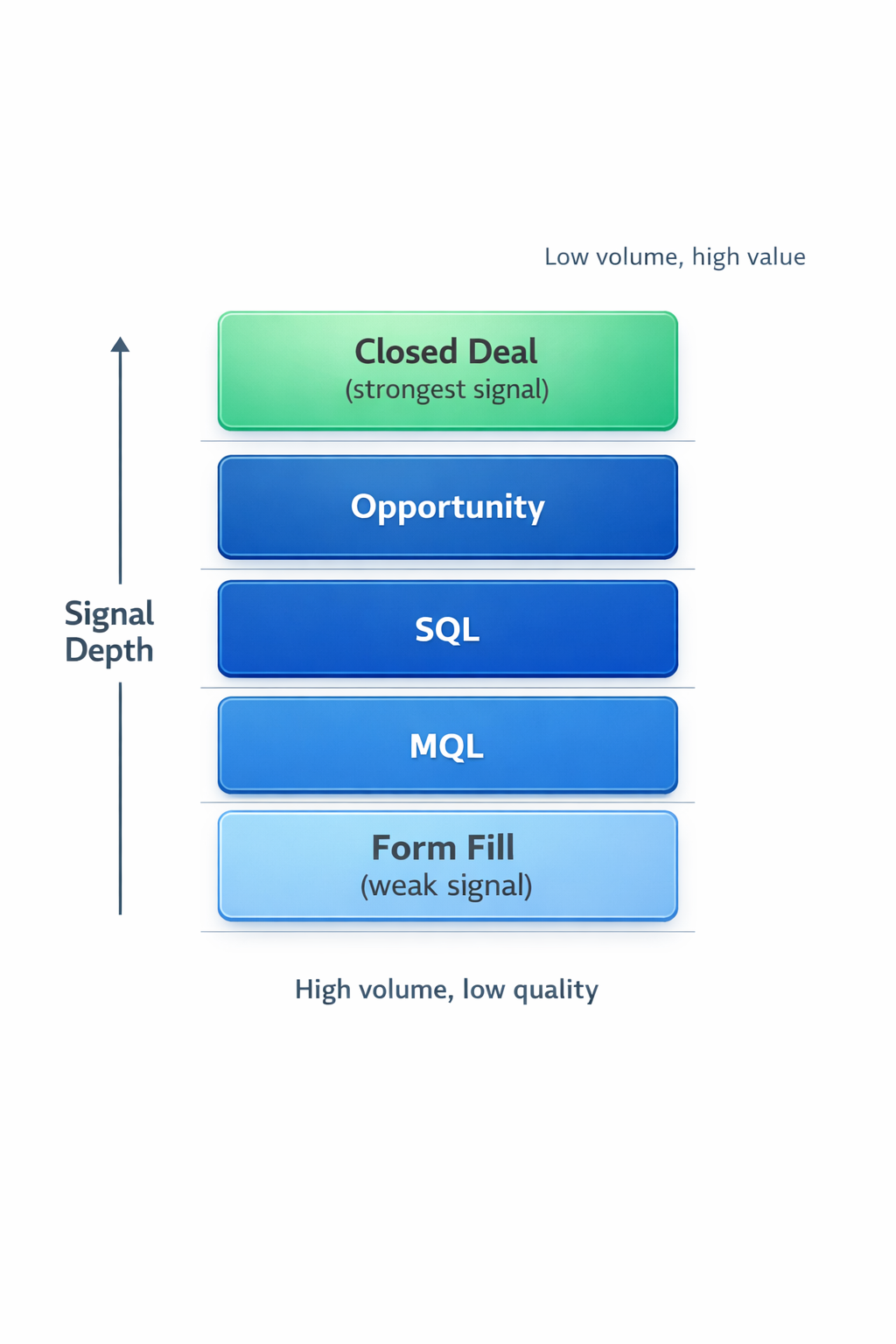
1. Conversion Events Are Too Broad
If every form fill counts equally, the system cannot distinguish between:
-
low-budget SMB inquiries;
-
high-value enterprise opportunities.
Without differentiation, the algorithm scales the easiest conversions.
2. CRM Data Isn’t Closing the Loop
Enterprise qualification usually happens after the lead is generated.
If that data stays in the CRM:
-
the ad platform keeps optimizing for shallow events;
-
high-quality outcomes never influence delivery.
This is why approaches like How to Use CRM Data to Build B2B Facebook Audiences That Convert are critical — they reconnect revenue signals with ad delivery.
3. Creative Attracts the Wrong Segment
Even with precise targeting, messaging can override audience intent.
For example:
-
“Start instantly” attracts SMB users looking for speed;
-
“Built for multi-team operations” filters toward enterprise buyers.
Creative acts as a pre-click qualification layer.
If it’s too broad, SMB traffic increases regardless of targeting.
A deeper breakdown of this can be found in How to Create Facebook Ads That Speak to Different Buyer Personas.
How to Separate SMB and Enterprise Effectively
This isn’t about narrowing audiences. It’s about restructuring how the system learns.
Segment Campaigns by Deal Intent
Running both segments in one campaign forces the algorithm to choose.
Instead:
-
isolate SMB and enterprise campaigns;
-
assign separate budgets;
-
evaluate them with different KPIs (volume vs quality).
This prevents signal contamination.
Optimize for Qualification, Not Just Conversion
Replace basic lead events with deeper signals:
-
sales-qualified leads (SQLs);
-
accepted opportunities;
-
pipeline creation events.
This aligns optimization with actual business outcomes.
Expect a temporary drop in volume — it’s a necessary tradeoff.
Use Creative as a Filtering Mechanism
Instead of maximizing clicks, design ads to repel the wrong audience.
Practical adjustments:
-
reference complexity (integrations, workflows);
-
mention scale (team size, budgets);
-
introduce friction (demo requests instead of instant access).
Lower conversion rate often means better targeting.
Align Landing Pages With Buyer Type
If your ad targets enterprise but the landing page feels SMB-focused, signals become mixed.
For enterprise pages:
-
include detailed product context and use cases;
-
show proof (case studies, ROI, integrations);
-
avoid overly simple forms that invite low-intent submissions.
The goal is filtering, not maximizing submissions.
Diagnostic Signals to Watch
You can identify SMB vs enterprise skew directly in Ads Manager.
Look for:
-
High CTR with weak pipeline quality
-
Stable CPL but declining acceptance rate
-
Fast (same-day) conversions dominating results
-
Low repeat engagement before conversion
These patterns often appear before revenue impact becomes obvious.
A Practical Way to Rebalance
You don’t need to rebuild everything.
A controlled shift works better:
-
Launch a separate campaign optimized for qualified leads.
-
Feed CRM-based outcomes back into the platform consistently.
-
Gradually reallocate budget based on pipeline quality, not CPL.
You’ll likely see:
-
fewer leads;
-
higher CPL;
-
stronger sales outcomes.
That’s the correct direction.
Final Takeaway
SMB vs enterprise targeting isn’t about audience size or filters. It’s about which signals your campaigns reinforce.
If you optimize for speed, you get SMB.
If you optimize for qualification, you eventually get enterprise.
The platform follows your feedback loop — not your intent.