Scaling a Facebook Ads campaign too early is one of the fastest ways to turn decent results into expensive results.
A campaign may look promising at low spend. CPC is acceptable. A few leads come through. Sales or purchases start to appear. Then the budget increases, delivery expands, and performance weakens.
The problem is often audience width.
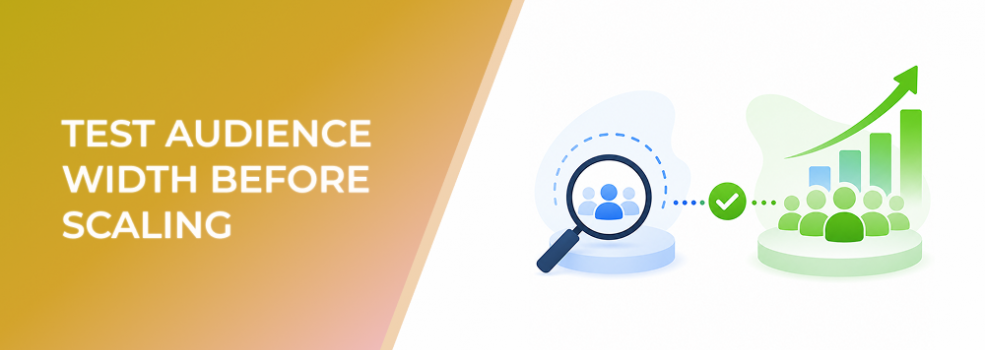
The campaign may not have proven whether the audience is broad enough to scale, narrow enough to stay relevant, or guided enough to produce qualified conversions. Before scaling, marketers need to test audience width deliberately.
The Problem
The problem is scaling before validating audience width.
Audience width describes how much room the campaign has to find relevant users. A broad audience gives Meta more exploration room. A narrow audience gives the campaign more direction. A guided audience sits between the two: it gives Meta room to optimize, but starts from stronger audience signals.
Many advertisers scale from whichever audience produced early signs of life. That is risky.
Early results can come from a small pocket of qualified users inside a broad audience. Once budget increases, the campaign may move into weaker segments. Early results can also come from a narrow audience that performs well at low volume but fatigues quickly when spend rises.
Without pre-scale testing, scaling becomes a stress test. The campaign discovers its audience limits after the budget has already increased.
Why This Problem Hurts Performance
Scaling untested audience width can hurt every major performance metric.
CPA may rise because the campaign starts reaching weaker-fit users. CAC may increase because the sales or purchase path becomes less efficient. ROAS may fall because additional spend finds lower-value buyers. Lead quality may drop because the campaign starts optimizing toward easier conversions instead of better customers.
It also creates operational problems.
Agencies may struggle to explain why a “winning” campaign stopped working after budget increased. Startup marketers may burn limited runway on audience expansion that was never validated. SMB owners may assume Facebook Ads “do not work” when the real issue was scaling the wrong audience structure.
Audience-width testing helps prevent those mistakes before they become expensive.
Common Scenarios Where This Happens
An ecommerce campaign performs well with a niche audience, but frequency rises quickly after budget increases.
A B2B campaign gets early demo requests from a guided audience, then broadens too fast and starts generating poor-fit leads.
A local business expands geography before proving that nearby high-intent segments are saturated.
An agency scales a client campaign based on low CPL, but downstream qualification rate drops after spend increases.
An affiliate marketer increases budget on a broad interest audience and sees clicks rise while payout-driving conversions stay flat.
Why the Problem Happens
This problem happens because advertisers often treat scaling as a budget decision instead of an audience decision.
They ask, “Can we spend more?” before asking, “Can this audience support more qualified delivery?”
Another cause is overreliance on early platform metrics. CPC, CTR, and CPL can suggest momentum, but they do not always reveal whether the audience can support profitable scale.
The problem also happens when campaigns lack a challenger audience. If there is only one audience in the account, marketers may scale it because there is nothing else to compare.
Finally, audience width is often confused with audience quality. A broad audience can be high quality if it has strong conversion signals and qualifying creative. A narrow audience can be weak if it is built from shallow assumptions.
The Solution
The solution is to run an audience-width validation test before scaling.
Start with your current best audience as the control. This may be broad, narrow, or guided. Then create one or two challenger audiences that differ mainly in width.
For example, if your current winner is narrow, test a guided expansion. Add related communities, adjacent profiles, similar customer traits, or broader professional criteria. If your current winner is broad, test a narrower high-intent audience to see whether relevance improves CPA or lead quality.
Keep the objective, offer, landing page, and creative theme consistent. The goal is to learn whether audience width changes business performance.
Use scale-readiness criteria. Before increasing budget, ask:
Does the audience produce conversions at an acceptable CPA?
Does lead or purchase quality hold up beyond the first few conversions?
Does frequency remain manageable?
Does performance rely on one small pocket of users?
Does the audience have logical adjacent segments for expansion?
Does the campaign produce clean retargeting traffic?
Meta’s own testing documentation supports comparing ad strategies across variables such as audience, and that same principle should guide pre-scale decision-making.
Once a width test produces a reliable winner, scale gradually. Increase budget in stages, expand to adjacent sources, and monitor downstream quality. Do not jump from a small narrow audience to a massive broad audience without a bridge.
How LeadEnforce Helps
LeadEnforce helps advertisers build better audience-width challengers before scaling.
If your current audience is broad, LeadEnforce can help create a narrower or guided challenger from Facebook groups, Instagram followers, LinkedIn job-title and company data, or custom social-profile sources.
If your current audience is narrow, LeadEnforce can help identify adjacent sources. For example, you might expand from one high-intent Facebook group to several related groups, from one Instagram niche profile to a cluster of similar profiles, or from one professional segment to a broader set of job titles and industries.
This is useful because scaling should not mean abandoning relevance. It should mean expanding from the strongest audience signal into the next most logical audience signal.
LeadEnforce is especially useful before budget increases, when the question is not “Can we spend more?” but “Where can we spend more without losing audience quality?”
Risks and Considerations
Audience-width tests can be misleading if you scale too quickly after one short test. Early results may reflect timing, creative novelty, or a small high-intent pocket.
A narrow audience may look best at first but lack long-term volume. A broad audience may look weak early but improve after Meta receives enough conversion signals. A guided audience may perform best only when the creative is specific enough.
Creative fatigue can also be mistaken for audience failure. If frequency rises and performance drops, check whether the message needs refreshing before replacing the audience.
Better targeting will not fix poor conversion tracking, weak landing pages, unqualified lead forms, unclear pricing, or a poor offer.
Prerequisites and Dependencies
You need a clear scaling goal. Scaling for lead volume is different from scaling for qualified pipeline, purchases, or ROAS.
You need baseline performance data. Do not scale an audience before you understand its normal CPA, conversion rate, lead quality, and frequency behavior.
You need enough budget to test at least one challenger audience properly.
You need creative that can work across the tested audience widths. Broad audiences often need clearer qualifiers, while narrow audiences often need more specific pain-point alignment.
If LeadEnforce is used, you need relevant source audiences that support expansion rather than random audience collection.
Practical Recommendations
Before scaling, classify your current audience as broad, narrow, or guided.
Build one challenger that expands or tightens audience width. Do not create too many ad sets at once.
Use downstream metrics as the scaling gate. For lead generation, prioritize qualification and sales acceptance. For ecommerce, prioritize purchase quality, AOV, CAC, and ROAS.
Scale from signal to signal. Move from one relevant source to adjacent sources instead of jumping immediately into undefined broad targeting.
Use LeadEnforce before scaling when you need more high-intent audience sources, cleaner seed audiences, or more relevant expansion paths.
Final Takeaway
Facebook Ads scaling should happen after audience width has been tested, not before.
A campaign that works at low spend may fail at higher spend if its audience is too narrow, too broad, or poorly guided. The fix is to validate audience width, compare challenger audiences, and scale from the strongest audience signals.
Join the free 7-day LeadEnforce trial period to build stronger audience-width tests before increasing your Facebook Ads budget.
Related LeadEnforce Articles
- Change Broad Facebook Ad Targeting Before It Wastes Budget — Explains how to make broad targeting more intentional before spend increases.
- How to Build High-Performing Custom Audiences in LeadEnforce — Useful for building focused audience inputs before scaling.
- Smarter Lookalikes: How to Use LeadEnforce to Reach High-Intent Audiences — Relevant for advertisers turning stronger seed audiences into broader expansion.
- Stop Facebook Ads From Reaching People Who Never Convert — Helps keep scaling decisions tied to conversion quality rather than volume alone.