Successful Facebook and Instagram advertising is rarely driven by tactics alone, regardless of how advanced targeting or creative execution may be. It is driven by a clear understanding of how users think, hesitate, and progress toward a buying decision over time.
Most users do not convert after seeing a single ad, even when the offer is relevant and professionally presented. Instead, they move through a series of psychological stages that shape how they interpret messages, assess risk, and decide when to act.
Advertisers who align campaigns with these stages typically see more stable performance and clearer optimization signals. Those who ignore them often face inconsistent results, rising costs, and unexplained drop-offs.
Why Psychological Stages Matter in Paid Social Advertising
People do not open Facebook or Instagram with the intention of researching products or comparing vendors. They open these platforms to consume content, stay connected, or briefly disengage from work and decision-making.
Advertising interrupts that mindset, which means relevance must be psychological rather than purely demographic or behavioral. If an ad does not match the user’s mental state, it is dismissed before the message is fully processed.
Understanding psychological stages allows advertisers to meet users where they actually are, rather than forcing them toward an outcome too soon.
How Users Progress Toward a Buying Decision
Before committing to a purchase, users typically experience a series of internal shifts that change how they evaluate information, credibility, and risk. Each shift reflects a different balance between curiosity, skepticism, and motivation.
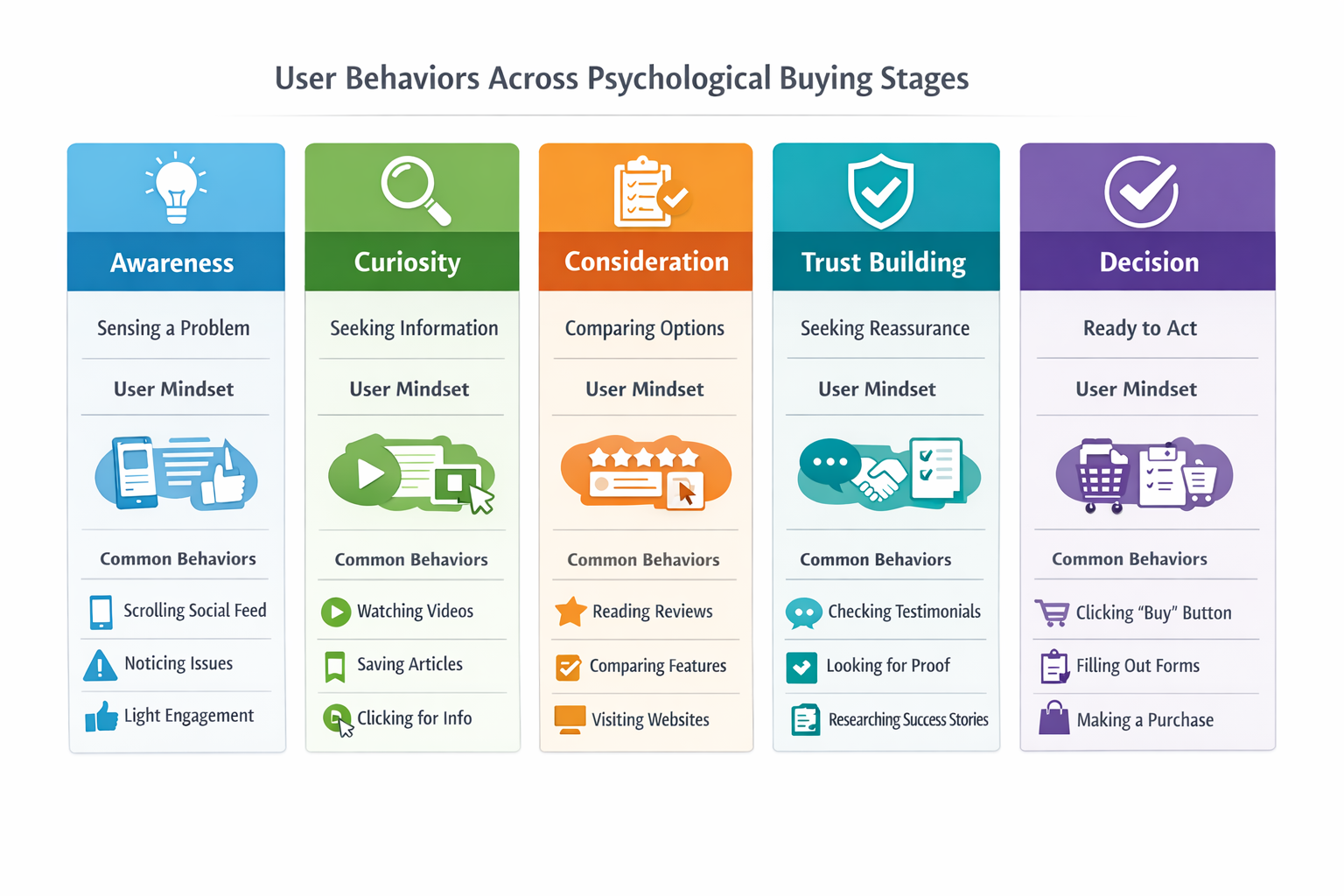
These stages are not strictly linear, and users may pause, repeat steps, or move backward depending on timing, budget constraints, or competing priorities. However, the sequence itself is highly consistent across industries and price points.
| Psychological Stage | User Mindset | Primary Goal | Common User Behavior |
|---|---|---|---|
| Awareness | Sensing a problem | Understand what’s wrong | Scrolling, light engagement |
| Curiosity | Seeking explanations | Learn without committing | Watching videos, saving posts |
| Consideration | Comparing options | Evaluate fit | Clicking, reading, revisiting |
| Trust Building | Reducing perceived risk | Feel confident | Looking for proof, reviews, reassurance |
| Decision | Choosing action | Move forward or delay | Converting, postponing, or returning later |
Most buying journeys include the following psychological stages:
-
Awareness, when users sense a problem or inefficiency but are not yet looking for solutions.
-
Curiosity, when users begin exploring information without any intention to commit.
-
Consideration, when users actively compare approaches, tools, or providers.
-
Trust building, when users assess credibility, risk, and reliability.
-
Decision, when users choose to act immediately or delay intentionally.
Recognizing this progression helps advertisers align messaging with intent instead of pushing conversions prematurely.
These stages are not strictly linear, and users may pause, repeat steps, or move backward depending on timing, budget constraints, or competing priorities.
This is why mapping intent before launching campaigns is critical, a process explained in detail in
How to Map the Customer Journey Before Launching Ad Campaigns.
Stage 1: Awareness — Recognizing a Problem
At the awareness stage, users are not thinking about products, services, or vendors. They are reacting to a vague sense that something in their business or marketing efforts is not working as expected.
This discomfort usually shows up as symptoms rather than clear diagnoses, such as inconsistent performance, rising ad costs, or unclear reporting. Users feel frustration but lack clarity.
Effective awareness-stage advertising helps users name the problem they are already experiencing. It creates recognition and relief rather than urgency or pressure.
Common awareness-stage triggers include:
-
Seeing ad spend increase while results stay flat.
-
Feeling confused by platform data or reporting changes.
-
Noticing competitors scale while their own campaigns stall.
Stage 2: Curiosity — Exploring Without Commitment
Once users recognize a problem, curiosity begins to develop naturally. They start paying closer attention to content that explains why the issue exists or why previous attempts failed.
At this stage, users are open to learning but resistant to persuasion. They want understanding before they are willing to consider change.
Curiosity-driven behavior often looks like passive engagement rather than action, including:
-
Watching educational videos longer than promotional ones.
-
Saving posts or ads for later review.
-
Clicking profiles or landing pages without converting.
Stage 3: Consideration — Actively Evaluating Options
During the consideration stage, users become more intentional and analytical. They are no longer asking whether a problem exists, but whether a specific approach fits their situation.
Their focus shifts toward relevance, differentiation, and practicality. Generic benefits and broad promises lose effectiveness quickly.
| Stage | Ad Objective | Message Focus | Example Angle |
|---|---|---|---|
| Awareness | Attention | Name the problem | “Why scaling feels random” |
| Curiosity | Education | Explain the cause | “Why most tests fail” |
| Consideration | Evaluation | Show differentiation | “How this approach works” |
| Trust Building | Reassurance | Reduce risk | “What to expect realistically” |
| Decision | Action | Remove friction | “What happens after you click” |
Users typically evaluate options based on factors such as:
-
Applicability to their business model, such as e-commerce or lead generation.
-
Expected outcomes, including stability, efficiency, or predictability.
-
Trade-offs, such as time investment, budget, or operational complexity.
At this stage, users also begin displaying behavioral signals that separate casual interest from real buying intent, which is why recognizing behavioral patterns that predict high-value customers can dramatically improve targeting and messaging decisions.
Stage 4: Trust Building — Reducing Perceived Risk
Even when users see relevance and value, hesitation remains strong. Trust becomes the primary barrier to action.
At this stage, users focus less on upside and more on avoiding mistakes, wasted budget, or repeated disappointment. Emotional risk often outweighs logical evaluation.
Trust-building messages should reduce uncertainty by addressing concerns such as:
-
How the process works in practice, not just in theory.
-
What results realistically look like over time.
-
What limitations or constraints exist.
Stage 5: Decision — Choosing Action or Delay
The decision stage does not always lead to immediate conversion. Many users delay action even when they are convinced of value.
Delays often happen because the next step feels unclear, inconvenient, or risky. Doing nothing feels safer than making a wrong choice.
Decision-stage ads should remove friction rather than add pressure by focusing on:
-
Clear calls to action with one obvious next step.
-
Transparent explanations of what happens after clicking.
-
Confidence-building reassurance rather than urgency alone.
Decision-stage behavior is often influenced by subtle psychological triggers rather than overt incentives. Certain moments, messages, or reassurances can significantly increase order value, as outlined in the buyer journey triggers that predict larger orders.
How Psychological Stages Influence Campaign Structure
A single campaign cannot effectively address every psychological stage at once. Each stage requires different messaging, creative formats, and optimization goals.
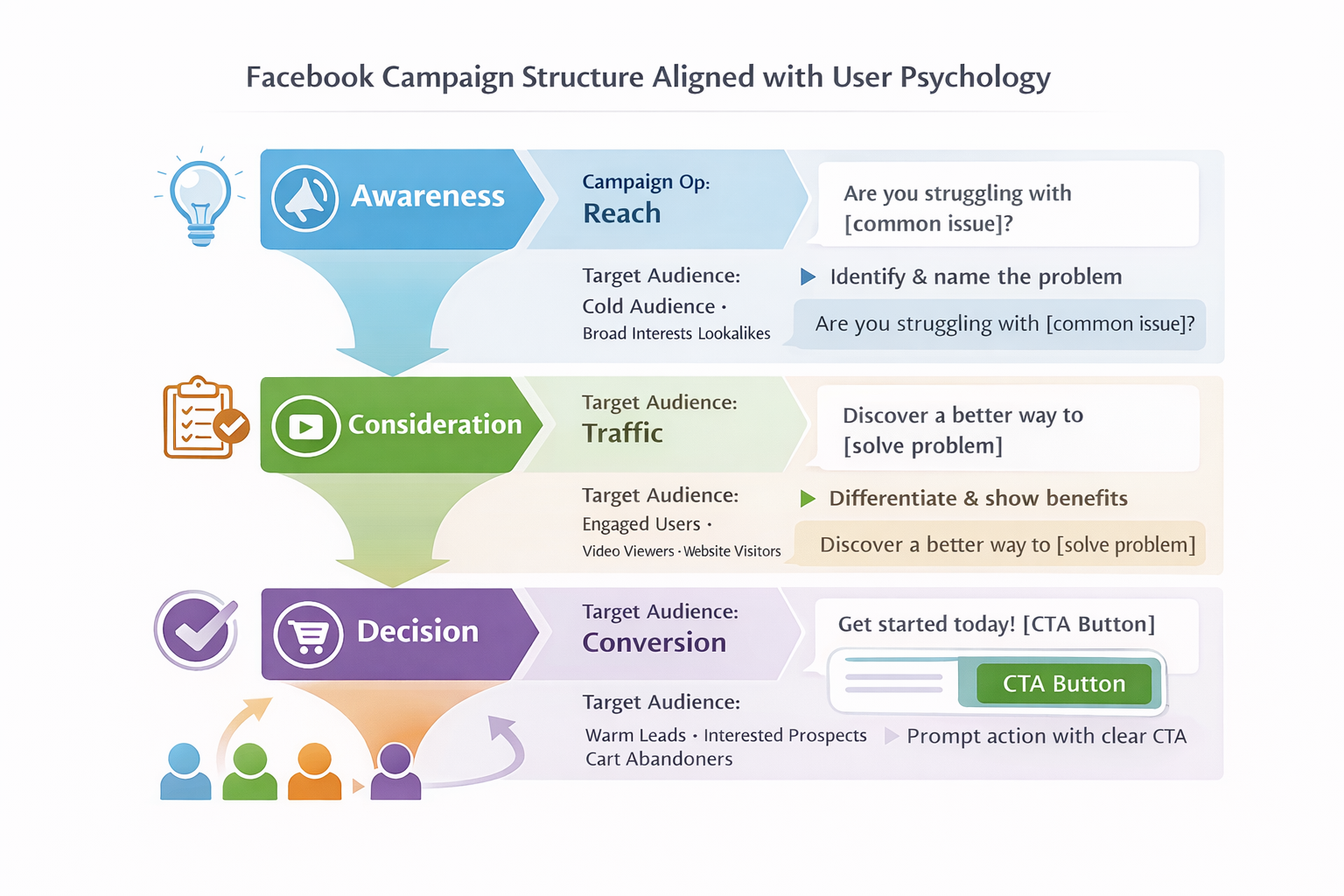
Advertisers who structure campaigns around intent rather than platform features gain clearer signals and more predictable performance. They also reduce fatigue caused by mismatched messages.
| Mistake | Stage Being Skipped | Why It Fails | Better Alternative |
|---|---|---|---|
| Selling to cold traffic | Awareness | No trust or context has been established | Start with problem-focused awareness ads |
| Overusing urgency | Trust Building | Increases fear and resistance | Add clarity, reassurance, and proof |
| One campaign for all users | All stages | Message does not match user intent | Segment campaigns by psychological stage |
A psychologically aligned structure often includes:
-
Awareness campaigns optimized for reach and engagement.
-
Consideration campaigns targeting users who previously interacted.
-
Conversion campaigns focused on warm or high-intent audiences.
This structure reflects how users naturally think and decide.
Aligning Creative With User Psychology
Creative effectiveness depends heavily on timing and context. A message that resonates at one stage can create resistance at another.
Effective creative alignment usually follows this progression:
-
Awareness creatives focus on problems and patterns users recognize.
-
Consideration creatives explain mechanisms, frameworks, or comparisons.
-
Decision creatives emphasize clarity, reassurance, and ease of action.
Consistency across stages builds familiarity, which lowers resistance over time.
Measuring Performance Across Psychological Stages
Evaluating all campaigns using conversion metrics alone leads to distorted conclusions. Each psychological stage serves a different role in the buying process.
Stage-appropriate metrics include:
-
Awareness: engagement quality, video retention, and reach relevance.
-
Consideration: click-through rate, saves, and on-site behavior.
-
Decision: conversion rate, cost per acquisition, and follow-up actions.
When metrics align with intent, optimization becomes strategic rather than reactive.
Final Thoughts: Advertising Is a Psychological Process
Paid social advertising is not a mechanical system driven by settings alone. It is a psychological process shaped by attention, trust, and timing.
Users need guidance as they move toward decisions, not pressure to act prematurely. Ads that respect this progression feel helpful rather than intrusive.
When campaigns align with psychological stages, performance becomes more predictable and scalable. Understanding user psychology is not optional; it is the foundation of effective Facebook and Instagram advertising.