Running ads that “just work” is rare. Most campaigns stall after initial wins. Performance drops. Budgets get paused. Everyone blames the creative.
But it’s not usually the ad.
The real reason campaigns fail — even with decent creative and decent targeting — is because deeper system-level problems were never fixed. ROI doesn’t come from hacks. It comes from structure.
This article breaks down the less obvious, but far more important drivers of paid advertising ROI — especially when you’re scaling across Facebook and Instagram.
Why your ad results decline over time — even if the creative is strong
Let’s start with a reality check. If your ads used to perform but don’t anymore, it’s likely not because your audience “got tired of them.” It’s because your system never adapted.
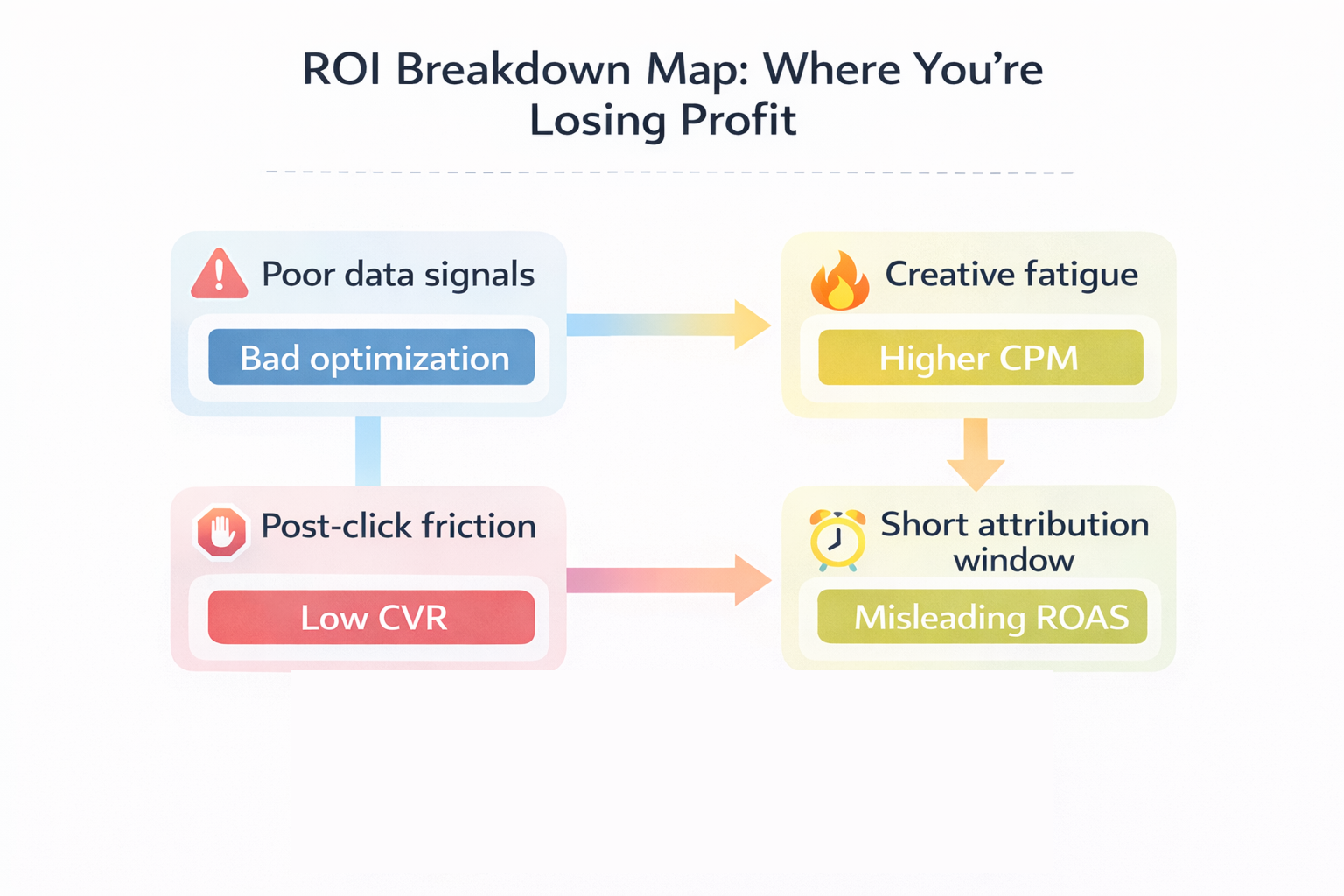
Here are some of the deeper causes that quietly destroy ROI over time:
-
Signal loss: As your budget scales, the platform has less precise data to optimize. You lose relevance.
-
Premature judgments: Ads that convert slowly get cut too early, even if they would’ve paid off.
-
Creative entropy: Winning creative decays faster than you expect — especially if you’re running the same top-performers without variation.
-
Post-click friction: A great ad can't save a landing page that confuses or slows down the user.
These aren't surface-level issues — they're structural. And unless you address them, you'll keep relaunching the same problems in new formats. Learn how to diagnose these issues quickly in this campaign performance troubleshooting guide.
Strong ROI starts with structured data
Before you even talk about scaling ads, you need to get your measurement infrastructure right. Otherwise, your data lies to you.
A lot of advertisers think their tracking is “fine.” But most accounts, especially legacy ones, have gaps — and those gaps quietly destroy ROAS.
Let’s break this down.
First, fix the data layer
Most performance loss starts here. If the platform can’t correctly track who buys, or when, it can’t learn what’s working.
Check for common signal issues like:
-
Missing events: Add-to-cart and purchase events that don’t always fire.
-
Improper deduplication: Pixel and server-side events double-counting conversions.
-
Weak match quality: Low email or phone match rates due to missing data inputs.
To build a stronger foundation, make sure your tracking setup captures key events reliably and sends clean, deduplicated signals back to the platform.
Your learning velocity matters more than your spend
Most brands optimize for efficiency. But the best advertisers optimize for insight velocity — how fast they learn from each campaign cycle.
Instead of chasing one “winning ad,” you need to build a testing system that keeps producing winners.
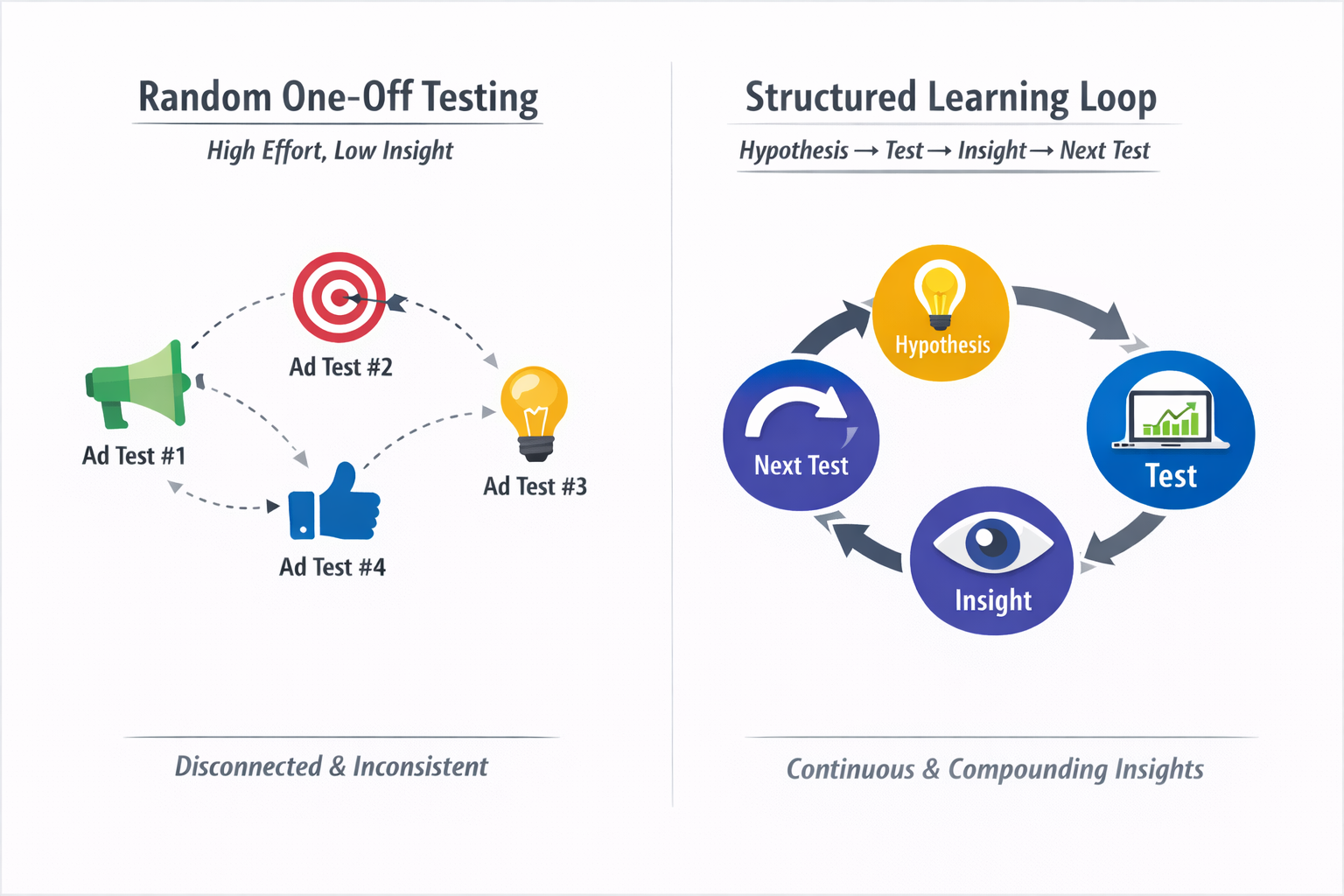
Shift your mindset from picking winners to running experiments
That means treating every test as a tool to learn — not just to win.
Each campaign should answer a question:
-
Did the emotional pitch outperform the logical one?
-
Which format (Reels, Stories, static) drives lower CAC for the same message?
-
Does price transparency increase or reduce conversion?
Even when a test “fails,” the learning is valuable. It tells you what not to scale — and why.
Also: don’t confuse fast performance with long-term potential. Some of your best long-game ads won’t be obvious in day-one metrics.
Let your tests run long enough to see if they're compounding — especially in prospecting campaigns. For practical testing frameworks that scale, read this article on creative testing systems.
Don’t let hidden ROI killers drain your ad budget
You can have a great offer, a sharp team, and beautiful creative — and still lose money if certain invisible blockers are in place.
Let’s look at a few silent killers of ROI most teams overlook:
1. Funnel latency
Not all products convert instantly. But many campaigns are optimized like they should.
When you only look at 1-day click performance, you cut ads before delayed buyers show up. This especially hurts:
-
Products over $75–100;
-
Subscriptions with trial periods;
-
Considered purchases (wellness, coaching, B2B).
To fix this, study your actual conversion timeline. If users often buy after 3–7 days, you need to:
-
Use longer attribution windows;
-
Delay retargeting sequences;
-
Evaluate cold campaigns on 7-day (or longer) returns.
For a detailed breakdown, see this article on Facebook attribution windows.
2. Post-click experience issues
If people click but don’t convert, the problem isn’t the ad — it’s what happens after.
Common issues that destroy intent post-click include:
-
Slow mobile load times — especially with videos, carousels, or animations;
-
Unclear messaging — if the landing page doesn’t match the promise made in the ad;
-
Overwhelming layout — too many CTAs, conflicting headlines, or confusing navigation;
-
Trust gaps — lack of reviews, unclear return policies, or unexpected shipping costs.
To improve this area, explore post-click optimization tactics.
3. Operational drag
Many performance problems come from internal delays — not ad-level decisions.
Common bottlenecks include:
-
Creative teams that only ship new ads once a month;
-
Decision-makers who take too long to approve spend;
-
No clear calendar for testing or scaling decisions.
If you want compounding results, you need compounding execution.
Build operational clarity:
-
Run weekly sprints — not monthly “launches”;
-
Assign one owner to each campaign phase;
-
Log not just ad metrics, but campaign insights each week.
How advanced advertisers scale ROI over time
Advertisers who consistently scale past $10K, $50K, or $100K/month in ad spend almost always do a few things differently.
Let’s break down what sets them apart.
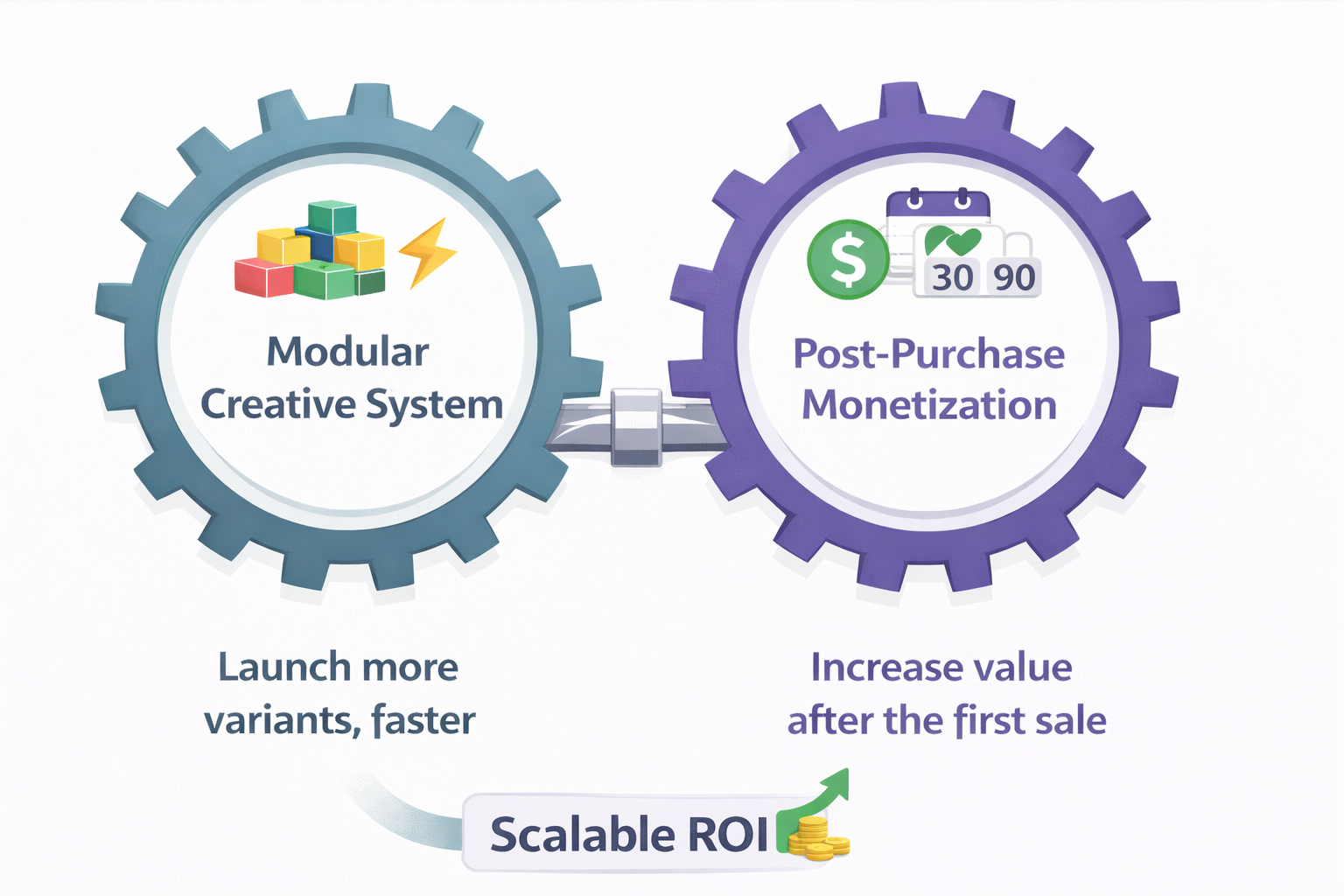
1. They build modular creative systems
Instead of making 5 fully finished ads, advanced teams build creative components that can be mixed and matched — headlines, hooks, proof elements, product shots.
This lets them launch 20+ variants from the same base set — and refresh weekly with minimal overhead.
Benefits of this modular approach include:
-
Faster iteration on what’s working;
-
Easier adaptation across formats (Reels, Stories, Feed);
-
Lower creative fatigue since elements stay fresh.
Think of it like building with LEGO blocks — instead of re-sculpting clay every time.
For structure inspiration, here’s a guide on how to build creative banks for faster launches.
2. They monetize after the first conversion
ROI doesn’t end at the checkout page. Most of your profits will come post-purchase.
The highest-performing advertisers use:
-
Upsells at checkout to increase average order value;
-
Post-purchase sequences via email and retargeting to lift lifetime value;
-
Winback campaigns at 30–60–90 days to drive repeat sales.
Even breakeven cold campaigns can become profitable with strong post-purchase flows.
If you’re only tracking front-end ROAS, you’re flying half-blind.
Final takeaway: ROI is operational, not inspirational
You don’t need better ideas. You need a better system.
ROI doesn’t come from luck, algorithms, or even brilliant creative. It comes from clean data, structured learning, and tight execution.
To build high-return campaigns consistently:
-
Audit and improve your signal quality;
-
Stop optimizing too early — track delayed value;
-
Reduce post-click friction before touching the ads;
-
Work in weekly testing cycles — not bursts;
-
Build modular creative that refreshes fast;
-
Treat campaigns as systems — not stunts.
The brands that scale profitably aren’t more creative. They’re just more consistent.