Most Facebook and Instagram advertisers still optimize for revenue or cheap conversions. That can make Ads Manager metrics look strong. It does not guarantee that your campaigns grow real profit.
Value-based optimization changes what the algorithm learns from. Instead of chasing "more purchases", it learns to chase "more valuable purchases". If you define "value" as profit or a proxy for profit, Meta starts working for your bottom line.
What value-based optimization changes in your Meta campaigns
Value-based optimization does not need new campaign types. It changes the numbers you send with your existing conversion events.
Today, many accounts send:
-
The same value for every lead or purchase; for example, 1 for each lead, 50 for each order.
-
Raw revenue as the value; for example, the order total including tax and shipping.
With value-based optimization, you instead send:
-
A value that reflects profit or long-term value, not just order size.
-
Different values for different customers, products, and actions, based on your own data.
Meta then prioritizes impressions that tend to create high-value events. This is the core idea behind profit-based bidding.
Why revenue optimization hides profit problems
On the surface, optimizing for revenue or purchase count feels logical. In practice, it often pushes the algorithm toward the wrong areas of your catalog and funnel. Many advertisers fall into the ROAS trap, where strong ROAS hides weak profit; see The ROAS Trap: Why High ROAS Isn’t Always Profitable.
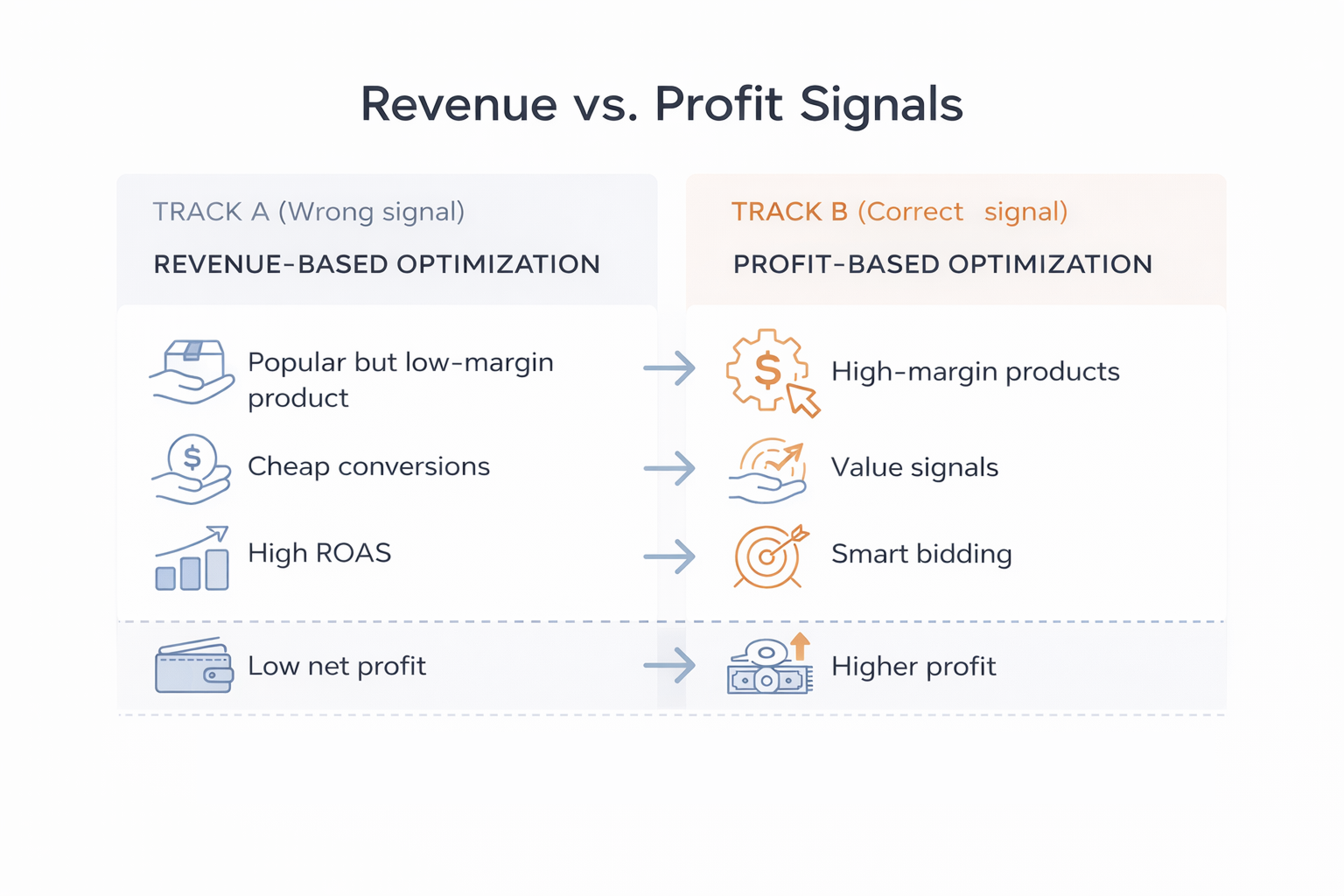
Revenue-based bidding often pushes low-margin "winners". These products sell easily, so the algorithm gives them more budget. But they might leave very little money after costs, discounts, and returns.
It can also overspend in expensive markets. If shipping or fees are much higher in some countries, true profit is lower but the algorithm doesn’t see it.
And it tends to attract discount-driven buyers who rarely purchase again at full price.
A revenue-optimized account often shows:
-
Stable or rising ROAS in Ads Manager.
-
Flat or decreasing profit in your finance reports.
Value-based optimization fixes this gap by teaching the system what "value" really means inside your business.
Step 1: define "value" in your business
Move from revenue to contribution margin
Contribution margin is a clearer measure of real profitability than revenue. It tells you how much money is left after variable costs.
Contribution margin = revenue − product cost − payment fees − shipping and packaging.
You can start with averages, such as 40% product cost and 6% fees, and refine later using SKU-level costs. Even a rough contribution margin beats using pure revenue.
Include risk, not only price
Two identical revenue orders may have different risk profiles. Returns, chargebacks, and fraud cut into profit.
You can adjust event values by:
-
Decreasing values for high-return categories.
-
Discounting risky payment methods.
-
Lowering value from regions with recurring fulfillment issues.
The goal is not precision — it’s directional accuracy.
Handle tax, vouchers, and fixed costs carefully
Many advertisers inflate values by including tax and shipping. But these rarely increase margin. This also shows why platform metrics often fail to match actual business outcomes, as explained in Why Facebook Ads Data Alone Can’t Explain True ROI.
Exclude taxes, subtract discounts, and treat shipping recovery separately. Fixed costs remain outside the value model because Meta optimizes marginal decisions.
Step 2: feed profit signals into Facebook and Instagram
Once you define "value", the next step is feeding it into Meta clearly and consistently.
Ecommerce: profit-based purchase values
Sending profit — not revenue — as the Purchase value is the simplest and most effective improvement.
In practice:
-
Map SKU-level profit margins.
-
Sum profit across all items in the cart.
-
Adjust for discounts and category-level return risk.
If real-time margin calculation isn’t ready, you can temporarily send a fixed fraction (e.g., 50% of revenue) as a proxy.
Lead generation: value tiers instead of "one lead = one value"
Lead gen funnels often hide huge differences in lead quality. You can improve Meta’s learning by giving higher values to higher-quality leads.
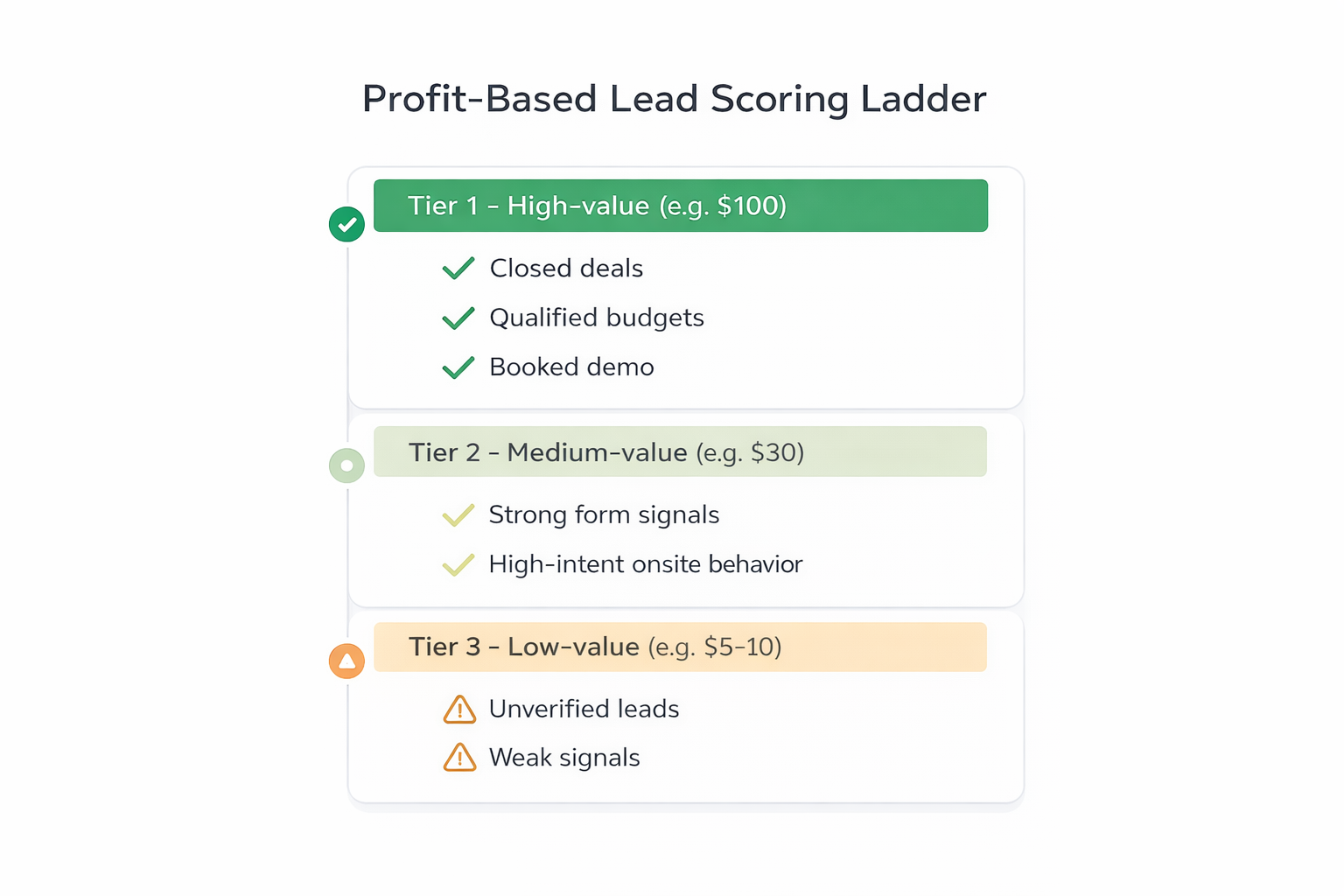
Example tiers:
-
High-value leads (closed deals) = 100
-
Medium-value = 30
-
Low-value = 5–10
Then add behavioral or qualification signals such as:
-
Budget indicators in form answers.
-
Booking a call.
-
Trial activation or onboarding steps.
Meta will gradually shift spend toward the leads sales teams prefer.
Subscription and repeat purchase models
Subscriptions capture most of their profit after the first payment. A simple fix is multiplying the first-month margin by the average retention period. More advanced setups send renewal events with their own margin values.
For advertisers implementing deeper LTV models, see Leveraging Customer Lifetime Value (LTV) for Facebook Ads Targeting.
Backend signals and offline conversion uploads are critical for these models.
Step 3: design bidding strategies around profit
After you feed better values, you can choose bidding strategies that match your economics.
Choosing between "maximize value" and target ROAS
"Maximize value" gives Meta freedom to explore and is ideal during calibration. Target ROAS is for when you know your margins and want predictable economics.
A practical workflow:
-
Start with maximize value while validating data.
-
Switch to tROAS at a safe, conservative level.
-
Slowly raise the target in controlled increments.
Structuring campaigns by economics, not only audience
Avoid mixing products with different economics inside the same optimization bucket.
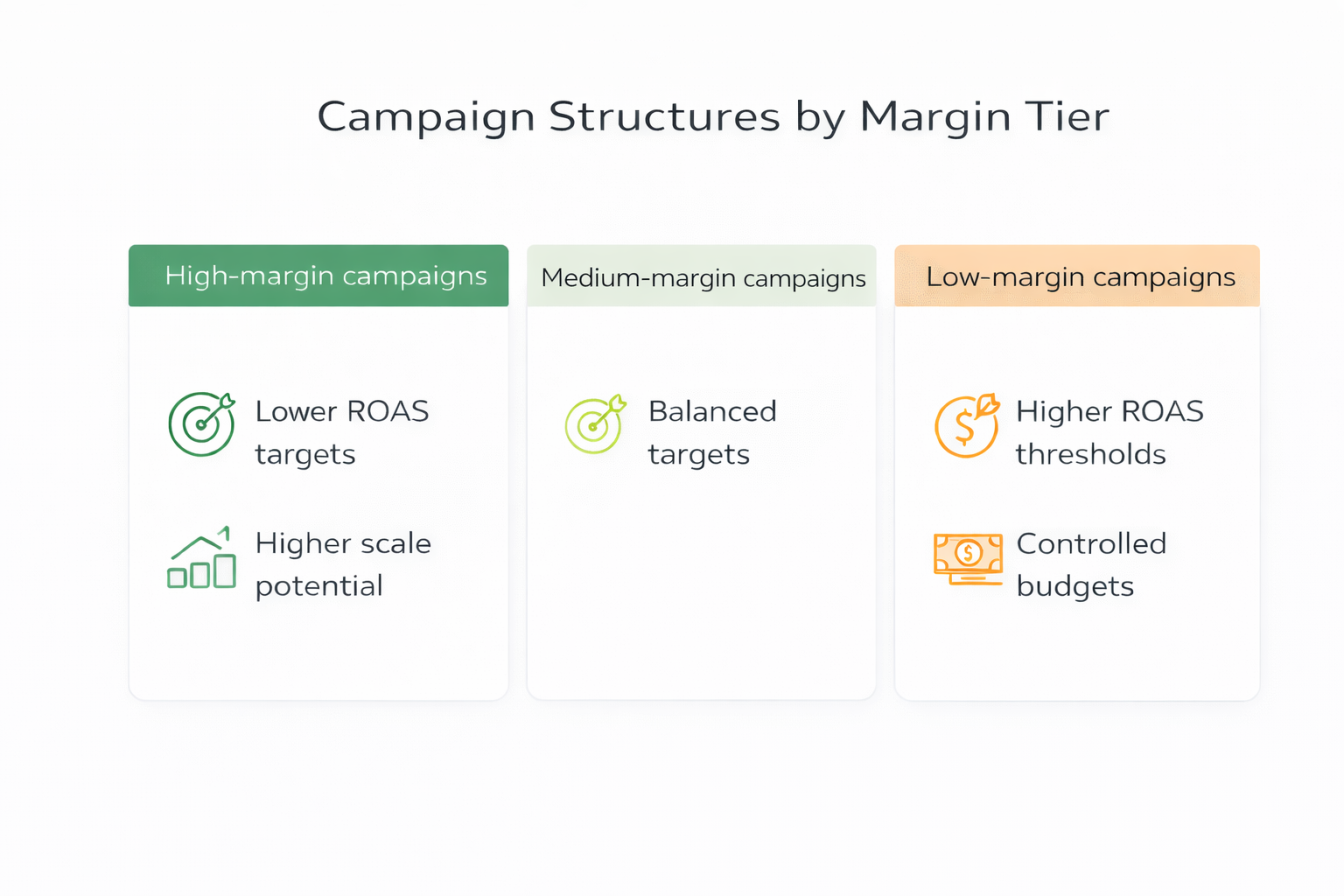
You can structure campaigns by:
-
Margin tiers.
-
LTV tiers.
-
Regions with different cost structures.
This prevents Meta from allocating budget to cheap-to-convert but low-margin items.
Managing learning and volatility
Profit-based optimization produces more variable values than revenue-based systems.
To maintain stability:
-
Keep budget changes under 20–30%.
-
Give each change at least one learning cycle.
-
Track profit metrics outside Ads Manager.
If you lack volume, optimize for earlier signals (e.g., qualified leads) and feed final profit via offline events.
Step 4: measure success with profit-focused metrics
Classic metrics will shift once you move to profit-based bidding. Lower ROAS or higher CPA might still be paired with higher net profit.
You can build a stronger measurement model using guidance like How to Measure True ROI From E-Commerce Advertising Campaigns.
Build a clean baseline
Track contribution margin, profit per order, and profit by campaign before switching optimization strategies.
Use incrementality tests
Run:
-
Region-based split tests.
-
Time-sliced comparisons.
-
Audience holdouts.
These help you understand true incremental profit beyond Ads Manager numbers.
Diagnose “worse” metrics with context
Ask:
-
Did average order margin increase?
-
Are new customers higher LTV?
-
Is product mix shifting toward higher-margin items?
If yes, performance is improving — even if surface metrics look worse.
Step 5: connect profit insights with GEO and SEO
Value-based optimization helps identify which audiences, intents, and pages produce meaningful profit.
Use high-value signals to refine audiences
Patterns will emerge in:
-
Interests and behaviors that over-index in high-margin purchases.
-
Creative angles that attract high-LTV buyers.
-
Placements where profit-based ROAS is strongest.
Let profitable intents shape SEO and content
Use your profitable queries and behaviors to:
-
Build more aligned landing pages.
-
Improve keyword targeting.
-
Write content that answers profitable user questions.
Fix landing pages that produce low-value customers
A landing page with great CPA but poor margin still underperforms. With profit data, you can redesign, reposition, or replace these pages.
Practical tips and examples for Meta advertisers
Quick wins for ecommerce
-
Remove tax and shipping from event values.
-
Use a margin factor as an interim solution.
-
Create dedicated campaigns for high-margin collections.
Quick wins for B2B and lead gen
-
Use "lead" and "qualified lead" as separate valued events.
-
Give booked calls a strong value bump.
-
Upload offline events like opportunities created.
Operational habits that support profit-based bidding
-
Update margin assumptions monthly.
-
Tag campaigns by margin tier.
-
Review profit metrics regularly — not just CPA or ROAS.
Rollout checklist for value-based optimization
Week 1–2: map economics
Define your value model, risk adjustments, and success metrics.
Week 3: implement and test tracking
Verify values in Test Events and cross-check totals.
Week 4–6: roll out profit-based bidding
Move budget gradually. Track profit and volume closely.
Stability issues often appear around week two, similar to patterns described in Why Your Facebook Ads Stop Performing After Two Weeks and How to Fix It.
Final thoughts
Meta’s algorithm is very good at hitting the goal you give it. If that goal is raw revenue or lead count, it will optimize for those. Value-based optimization is about giving it a better goal that reflects how your business actually makes money.
When your event values align with your true economics, Meta begins to prioritize the customers, regions, and products that generate real margin, not just impressions or cheap conversions. If you want to understand why revenue-facing metrics alone often mislead advertisers, Leadenforce breaks this down in Why Facebook Ads Data Alone Can’t Explain True ROI.
The goal is simple: reshape your optimization so that every budget decision pushes toward higher profit, stronger customer quality, and long-term growth.