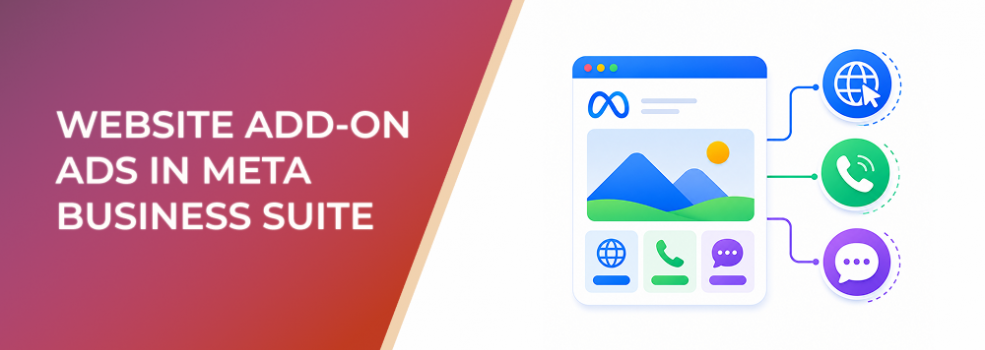
Website traffic campaigns often fail for a simple reason: not every buyer wants to convert through a landing page.
Some users want to read details. Some want a quick answer. Some want to call. Some prefer WhatsApp or messaging before they commit.
Website add-on ads in Meta Business Suite can support that reality by giving users more than one response path. But extra options only help when the audience, offer, and follow-up process are ready.
Otherwise, the campaign can generate more activity without better outcomes.
What website add-on ads are trying to solve
A standard website ad assumes the website is the best next step for every user.
That is not always true.
For service businesses, high-ticket products, B2B consultations, local advertisers, and ecommerce brands with complex products, a direct contact option can reduce friction. A user may need pricing clarification, appointment availability, fit confirmation, delivery details, or a human answer before taking the next step.
A website add-on can support multiple paths: website visit, phone call, WhatsApp conversation, or another direct response action depending on setup and availability.
The campaign question changes from “How many people clicked?” to “Which response path created useful intent?”
Business impact on CPC, CPA, CAC, ROAS, and lead quality
Website add-ons can improve budget efficiency when they help users choose the right conversion path.
A prospect who is ready to call may be wasted on a long landing page. A buyer who needs details may be better served by the website. A user comparing options may prefer WhatsApp before making a decision.
When response paths are aligned, advertisers may see better conversion performance, stronger lead quality, and more useful campaign learning.
But if the setup is weak, CAC can rise quickly. Calls may come from unqualified users. WhatsApp messages may go unanswered. Website visitors may bounce because the landing page does not match the ad promise.
The business impact depends on whether direct response options produce qualified outcomes, not just more interactions.
Typical scenarios where this applies
Local service businesses
Clinics, salons, repair companies, contractors, and appointment-based businesses often benefit from letting users call or message immediately.
High-consideration products
When customers need help with sizing, compatibility, pricing, availability, or customization, a direct message option can reduce hesitation.
B2B consultations
A website can explain the service, while a call or message path helps prospects ask about fit, scope, or next steps.
Time-sensitive offers
When booking windows, availability, or deadlines matter, direct response options can capture intent before users delay.
Agencies managing client lead quality
Website add-ons can help agencies compare whether website visitors, callers, or message leads produce better downstream results.
Risks and considerations
The biggest risk is operational readiness.
A call option is only valuable if calls are answered. A WhatsApp option is only valuable if messages receive timely, useful replies. If the business cannot handle direct response, the campaign may pay for intent and then lose it.
Another risk is low-quality contact volume. If the ad copy is broad, users may call or message with irrelevant questions. That wastes sales time and makes CPA look worse after qualification.
Mixed messaging is also common. If the ad promises one thing, the website says another, and the call handler gives a third answer, conversion performance suffers.
Finally, advertisers should not assume every direct interaction is valuable. A higher volume of messages or calls may still produce poor CAC if those conversations do not become quotes, demos, bookings, or sales.
Prerequisites and dependencies
Before using website add-ons, confirm:
- The website page matches the ad promise.
- The phone number or messaging channel is correct.
- The team can respond during the promoted window.
- The offer is clear enough to reduce irrelevant inquiries.
- The business has a definition of a qualified call or message.
- The campaign naming makes response paths easy to compare.
- The audience is relevant enough for direct contact options.
- The follow-up process is ready before spend begins.
The response path should be treated as part of the campaign, not an afterthought.
How LeadEnforce helps
LeadEnforce helps improve the audience quality behind website add-on ads.
That matters because website add-ons can create direct conversations. When the audience is too broad, direct response options may generate noise: accidental calls, vague questions, low-fit messages, or users outside the target market.
LeadEnforce lets advertisers build audiences from Facebook groups, Instagram profiles, followers, engagers, LinkedIn professional data, and custom social-profile data.
A B2B team can build audiences around professional segments. A local advertiser can target users connected to relevant communities. An ecommerce brand can create segments from niche Instagram profiles. An agency can compare audiences by response quality instead of only click volume.
LeadEnforce does not replace strong follow-up. It helps make the audience more relevant before the user chooses a response path.
Practical recommendations
Choose the add-on based on buyer friction
Do not add calls or WhatsApp simply because the feature is available. Use direct contact when buyers commonly need answers before converting.
Make the ad copy specific
State who the offer is for, what users can expect, and what the next step involves. Specificity protects sales time.
Staff the response path
If the ad encourages calls, someone needs to answer. If it encourages WhatsApp messages, someone needs to respond quickly and consistently.
Compare response quality, not just response volume
Review which path produces qualified outcomes. A smaller number of high-quality calls may be more valuable than a larger number of low-intent clicks.
Segment audiences during testing
Run structured tests by audience source. Website add-on campaigns become more useful when you can see which audience produces better conversations.
Keep the website experience strong
The add-on should support the website, not compensate for a weak page. The landing page still needs to explain the offer and guide users forward.
Final takeaway
Website add-on ads can make Meta Business Suite campaigns more flexible by letting users choose the response path that fits their buying stage.
They work best when the audience is relevant, the offer is clear, the website is aligned, and the business is ready to handle calls or messages. Without that preparation, extra response options can create more noise instead of better performance.
To build more relevant audiences for website, call, and message-based campaigns, join the free 7-day LeadEnforce trial period.
Related LeadEnforce Articles
- About Lead Ads With Calling: How to Generate Higher-Intent Leads — Explains when call-based lead paths can improve lead quality.
- Use Call Insights to Understand Which Lead Ads Create Real Conversations — Helps advertisers evaluate call quality rather than call volume alone.
- Reply to Messages in Meta Business Suite Without Losing High-Intent Leads — Useful for teams handling message-based paid leads.
- How to Choose the Right Meta Ad Destination Without Wasting Clicks — Helps advertisers decide whether users should go to a website, call path, or messaging flow.