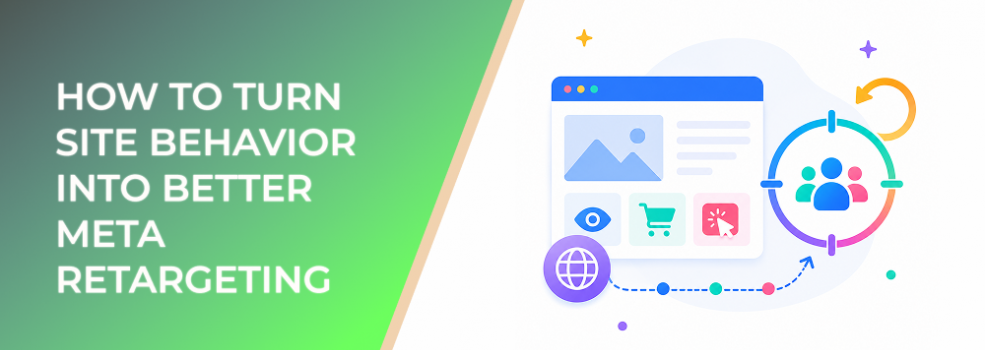
Website traffic is not one audience.
Some visitors bounce after a few seconds. Some read a blog post. Some visit pricing pages. Some view products, start checkout, or submit a form. If all of those users are grouped into the same retargeting audience, your campaign loses context.
Website event custom audiences help advertisers turn site behavior into more useful audience segments. Instead of retargeting every visitor with the same message, you can build audiences based on the actions that matter most to your funnel.
What website event custom audiences solve
A website event custom audience is built from actions people take on your website. These actions can include page visits, product views, form starts, purchases, lead events, checkout behavior, or other meaningful website interactions depending on your setup.
The purpose is to identify intent.
A user who visits your homepage once may not be ready for a sales ad. A user who visits your pricing page twice in one week is showing a different level of interest. A user who begins checkout and leaves is even further along.
Website event custom audiences let you make those distinctions inside your campaign strategy.
Business impact on CPC, CPA, CAC, and conversion performance
Better website-event segmentation can improve paid social performance because it helps Meta and your creative work with cleaner signals.
When the audience is too broad, campaigns may spend on people who clicked casually but never had real buying intent. That can make CPC look acceptable while CPA, CAC, and lead quality suffer.
When the audience is segmented by meaningful behavior, the campaign can become more efficient:
- Pricing-page visitors can receive proof, demos, or objection-handling ads.
- Product viewers can see product-specific benefits or comparisons.
- Cart abandoners can receive reminder and reassurance messaging.
- Blog visitors can be nurtured instead of pushed too aggressively.
- Past converters can be excluded or moved into upsell campaigns.
The result is a better match between user intent, message, and budget allocation.
Typical scenarios where this applies
Retargeting product or pricing page visitors
These users have moved beyond casual browsing. They are comparing options, evaluating fit, or checking cost. They usually deserve a stronger conversion-focused message than general site visitors.
Recovering abandoned carts or incomplete forms
When someone starts an action but does not finish, the issue may be trust, timing, friction, or offer clarity. Retargeting can help address that gap.
Nurturing content visitors
Not every content visitor is ready to buy. Segmenting blog, guide, or educational traffic lets you send them useful follow-up instead of forcing them into a sales sequence too early.
Separating new visitors from repeat visitors
Repeat visits often signal stronger intent. A user who returns to the same product, service, or pricing page may be worth prioritizing.
Building lookalike seed audiences
Website event audiences can also become source audiences for expansion when they reflect meaningful conversion behavior.
Risks and considerations
The biggest mistake is assuming all website traffic is valuable.
If your campaign targets “all visitors” from the last 30 days, it may include accidental clicks, low-intent blog readers, bots, old traffic, and people outside your ideal customer profile. That can weaken retargeting performance.
Another risk is making audiences too small. Overly narrow event combinations can limit delivery, increase frequency, and make performance volatile.
Advertisers also need to consider data quality. If website events are inconsistent, duplicated, missing, or mapped to the wrong funnel stage, the audience may not represent what you think it represents.
Finally, privacy and user consent requirements matter. Marketers should follow applicable platform policies and privacy rules when using website-based audiences.
Prerequisites and dependencies
Before building website event custom audiences, advertisers should have:
- Website events collected through Meta’s approved setup.
- Clear definitions for each meaningful funnel action.
- Enough recent traffic to support delivery.
- Retention windows that match the buying cycle.
- Exclusions for customers, recent converters, or irrelevant users.
- Creative that matches each audience’s behavior.
- Reporting that looks beyond CPC and tracks conversion quality.
The strongest website event audiences are built around business meaning, not just technical availability.
How LeadEnforce helps
LeadEnforce helps improve the quality of the traffic that later becomes your website event audience.
If your website visitors come from broad, weak, or mismatched targeting, your retargeting audience will inherit that weakness. Meta may then spend more budget re-engaging people who were never strong prospects.
LeadEnforce helps advertisers build high-intent audiences from Facebook groups, Instagram profiles, Instagram followers and engagers, LinkedIn professional data, and custom social-profile sources. These audiences can be used to attract more relevant visitors before website event retargeting begins.
For example, a B2B advertiser can reach a more precise professional audience before building pricing-page retargeting pools. An ecommerce brand can reach people connected to relevant Instagram profiles or niche communities before retargeting product viewers. An agency can build cleaner audience inputs for each client instead of relying only on broad interest stacks.
Better prospecting inputs create better retargeting pools.
Practical recommendations
Segment by intent, not convenience
Do not default to “all website visitors.” Separate users based on the actions that reveal funnel stage and buying intent.
Use different messages for different behaviors
A product viewer, blog reader, and cart abandoner should not see the same ad. Match creative to the likely reason they have not converted yet.
Keep retention windows realistic
Shorter windows often capture stronger intent. Longer windows can add volume but may include users who are no longer in-market.
Exclude completed converters where appropriate
Do not keep showing acquisition ads to people who already bought, booked, or submitted the intended form unless you have a retention or upsell strategy.
Monitor audience saturation
Small retargeting pools can fatigue quickly. Watch frequency, CTR decline, CPA changes, and lead quality before scaling.
Improve traffic quality upstream
If retargeting is weak, the problem may be your prospecting audience. Use better audience inputs so website-event audiences contain more qualified users.
Final takeaway
Website event custom audiences help advertisers stop treating site visitors as one generic pool. By segmenting users according to real behavior, marketers can improve message relevance, reduce wasted spend, and make retargeting more useful for CPA, CAC, and ROAS.
The best results come from combining clean website signals with stronger prospecting audiences upstream.
To create more relevant audience inputs before building your next website retargeting pool, join the free 7-day LeadEnforce trial period.
Related LeadEnforce Articles
- How to Convert Website Visitors into Paying Customers with Facebook Ads — Directly relevant for turning website traffic into structured retargeting audiences.
- How to Retarget Website Visitors Who Didn’t Convert on Facebook — Useful for building behavior-based retargeting flows from non-converting visitors.
- Should You Retarget Website Visitors or Add-to-Cart Users First? — Helps advertisers prioritize retargeting audiences by intent level.
- Why Your Retargeting Campaign Isn’t Delivering — Explains common delivery and saturation issues in retargeting audiences.
- A Beginner’s Guide to Custom Audience Targeting — Provides a broader foundation for custom audience strategy.