Facebook ad results can feel volatile — strong one week, tanking the next. The issue isn’t always the ad or the budget. In reality, performance is shaped by invisible platform dynamics that most advertisers overlook.
In this article, we go beyond the basics. We’ll explore deeper mechanics of Facebook Ads that affect delivery, conversion rates, and scaling. These insights come from working inside hundreds of Meta ad accounts across industries — not from help docs or templates.
Creative fatigue and algorithmic decay
Most advertisers know creative fatigue exists — but they often misdiagnose it or respond too late.
Signs of fatigue
-
Declining CTR despite steady CPMs;
-
Decreasing engagement ratios (clicks, saves, comments vs. impressions);
-
Increasing CPA in evergreen campaigns with no audience changes.
While the platform doesn't publicly expose fatigue scores, it does factor engagement decay into delivery. Once your ad stops generating positive user signals (like dwell time, saves, shares), Facebook quietly deprioritizes it — even if your bid stays high.
Many brands keep extending the life of a high-performing ad for too long, squeezing short-term results while harming long-term account health. A fatigued ad doesn’t just stop converting — it teaches the system to expect underperformance from your domain or product line.
Avoid the slow bleed. Implement creative rotation frameworks where variations are pre-built and swapped every 5–7 days, depending on audience saturation. Use a naming convention to track ad "age" and segment performance by time window. Treat ad creative like inventory — fresh stock always moves better.
For a deeper breakdown of why evergreen campaigns decline over time, see Why evergreen Facebook ad campaigns need periodic creative refreshes.
Broad targeting punishes unclear messaging
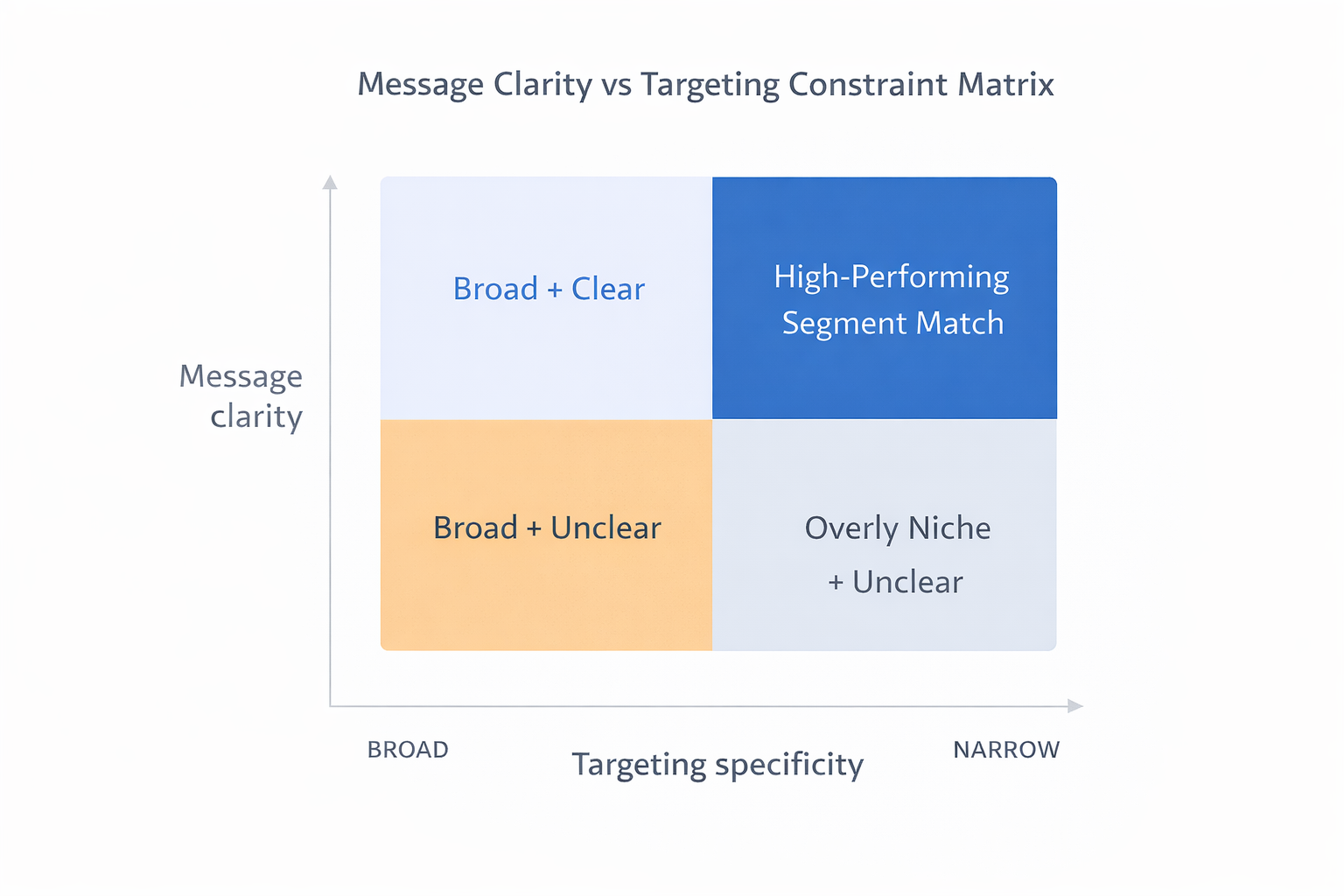
Broad targeting isn't just about audience expansion — it's about placing full weight on creative to do the filtering.
Common pitfalls
-
Launching broad ads with one-size-fits-all messaging;
-
Using generic visuals or product-first headlines;
-
Assuming Meta will "find the right audience" without enough input.
Facebook’s algorithm leans on behavioral signals. With broad audiences, there's less demographic constraint, so it depends heavily on how different types of people interact with your creative. If an ad doesn’t clearly signal who it’s for and why they should care, the system fails to cluster conversions — which hurts delivery and optimization.
How to fix it
-
Create multiple ad angles tailored to specific use cases (e.g., for an AI writing tool: one ad for marketers, one for students, one for founders);
-
Use distinct hooks, visuals, and testimonials that resonate with each subgroup;
-
Let Meta auto-optimize across the variants within a single ad set.
This improves performance faster than granular audience targeting because it aligns with how the algorithm learns. You're not just feeding the system impressions — you're feeding it patterns.
Advanced tip: Use video average watch time and click-through heatmaps to diagnose which angles hold attention. Low engagement early in the funnel means the wrong people are seeing the ad — not just that the ad is weak.
Short attribution windows distort optimization
Advertisers often kill campaigns too early because they're watching the wrong time horizon.
What goes wrong
-
The default 1-day click or 1-day view attribution windows don’t capture mid-funnel or high-consideration purchases;
-
Facebook reports conversions only within those short windows, skewing ROAS downward;
-
Automated rules and budget allocation logic get distorted by short-term lag.
This is especially damaging for products with a longer buyer journey — think subscription services, B2B software, luxury goods, or anything with lead nurturing.
How to adjust
-
Switch to 7-day click attribution at minimum. This gives Meta enough signal volume to make informed delivery decisions;
-
Cross-check ad results with post-click data in tools like Google Analytics or your CRM;
-
Delay optimization decisions (pauses, bid changes, budget shifts) until at least 72 hours after launch — or longer, depending on the product cycle.
Even better, create dashboards that map ad click timestamps to eventual purchases using internal IDs. This lets you run lag-adjusted ROAS reports, which are far more reliable than what Facebook's UI shows in real time.
For a deeper explanation of attribution delays and reporting gaps, see Meta ads attribution: windows, delays, and data accuracy.
Advanced insight: If you consistently see high quality leads convert 5–10 days after the ad click, your campaign isn't underperforming — your attribution setup is.
Landing page experience feeds back into delivery
Most advertisers separate “ad performance” from “website performance.” Facebook doesn’t.
Hidden performance drains
-
Pages that load in more than 3 seconds (especially on mobile) cause users to bounce before conversion pixels can fire;
-
Aggressive exit popups or interstitials hurt scroll depth and session duration;
-
Mismatched creative-to-page experience (e.g., ad promises one offer, but page shows a different layout or product).
Facebook uses page engagement post-click (scroll, time on site, bounce rate) as a quality signal. These signals feed back into your ad's “estimated action rate,” which is a key factor in auction wins. Poor page experience means worse delivery — even with great CTR and budget.
How to improve it
-
Use Meta’s "landing page views" and "engaged view conversions" as key metrics, not just clicks;
-
Run A/B tests with reduced scripts and compressed images to speed up mobile load;
-
Match ad angle to page structure: if your ad sells “free trial,” don’t send users to a homepage — send them to a trial signup page.
For practical optimization patterns that improve both conversion rate and ad delivery, see How to optimize landing pages for better conversions.
Advanced insight: Facebook tracks domain-level signals. A slow or deceptive landing page can lower your domain’s reputation across all campaigns — even when you test new creatives.
Account-level signals shape delivery power
Advertisers often assume the ad account is a neutral container. It’s not.
| Signal source | Events tracked | Conversion match depth |
| Pixel only | View content, Add to cart, Purchase | Basic match (browser only) |
| Pixel + CAPI | View content, Add to cart, Purchase | Higher match (browser + server) |
| Pixel + CAPI + CRM | View content, Add to cart, Repeat buyer, High-value customer | Highest match (server + CRM data) |
System-level factors
-
Ad accounts with longer history and high-quality signals (low bounce, consistent conversion tracking) tend to get favorable auction treatment;
-
New ad accounts, or those with recent policy violations or pixel resets, may see unstable CPMs and slower learning;
-
Domains linked to accounts with frequent ad rejections or audience feedback penalties are deprioritized in delivery.
How to improve signal quality
-
Use Conversions API (CAPI) in addition to the Pixel for richer event tracking;
-
Integrate your CRM or server-side events to supply back conversions that Meta might miss;
-
Avoid resetting Pixels or Business Managers unless absolutely necessary — every reset erases learning.
If you’re not using server-side tracking yet, start with How to use Conversion API without a dev team.
Advanced insight: Pixel signal density matters. Even if you track purchases, if you don't track add-to-cart, initiate checkout, or page views — Meta has less granularity to model conversion intent. The more signal types you track, the more efficiently the system learns.
Conclusion: it's not just the ads
Strong performance on Facebook and Instagram isn’t just about better creatives or budgets. It’s about system alignment — making sure your strategy supports how the Meta platform actually works.
Most advertisers get stuck tweaking headlines or adjusting budgets, while ignoring structural blockers like attribution lag, signal loss, or fatigue mismanagement. These deeper elements shape performance far more than most realize.
To consistently improve results:
-
Refresh creative often, with strategic rotation;
-
Match creative messaging to targeting type (especially for broad audiences);
-
Extend your optimization windows and connect offline data;
-
Improve page experience, not just ad copy;
-
Seed campaigns with early positive signals;
-
Strengthen the account’s data feedback loops with robust tracking.
When these systems work together, your ad account doesn’t just perform better — it compounds better over time.