When a campaign underspends, it usually gets framed as a delivery issue.
It isn’t.
Meta is filtering auctions. If your budget isn’t being used, it means the system is rejecting most opportunities because they don’t meet its expected performance threshold.
Once you look at it this way, the problem becomes easier to diagnose and much harder to fix with surface-level tweaks.
Start With the Shape of Delivery
Before touching settings, look at how the campaign spends during the day.
You’ll usually recognize one of these patterns:
-
Flat underdelivery all day. Spend never ramps. This points to a structural constraint such as a limited audience, restrictive targeting, or weak optimization signals.
-
Spend concentrated in a few hours. Delivery is quiet, then spikes. The system is skipping low-confidence auctions and waiting for better ones.
-
On/off delivery cycles. The campaign spends, pauses, then resumes. That usually points to unstable signals or borderline competitiveness.
These patterns are not random. They reflect how aggressively Meta is willing to participate in auctions.
You’re Losing Auctions More Often Than You Think
Most underspending is not about reach. It is about losing.
Your ads are entering auctions, but they are not winning enough of them to scale delivery.
You will usually see indirect signals first:
-
CPM increases, but impressions do not scale with it.
-
Budget increases do not produce more reach.
-
Delivery weakens when competition intensifies in the same audience.
That is also why raising budget alone rarely fixes underspending. You are asking the system to compete more without improving your position.
Targeting Constraints Quietly Cap Spend
Audience size in Ads Manager is theoretical. Real delivery is much narrower.
At any given moment, only a fraction of users are active, eligible for your optimization event, and still valuable to reach. When you layer filters, that pool gets even smaller.
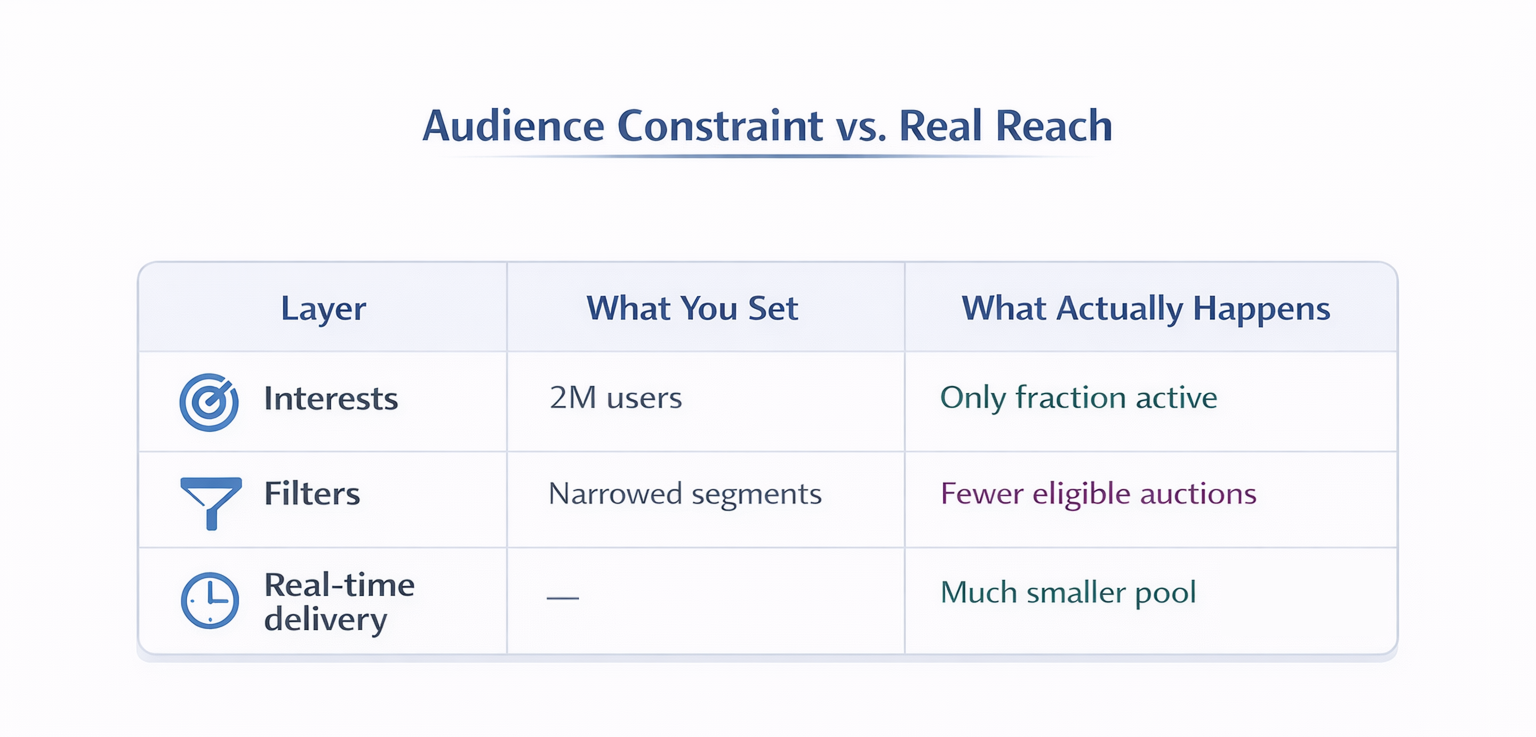
A few signs usually appear together:
-
Reach stalls earlier than expected.
-
Frequency starts climbing too soon.
-
Spend plateaus even though the budget is still modest.
This is one reason Facebook Ads Audience Too Narrow? How to Troubleshoot a Limited Audience fits naturally with this topic. Narrow targeting does not just reduce scale. It also reduces the system’s room to learn.
Weak Signals Don’t Stop Delivery, They Make It Selective
Low conversion volume does not automatically stop a campaign. It changes how cautiously Meta behaves.
When signals are strong, Meta expands confidently. When they weaken, Meta becomes more selective and starts passing on borderline auctions.
You will often notice:
-
Spend tapering after a few weaker days.
-
Delivery concentrating into smaller windows.
-
More volatility after edits or resets.
Even small tracking issues matter here. Missing or delayed events do not just affect reporting. They weaken the feedback loop Meta uses to decide whether to bid at all.
That is why How to Create Facebook Pixel and Track Conversions is directly relevant. If the system cannot trust the signal, it will not spend aggressively.
Creative Problems Often Show Up as Underspending
Creative does not need to fail outright to reduce delivery.
It just needs to perform slightly worse than competing ads in the same auctions.
That is why this pattern is common:
-
CTR looks acceptable.
-
CPA is still within range.
-
But impressions do not scale when budget increases.
From the system’s perspective, your ad is simply not the best option available. This gets worse over time as other advertisers refresh hooks, offers, and formats.
That is also why Ad Fatigue on Facebook: How to Spot It Early and Fix It Fast belongs next to this topic. A campaign can underspend not because the ad is bad, but because it is no longer competitive enough.
Budget Can Outrun Your Data
Scaling assumes the system can find more users similar to your converters.
That only works when there is enough signal depth behind the campaign. If there is not, Meta effectively limits delivery instead of forcing expansion into weaker opportunities.
In practice, that means:
-
It avoids low-confidence users.
-
It protects efficiency by leaving part of the budget unused.
This is why increasing budget on low-volume purchase campaigns often changes very little. You run out of predictable opportunities before you run out of budget.
What Actually Fixes Partial Spend
You do not fix underspending directly. You remove the constraints that cause filtering.
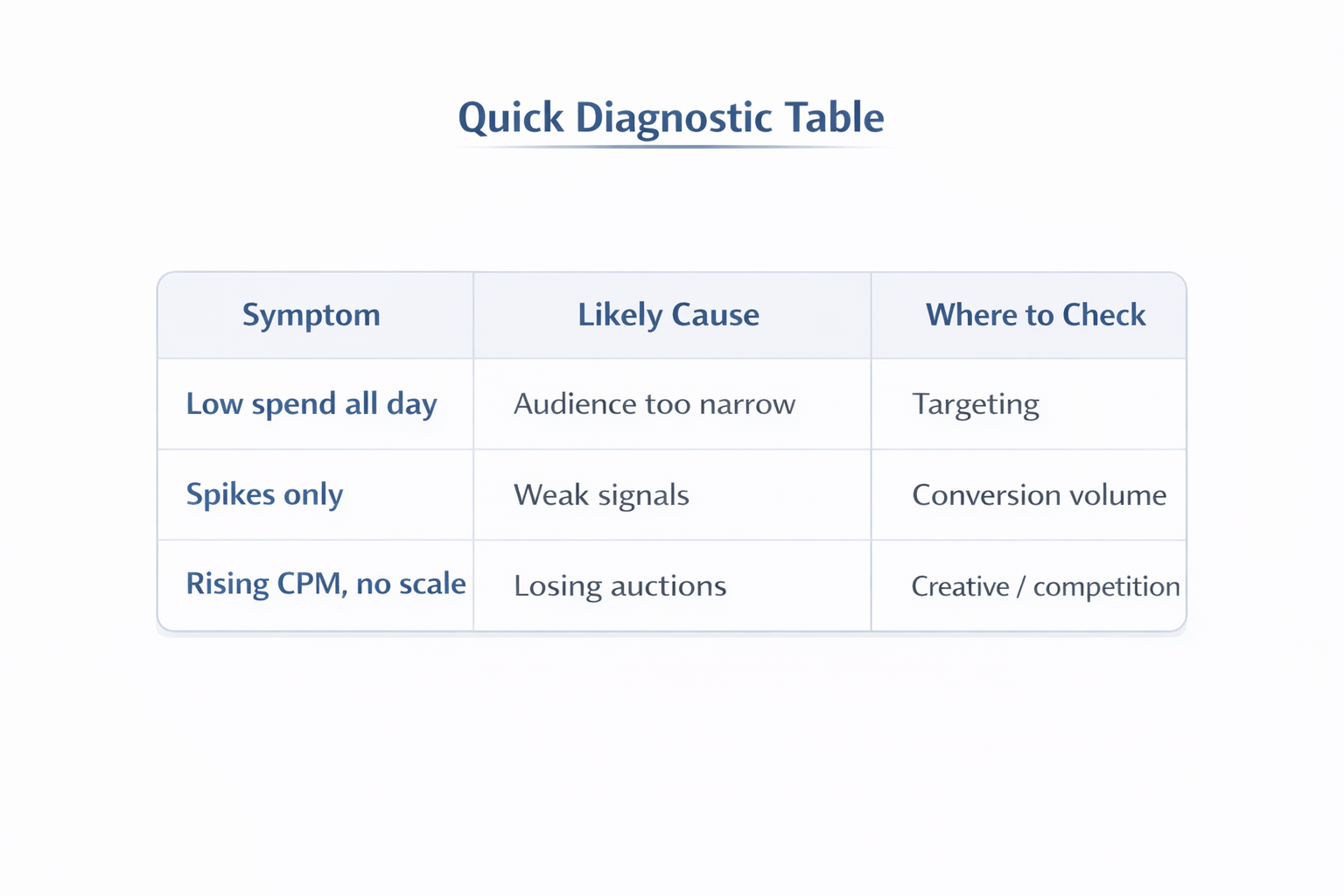
In practice, that usually means:
-
Expanding auction access. Broaden audiences, remove unnecessary targeting layers, and allow more placements so the system has more chances to find viable auctions.
-
Stabilizing signals. Improve tracking, consolidate data where needed, and avoid making too many structural changes in short periods.
-
Improving competitiveness. Refresh creatives, sharpen the offer, and make sure post-click experience supports the promise made in the ad.
If one of those areas stays weak, the campaign will usually keep hitting a ceiling no matter how much budget you add.
The More Useful Way to Think About It
Underspending is not a delivery bug.
It is a filtering outcome.
Your campaign spends when two things are true:
-
it can enter enough auctions;
-
it can win enough of them.
If either breaks, spend drops.
That is the framing that leads to better decisions and fewer random tweaks. Instead of asking why Meta is not spending, ask where your campaign stops being eligible or competitive enough to deserve more delivery.