Many advertisers assume that lead quality should remain stable if the campaign setup remains unchanged. In practice, the opposite often happens.
A campaign may generate highly qualified leads during one week and low-intent submissions the next — even when targeting, budget, and creatives stay the same.
These fluctuations rarely come from randomness. They usually appear when the ad platform’s optimization model begins prioritizing slightly different behavioral signals inside the same audience.
Understanding why this happens requires looking at how the algorithm interprets conversion events and how small signal changes can redirect delivery.
The Algorithm Optimizes for Conversion Probability, Not Lead Quality
Ad platforms do not understand lead quality in the way a sales team does.
The optimization system evaluates only one measurable outcome — the probability that a user will complete the tracked conversion event. If the conversion event is Lead, the model learns which users are most likely to submit a form.
That becomes problematic when different types of users trigger the same event.
A campaign might generate leads from:
-
High-intent buyers.
Users actively researching the product category who submit realistic inquiries. -
Early-stage researchers.
Visitors downloading guides or requesting demos without immediate purchase intent. -
Low-intent form fillers.
Users submitting forms casually or with incomplete information.
From the algorithm’s perspective, these behaviors look identical if they trigger the same event. Over time, the system begins identifying clusters of users who submit forms most easily — not those most likely to become customers.
This difference between lead volume and business value is discussed in more detail in Lead Quality vs Lead Volume: What Facebook Advertisers Need to Know.
If lower-intent users convert more frequently, the delivery model gradually shifts toward those profiles. That shift often explains why lead quality changes even when campaign settings remain stable.
Small Changes in Conversion Patterns Can Redirect Delivery
Meta’s delivery system constantly recalculates which users are most likely to convert.
Even small shifts in recent lead patterns can redirect optimization.
For example, a campaign may initially generate leads primarily from high-intent buyers. The algorithm learns their behavioral signals and begins bidding more aggressively for similar users.
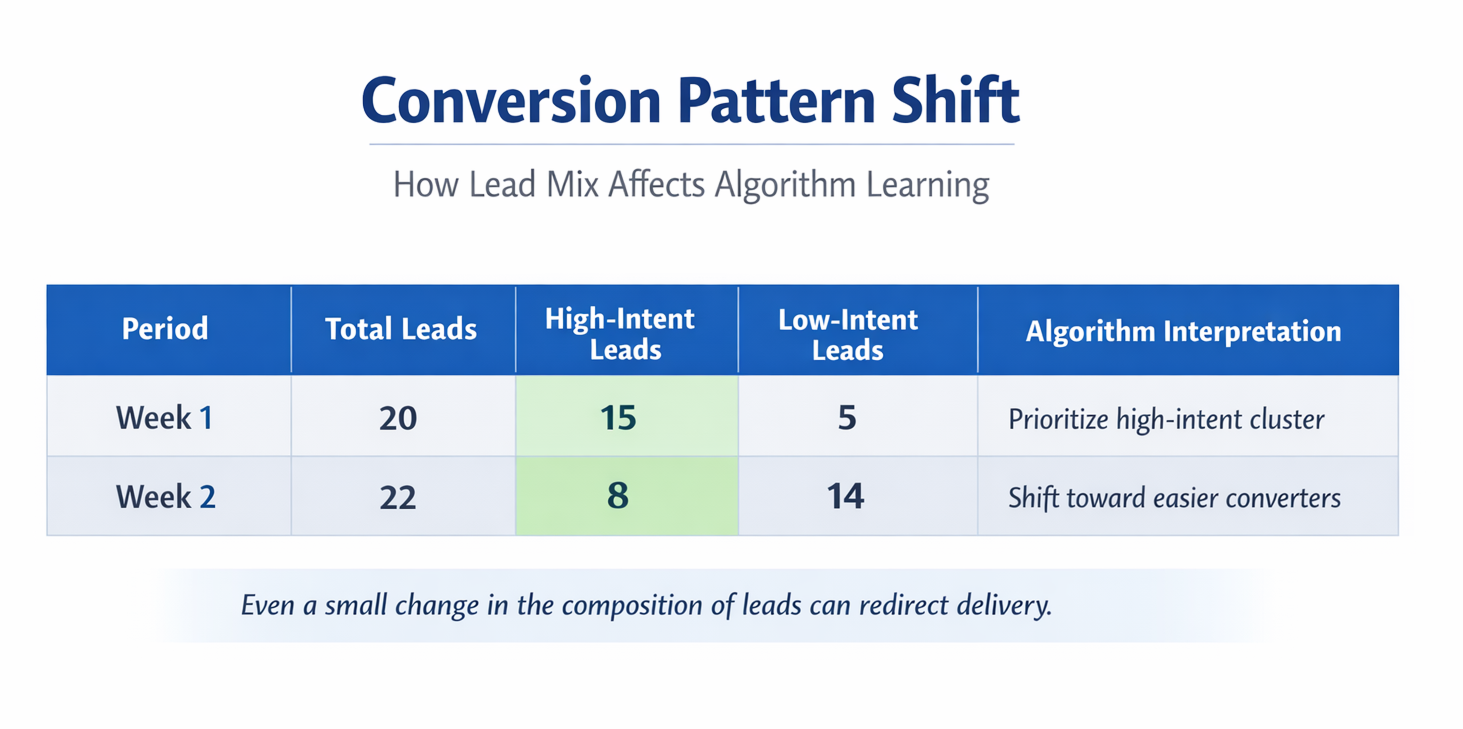
But if later conversions come mostly from casual form submitters, the model interprets that pattern as the new signal cluster.
The campaign continues generating leads — but the audience composition gradually changes.
From the advertiser’s perspective, lead quality appears inconsistent even though the platform still reports strong conversion performance.
Audience Expansion Introduces New Behavioral Clusters
Audience expansion features can also introduce unexpected shifts in lead quality.
When the algorithm struggles to find enough conversions within the original targeting pool, it begins testing adjacent behavioral clusters. This often happens with:
-
broad targeting;
-
lookalike audiences with expansion enabled;
-
campaigns with low conversion volume.
Once expansion begins, the system may discover segments that submit forms easily but have weaker buying intent.
You can often see this change in Ads Manager signals:
-
CPM decreases slightly — suggesting cheaper auctions;
-
lead volume increases, but sales remain flat;
-
demographic or placement distribution shifts.
The campaign has not stopped working. The model simply found users who convert more easily at the event level.
This mechanism is explained further in Why Audience Expansion Sometimes Lowers Facebook Ads ROI.
Lead Forms Can Distort Conversion Signals
Lead quality often fluctuates when campaigns rely on native lead forms.
These forms reduce friction significantly because the platform auto-fills contact information. While this improves conversion rates, it also weakens intent signals.
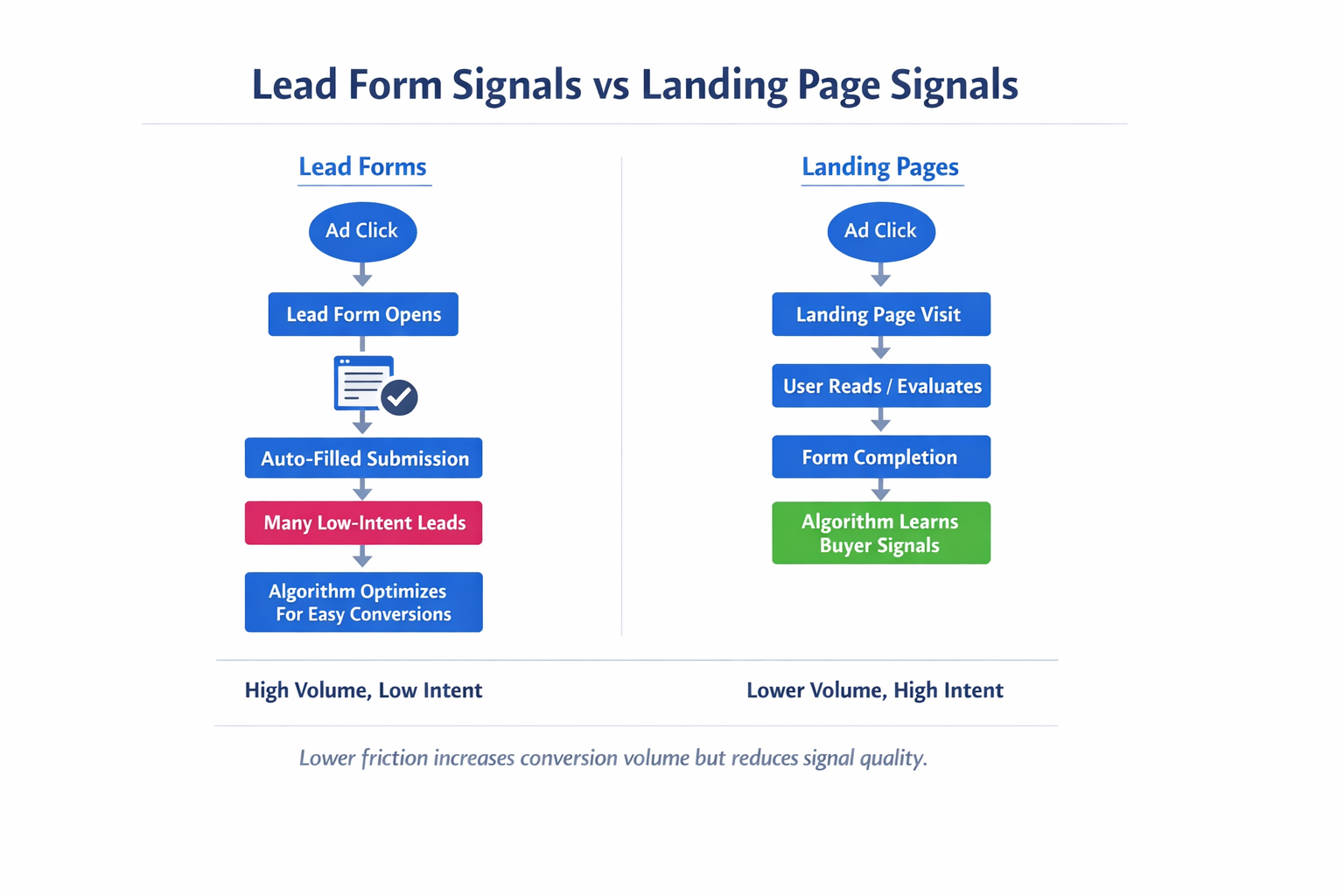
Common patterns include:
-
accidental submissions from users exploring the form;
-
low-commitment inquiries from users seeking information rather than solutions;
-
minimal qualification data that prevents the algorithm from distinguishing serious prospects.
The platform still counts these submissions as successful conversions. Over time, the model starts prioritizing users who submit forms most easily.
Campaigns that send traffic to landing pages often generate fewer leads but more stable quality because the extra friction filters out casual interest.
A deeper comparison is explained in Lead Forms vs Landing Pages: Which Converts?
Creative Messaging Attracts Different Intent Levels
Creative messaging can quietly reshape the intent profile of incoming leads.
Two ads targeting the same audience can attract very different users depending on how the offer is framed.
A message promoting a product demo usually attracts buyers evaluating solutions. A message offering educational content attracts a broader group researching the topic.
If both ads lead to the same form, the algorithm mixes two intent levels inside the campaign.
Over time, whichever group produces more conversion events begins dominating delivery.
This is why campaigns that combine educational and sales offers often experience unstable lead quality.
Attribution Delays Can Mislead Optimization
Another factor is the delay between lead submission and confirmed sales outcomes.
Ad platforms receive the conversion signal immediately after the form submission. However, the actual business value of that lead may only appear days or weeks later.
During that time, the algorithm assumes all leads have equal value.
For example:
-
a campaign generates 30 leads in a few days;
-
the algorithm treats all submissions as successful conversions;
-
later, only a small portion of those leads become real opportunities.
Without deeper conversion feedback — such as qualified leads or booked calls — the system keeps optimizing toward behaviors that generate the most submissions.
The mechanics behind this delay are explained in Attribution Lag in Facebook Ads: Why Results Look Better (or Worse) Days Later.
Stabilizing Lead Quality Requires Better Signals
The most reliable way to reduce lead quality fluctuations is improving the signals the algorithm receives.
Several structural changes help align optimization with real business outcomes:
-
track deeper conversion events such as qualified leads or meetings;
-
separate educational and sales offers into different campaigns;
-
add qualification questions to lead forms;
-
consolidate campaigns with low conversion volume.
These adjustments help the algorithm identify the users who actually matter.
The Key Insight
Inconsistent lead quality rarely means a campaign suddenly stopped working.
More often, the algorithm simply discovered a group of users who complete the tracked conversion event more easily.
Unless the conversion signal reflects real business value, the system will continue optimizing for the easiest measurable outcome.
The most stable campaigns are not those with the highest lead volume — they are the ones where conversion tracking reflects the true definition of a qualified customer.