Combining campaigns is not always beneficial. In some situations it helps algorithms learn faster and increases efficiency; in others it can reduce control and harm results. Understanding when consolidation works—and when it backfires—can help marketers maintain strong campaign performance.
Many advertisers accumulate dozens or even hundreds of campaigns over time. New campaigns are often created to test audiences, creatives, or bidding strategies. As accounts grow, they become harder to manage and data becomes fragmented across multiple campaigns.
Campaign consolidation is the process of merging multiple campaigns into fewer, larger ones. The goal is usually to simplify management, increase data density for optimization algorithms, and improve performance stability.
However, consolidation is not universally beneficial. According to multiple industry studies, campaign restructuring can significantly impact performance metrics such as cost per acquisition (CPA), click‑through rate (CTR), and return on ad spend (ROAS). In some cases, consolidation improves results. In others, it introduces inefficiencies.
Why Advertisers Consolidate Campaigns
There are several common reasons marketers decide to consolidate campaigns.
1. Algorithm Learning Efficiency
Modern advertising platforms rely heavily on machine learning. Campaigns with limited data often struggle to exit the "learning phase." Larger campaigns accumulate data faster, allowing algorithms to optimize more effectively.
Industry data suggests that campaigns receiving fewer than 50 optimization events per week are significantly more likely to remain in learning mode and show unstable performance. Consolidation can help reach that threshold faster.
2. Simplified Account Management
Managing large numbers of campaigns increases operational complexity. Marketers must monitor budgets, creatives, audiences, and performance metrics across many campaign groups.
A 2023 marketing operations survey found that advertisers managing more than 100 active campaigns spend up to 35% more time on routine campaign maintenance compared to those running fewer consolidated structures.
3. Budget Efficiency
Fragmented campaigns often result in under‑spent budgets or uneven allocation. Consolidation allows budgets to flow toward the best performing ad sets automatically.
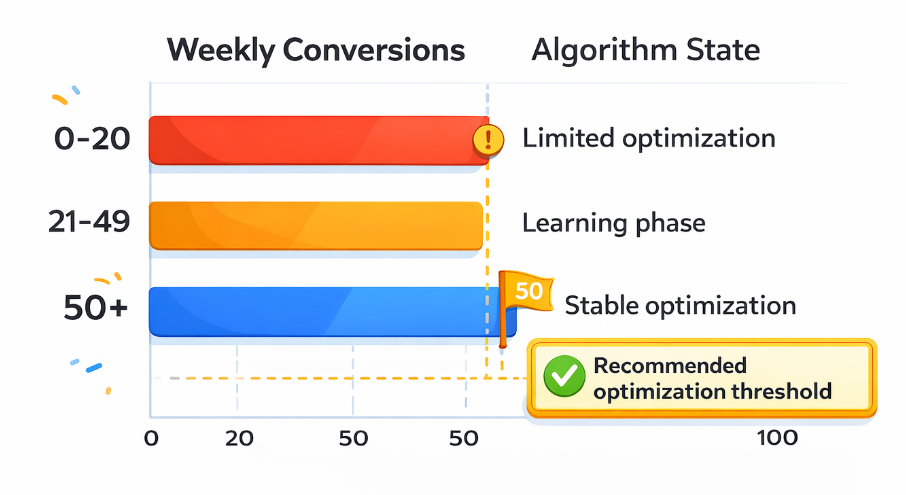
Conversion volume strongly affects algorithm performance. Most advertising platforms recommend roughly 50 conversion events per week for stable optimization and exit from the learning phase
Some advertisers report improvements of 10–20% in budget utilization after reducing campaign fragmentation.
When Campaign Consolidation Improves Performance
Consolidation tends to work best in several specific scenarios.
Low Data Volume Campaigns
If campaigns generate limited conversions, performance algorithms struggle to identify patterns. Merging campaigns can increase signal density.
For example, combining five campaigns that each produce 10 conversions per week into a single campaign producing 50 conversions allows algorithms to optimize more confidently.
Similar Target Audiences
Campaigns targeting highly overlapping audiences often compete against each other in auctions. This internal competition can increase costs.
Research suggests that overlapping audience campaigns can increase CPM by as much as 15–20%. Consolidation reduces this overlap and helps centralize bidding.
Identical Goals and Bidding Strategies
If multiple campaigns pursue the same conversion objective with the same bidding model, maintaining separate structures often adds unnecessary complexity.
Combining them can strengthen algorithmic learning while maintaining consistent optimization signals.
When Campaign Consolidation Hurts Performance
Despite its advantages, consolidation can introduce several problems.
Loss of Budget Control
Separate campaigns allow advertisers to allocate budgets to specific audiences, regions, or products. Consolidation removes some of that precision.
When campaigns are merged, high‑volume segments may consume the majority of the budget, leaving niche segments underfunded.
Mixed Audience Intent
Combining campaigns that target audiences with different purchase intent can confuse optimization algorithms.
For example, prospecting and retargeting audiences behave very differently. Retargeting typically produces significantly higher conversion rates. If both are merged into one campaign, the algorithm may prioritize retargeting traffic and neglect new user acquisition.
Performance Volatility During Transition
Campaign restructuring resets learning signals in many advertising platforms.
Studies show that after major campaign changes, performance may fluctuate for 3–7 days while algorithms re‑enter the learning phase. During this period, cost per acquisition may temporarily increase by 20–40%.
Best Practices for Campaign Consolidation
To avoid negative outcomes, consolidation should follow a structured approach.
Consolidate Gradually
Instead of merging many campaigns simultaneously, combine them in stages. This allows advertisers to monitor performance changes and prevent large disruptions.
Keep Distinct Objectives Separate
Campaigns with different goals—such as lead generation, brand awareness, or retargeting—should remain separate to preserve optimization clarity.
Monitor Learning Phase Metrics
After consolidation, closely track key indicators such as conversion volume, CPA, CTR, and frequency during the learning period.
If performance declines significantly, reverting the structure may be necessary.
Conclusion
Campaign consolidation can be a powerful strategy for improving performance, especially when campaigns suffer from low data volume, audience overlap, or excessive structural complexity.
However, merging campaigns without careful evaluation can lead to reduced control, algorithm confusion, and short‑term performance declines.
The most effective approach is strategic consolidation—simplifying structures while preserving meaningful segmentation. By balancing data efficiency with targeting precision, advertisers can maintain strong optimization signals and achieve more stable campaign performance.
Suggested Reading