

Social ads on Facebook and Instagram offer reach, scale, and targeting that few platforms can match. Yet many businesses still struggle to get results.
It’s rarely due to the algorithm alone. And it’s not simply a matter of increasing budget or testing more creative.
The real issues are structural. They stem from how campaigns are planned, how offers are packaged, and how users are guided from ad to action.
Here’s a closer look at the most common — and costly — mistakes businesses make with social ads, and what to do instead.
The Problem Isn’t the Platform — It’s the Strategy
Many advertisers blame Meta’s ad delivery system when results stall. But in most cases, the deeper problem is misalignment — between the offer, the message, and the customer journey.
An ad might be targeting the wrong segment, or promoting an offer that lacks urgency. The landing page might not match the promise made in the ad.
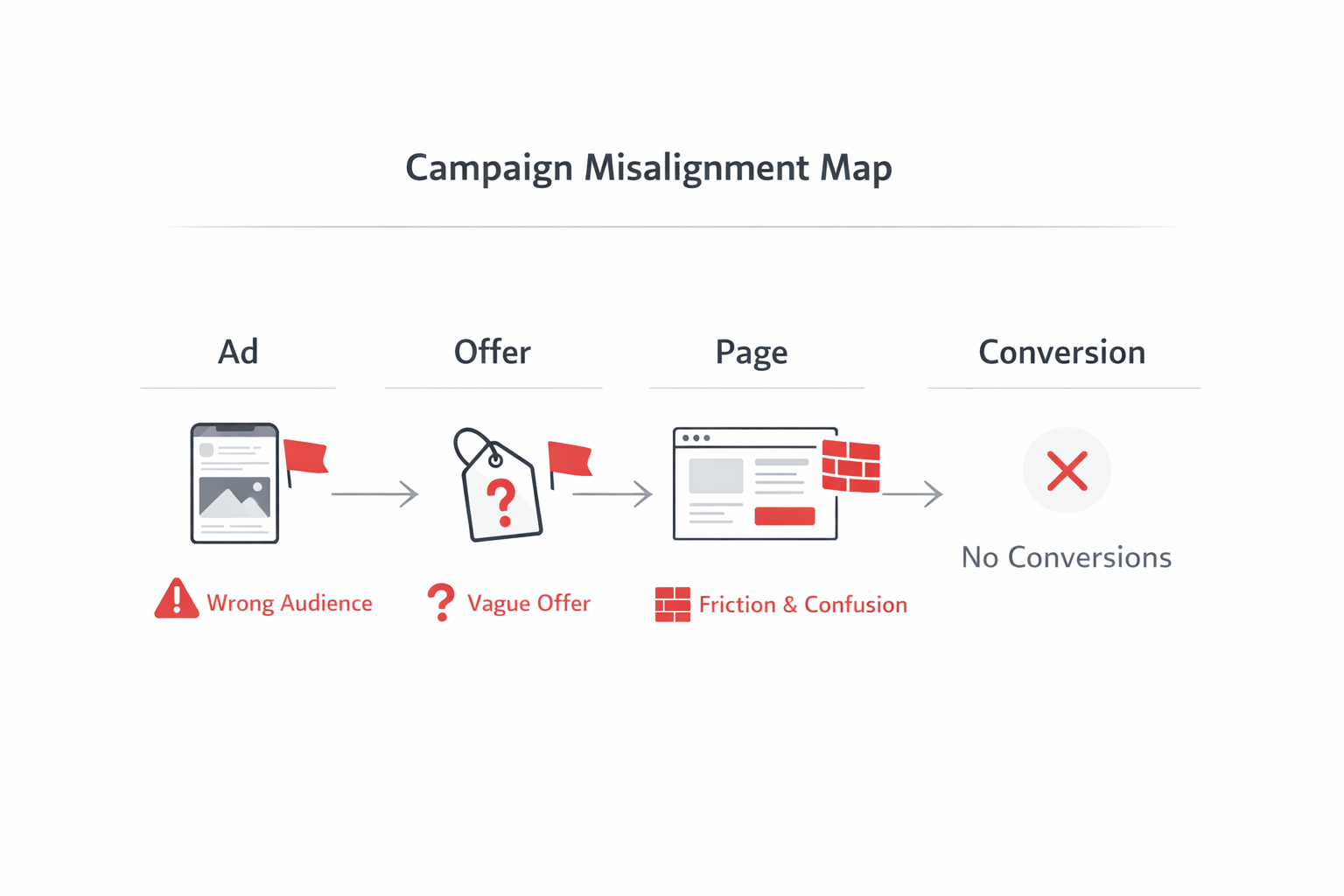
If your funnel breaks after the click, it doesn’t matter how strong your CTR looks. The full experience has to convert — not just the creative.
To fix this, advertisers need to revisit the fundamentals of campaign design. For a breakdown of how to structure campaigns for sustainable success, explore The Facebook Ad Optimization Framework Every Marketer Should Use.
Most Businesses Focus Too Much on the Ad — and Not Enough on the Offer
Many marketers put all their energy into ad visuals and clever headlines. But conversions happen when the offer itself is strong — not just how it looks in the feed.
You might have a beautifully designed ad for a free trial, but if the landing page lacks clear pricing or benefit copy, users drop off.
Your offer must check three boxes:
-
Clarity: Explain the value quickly. For example, “30% off all ergonomic chairs this week” is clearer than “Work better, feel better.”
-
Relevance: Match what your audience cares about now. A holiday bundle may perform well in Q4, but flop in January.
-
Frictionless access: Fewer steps mean higher conversions. Don’t bury the CTA or require users to search for what you promised.
To improve offer clarity and execution, see Why Your Facebook Ads Look Great But Still Don’t Sell.
Creative Testing Alone Won’t Save a Bad Campaign
A/B testing is valuable, but only when it’s part of a larger strategy. Swapping images won’t fix a mismatched funnel or a message that doesn’t resonate.
For example, you might see strong CTRs on a top-of-funnel video ad — but no purchases. The issue is likely post-click, not creative.
Instead of only testing visuals, test alignment between message, funnel stage, and user intent.
You’ll get better results when your ads match buyer awareness. Learn how to align creative and copy to different stages in How to Match Your Ad Copy to Funnel Stage for Higher Conversions.
Relying Too Heavily on AI or “Best Practices”
AI-powered tools like Meta Advantage+ and automated rules can scale campaigns faster. But automation only works if the strategy behind it is sound.
For example, many advertisers ask AI tools to write ad headlines. But if the prompts are vague, the results will be generic — and performance will suffer.

Treat AI like a junior assistant. It’s great for idea generation and speed — not for messaging decisions or brand alignment.
AI works best when:
-
Your offer and audience are clearly defined.
-
Your campaigns have clear objectives and stages.
-
You monitor performance and iterate manually where it matters.
To explore how to balance automation with strategy, see How to Optimize Campaign Performance With Meta Advantage+.
Metrics Are Misunderstood — or Ignored
Vanity metrics like likes and low CPMs are tempting to track. But they rarely lead to real business results.
A campaign that delivers 1,000 clicks but no sales might look successful on the surface — until you check your actual ROI.
To diagnose performance accurately, go beyond the basics:
-
Track cost per qualified lead or purchase, not just cost per click.
-
Monitor drop-off points: Are users leaving at the form, the cart, or the landing page?
-
Watch for delayed conversions. Some users convert days after exposure — especially in retargeting funnels.
If you’re not sure which metrics truly matter, refer to How to Analyze Facebook Ad Performance Beyond CTR and CPC.
Your Ad Can’t Fix a Broken User Journey
Even the best creative won’t convert if the path to purchase is confusing, mismatched, or full of friction.
Strong-performing campaigns create a consistent experience from first click to final action.
That means:
-
Ad creative and copy match what users see on the landing page.
-
The offer is relevant to the user’s current mindset and stage.
-
Each step (click, form, purchase) is optimized for speed and clarity.
You can’t rely on a single touchpoint. Build your funnel to guide users from scroll to sale. For a visual breakdown of this concept, read Facebook Ads Funnel Strategy: From Audience Identification to Conversion.
