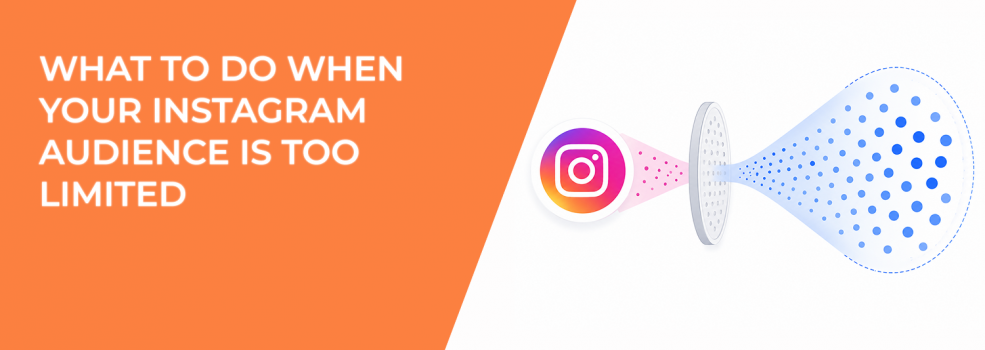
A limited Instagram audience often looks precise in setup, but weak in delivery.
You choose a few direct interests, tighten the age range, narrow the location, and expect cleaner traffic. Instead, the campaign struggles to spend, CPM rises, and results become unstable after a small number of conversions.
The problem is not always that the audience is “wrong.” Sometimes it is too compressed. Meta does not have enough room to compare users, find stronger pockets of intent, or move budget toward cheaper conversion opportunities.
Why narrow Instagram interests can restrict delivery
Interest targeting works best when Meta has enough variation inside the audience.
If you only target the most obvious interests, you may box the campaign into a small group of users who are expensive, over-targeted, or already saturated by competitors. Instagram then has fewer auctions where your ad can win efficiently.
This is common when advertisers target only direct category interests. A fitness brand targets “fitness.” A skincare brand targets “skincare.” A SaaS company targets one business software interest. These audiences may be relevant, but they are also obvious to every competitor in the same market.
When your audience is too limited, you may see:
- Low reach despite active budget. Meta cannot find enough eligible users who match your setup and action goal.
- High CPM from auction pressure. Competitors often bid on the same obvious interest groups.
- Fast frequency growth. The same users see the ad repeatedly because the pool is too small.
- Unstable CPA. A few conversions make performance look promising, then costs jump when Meta exhausts the easiest users.
If this happens, do not immediately rewrite the ad. First, troubleshoot a limited audience and check whether the campaign has enough delivery space.
The missed opportunity: adjacent intent
Instagram buying intent does not always sit inside the most direct interest.
A person ready to buy running shoes may follow marathon accounts, recovery tools, outdoor communities, nutrition creators, and local race pages. If you only target “running shoes,” you miss the surrounding behavior that often predicts purchase intent.
This matters because Meta’s interest categories are not perfect buyer labels. They are broad indicators of activity and association. A narrow interest can describe what someone likes, but adjacent interests can show the context behind why they might buy.
For example:
- A project management tool could test startup founders, remote work, productivity systems, and business operations.
- A premium skincare brand could test beauty creators, wellness routines, dermatology content, and clean lifestyle interests.
- A local gym could test fitness, healthy eating, running clubs, yoga studios, and nearby wellness businesses.
The goal is not to make the audience broad for the sake of reach. The goal is to cover the behaviors that surround the buying problem.
How limited audiences raise costs before you notice
A narrow audience can perform well for a few days because Meta starts with the easiest matches.
Those early users may already have strong intent, recent engagement, or lower auction competition. Once that pocket is used, the campaign has fewer options left. CPM rises, frequency climbs, and CPA becomes harder to control.
This is why small audiences often create false confidence. A campaign can show strong early results without being scalable.
The warning signs usually appear in this order:
- Delivery concentrates quickly. One ad set spends, but reach expands slowly compared with budget.
- Frequency rises before conversion volume grows. Users see the ad again, but the campaign does not produce enough new buyers.
- CPM increases while CTR stays acceptable. The ad still gets attention, but auctions become more expensive.
- CPA spikes after the first conversions. Meta runs out of easy converters inside the audience.
At that point, cutting budget may stabilize costs, but it does not solve the audience constraint. You need more qualified room for Meta to work.
Expand around the buyer, not the category
The safest way to fix a limited Instagram audience is to expand in rings.
Start with the direct interest, then add adjacent interests, hobbies, brands, creators, communities, and similar businesses that reflect the same buyer motivation. This gives Meta more delivery space without pushing the campaign into irrelevant traffic.
For example, an online course about bookkeeping should not only target “accounting.” It could test small business owners, invoicing tools, freelancer communities, tax preparation content, and business finance creators. These users may not all identify with accounting, but they may feel the operational problem the course solves.
That is the difference between category targeting and intent targeting.
Category targeting asks, “Who matches this product label?” Intent targeting asks, “Who is likely dealing with the problem this product solves?”
This is where audience size versus quality becomes important. A slightly larger audience can outperform a narrow one when it includes enough related signals for Meta to sort through.
How LeadEnforce can help
LeadEnforce can help when native Instagram interests are too broad in one place and too limited in another.
Instead of relying only on Meta’s built-in interest categories, advertisers can build audiences from Instagram account followers, engagers, Facebook groups, and social profile data. This gives you more precise source-based audiences to test against native interest groups.
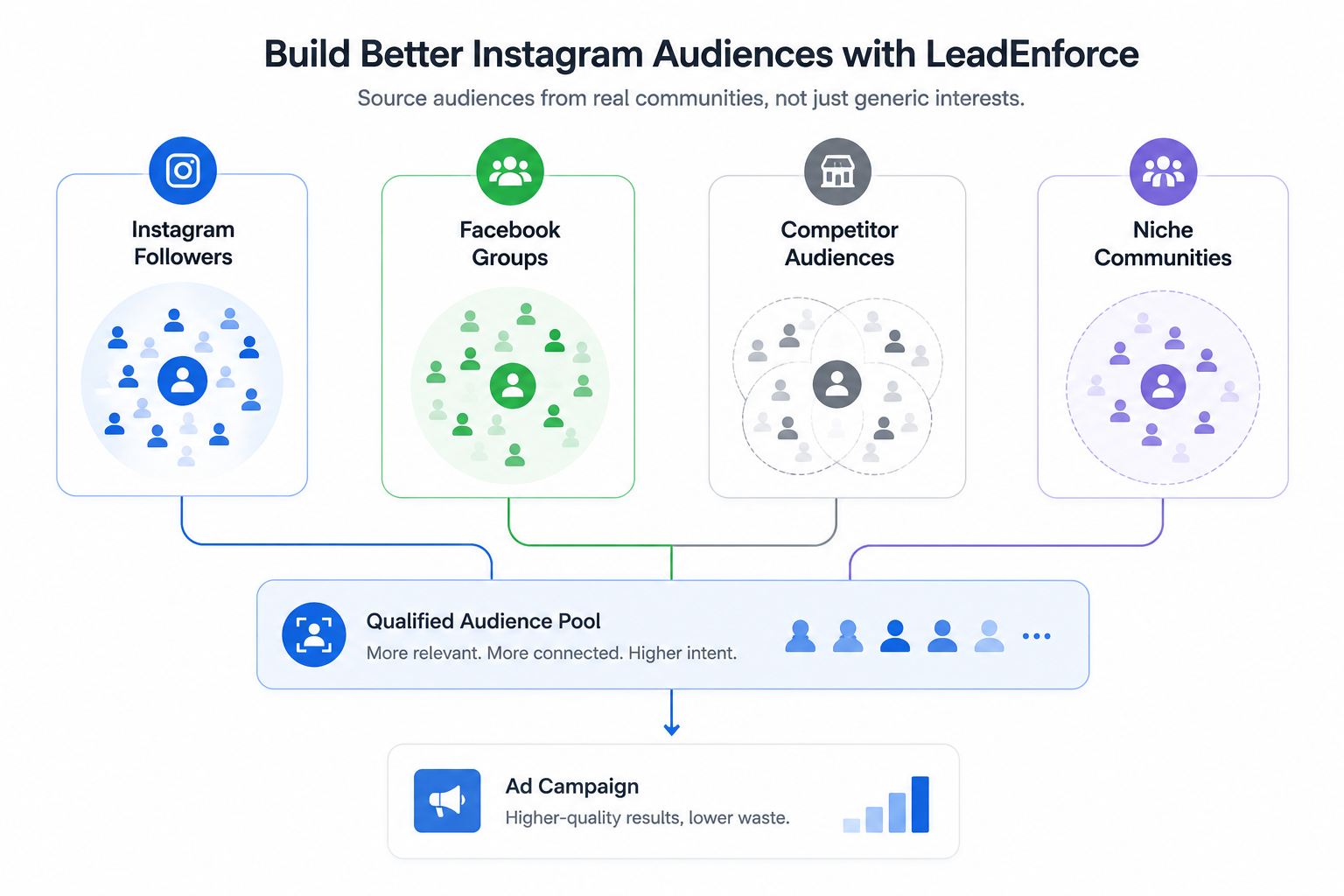
For example, a B2B advertiser could build an audience from followers of niche industry accounts. A local service business could test people connected to relevant community pages or groups. An e-commerce brand could compare followers of similar businesses against standard Instagram interests.
This is useful because similar businesses and niche communities often reveal intent better than generic interest labels. The advertiser still needs to test the audience, but the starting pool is more connected to real buyer behavior.
For Instagram campaigns, the goal is to reach the right Instagram audience without broad targeting, not to choose between tiny precision and uncontrolled reach.
What to do before increasing budget
Do not scale a limited audience just because early CPA looks good.
First, check whether the audience can keep producing results as spend increases. If frequency rises too fast, CPM keeps climbing, or conversion volume stays flat, the campaign needs more audience depth before more budget.
A practical fix is to create three audience layers:
- Core interest layer. Keep the most direct interests that describe the product category.
- Adjacent behavior layer. Add hobbies, creators, communities, and related problems around the buyer.
- Similar business layer. Test followers or audiences connected to competitors, complementary brands, or industry pages.
Run these layers separately at first if budget allows. If one layer produces better qualified actions, use it to guide the next audience build. If all layers underperform, the issue may sit in the offer, creative angle, or landing page.
Final takeaway
A limited Instagram audience does not just reduce reach. It reduces Meta’s ability to find efficient conversions.
If your campaign has low reach, rising CPM, fast frequency growth, or unstable CPA, the audience may be too compressed. Expand around adjacent interests, hobbies, communities, and similar businesses before increasing spend.
The strongest Instagram audiences are not always the narrowest. They are broad enough to deliver, but still connected to the buyer’s real motivation.