
Many advertisers assume that splitting campaigns provides more control. Separate audiences, multiple ad sets, and tightly segmented budgets appear to offer precision.
In practice, excessive fragmentation often weakens performance. When budgets, audiences, and conversion signals are spread across too many campaigns, Meta’s optimization system receives weaker feedback and spends more time recalibrating delivery.
There are situations where consolidating campaigns leads to noticeably stronger performance. Understanding why requires looking at how Meta’s delivery system allocates spend, evaluates signals, and updates its bidding model.
Fragmented Campaign Structures Often Dilute Optimization Signals
Meta’s delivery system improves when it receives consistent and concentrated conversion signals. When those signals are scattered across multiple campaigns or ad sets, each segment operates with limited feedback.
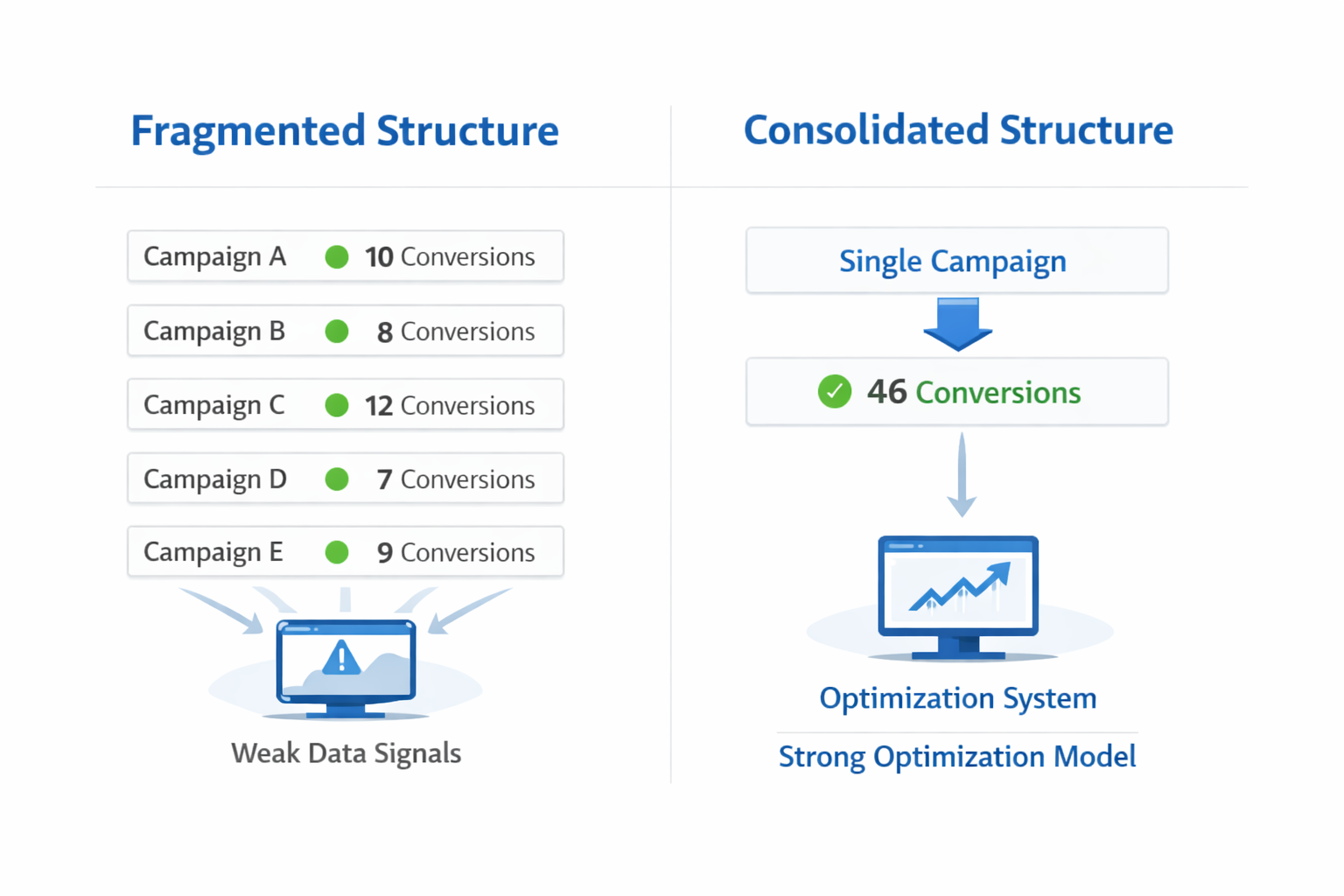
A common scenario looks like this:
An advertiser runs five campaigns targeting similar audiences:
-
Campaign A: broad targeting.
-
Campaign B: lookalike audience.
-
Campaign C: interest stack.
-
Campaign D: retargeting.
-
Campaign E: testing creatives.
Each campaign might generate only a handful of conversions per week. Because optimization happens at the ad set level, Meta’s system must build predictive models using very small datasets.
This creates two structural problems:
-
The learning phase resets frequently. When an ad set receives fewer than roughly 50 optimization events per week, delivery remains unstable. The system keeps recalculating auction predictions instead of refining them.
-
Behavioral patterns become harder to detect. If three conversions appear in different campaigns, the algorithm treats them as unrelated signals rather than reinforcing the same behavioral cluster.
A consolidated structure concentrates these signals into fewer optimization units. Instead of five campaigns receiving ten conversions each, a single campaign might receive fifty. The delivery system then identifies patterns faster and adjusts bids with more confidence.
If you want a deeper breakdown of how campaign structure affects optimization, see Meta campaigns explained: how to structure high-performance campaigns.
Auction Efficiency Improves When Campaigns Compete Less Internally
Another hidden issue in fragmented account structures is internal auction competition.
Meta’s system allows multiple campaigns from the same account to enter the same auction if their targeting overlaps. When that happens, your campaigns effectively bid against each other.
This situation occurs frequently when advertisers separate campaigns by:
-
creative type;
-
audience hypothesis;
-
funnel stage;
-
testing framework.
Even when the targeting appears different, the algorithm often expands delivery into overlapping behavioral segments.
Inside Ads Manager, this usually appears as:
-
stable impressions but rising CPM;
-
fluctuating delivery between campaigns;
-
inconsistent spend pacing.
When campaigns are consolidated, internal competition decreases. Instead of multiple campaigns bidding independently, one campaign allocates budget across ad sets and creatives.
The system can then prioritize the strongest combinations without forcing them to compete in the same auction environment.
A more detailed explanation of this behavior is covered in Facebook ad auction: do ad sets compete against each other?
Larger Budgets Give the Algorithm More Freedom to Allocate Spend
Budget fragmentation limits how aggressively the system can pursue high-probability conversions.
Consider two different structures.
Structure A:
-
5 campaigns;
-
$100 daily budget each;
-
$500 total spend.
Structure B:
-
1 campaign;
-
$500 daily budget.
In Structure A, each campaign has limited flexibility. Even if the system identifies a high-performing audience or creative combination, it cannot shift budget from other campaigns.
Budget is locked at the campaign level.
Structure B behaves differently. A consolidated campaign allows Meta to reallocate spend dynamically:
-
more budget flows to ad sets generating conversions;
-
weaker segments receive less delivery;
-
winning creatives scale faster.
Advertisers often notice the following pattern after consolidation:
-
daily spend stabilizes;
-
CPA variance declines;
-
stronger ads receive significantly more impressions.
This behavior reflects the system’s ability to shift spend toward high-probability auction opportunities without structural constraints.
Learning Phase Stability Improves With Fewer Optimization Units
One of the most common performance issues in complex accounts is constant learning phase resets.
The learning phase restarts whenever:
-
budgets change significantly;
-
targeting changes;
-
ads are edited or replaced;
-
new ad sets launch.
When an account contains dozens of campaigns and ad sets, these resets occur frequently. The algorithm never reaches a stable optimization state because the structure keeps changing.
A consolidated campaign reduces the number of optimization units. Instead of 30 ad sets each receiving sporadic conversions, the account might operate with 6 – 8 well-funded ad sets.
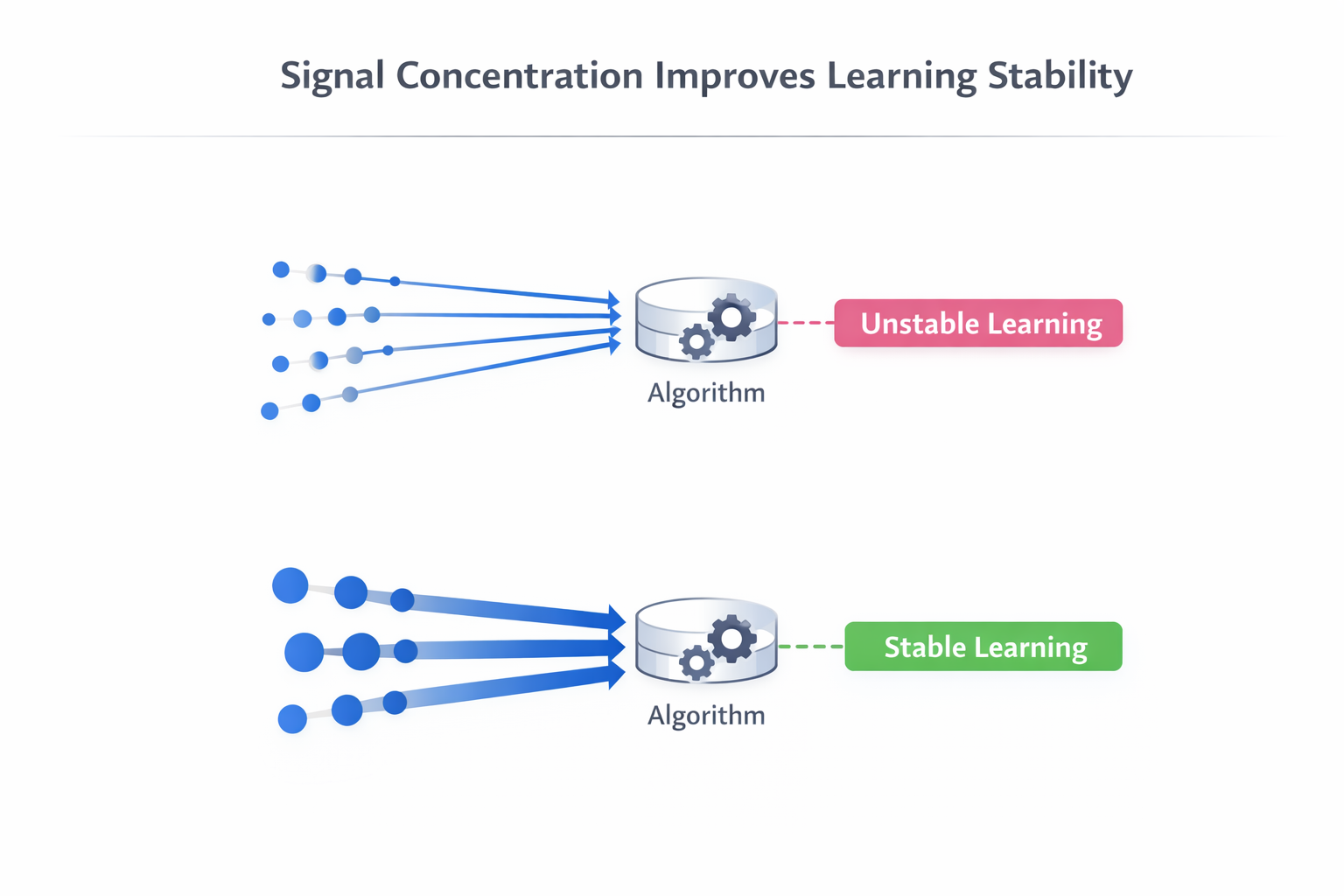
This creates two operational advantages:
-
Conversion thresholds are reached faster.
The system can gather enough data to exit learning within a few days rather than several weeks. -
Delivery becomes predictable.
Budget pacing, impression distribution, and CPA stabilize because the model no longer resets continuously.
Media buyers often recognize this shift in Ads Manager when they see:
-
fewer “Learning Limited” labels;
-
smoother daily spend curves;
-
steadier cost per result.
If learning phase instability is a recurring issue, the mechanics are explained in how to finish the Facebook learning phase quickly.
Consolidation Helps the Algorithm Identify Creative Winners Faster
Creative testing often becomes inefficient in heavily segmented campaign structures.
Imagine a situation where the same three creatives are distributed across several campaigns. Each campaign might receive limited impressions, which slows down the testing process.
A typical result:
-
Creative A receives 2,000 impressions;
-
Creative B receives 2,200 impressions;
-
Creative C receives 1,900 impressions.
The algorithm struggles to determine meaningful performance differences with such small samples.
When campaigns are consolidated, impressions accumulate faster. A single campaign may generate:
-
20,000 impressions for Creative A;
-
18,000 impressions for Creative B;
-
22,000 impressions for Creative C.
The larger sample allows the system to:
-
identify CTR differences faster;
-
observe post-click behavior patterns;
-
allocate more delivery to winning creatives.
In practical terms, this means that strong ads scale earlier while weaker ones lose impressions quickly.
This acceleration can shorten the creative testing cycle from several weeks to a few days.
Consolidation Is Most Useful in Specific Situations
Campaign consolidation is most useful when fragmentation prevents the algorithm from collecting enough data.
Three situations commonly benefit from consolidation.
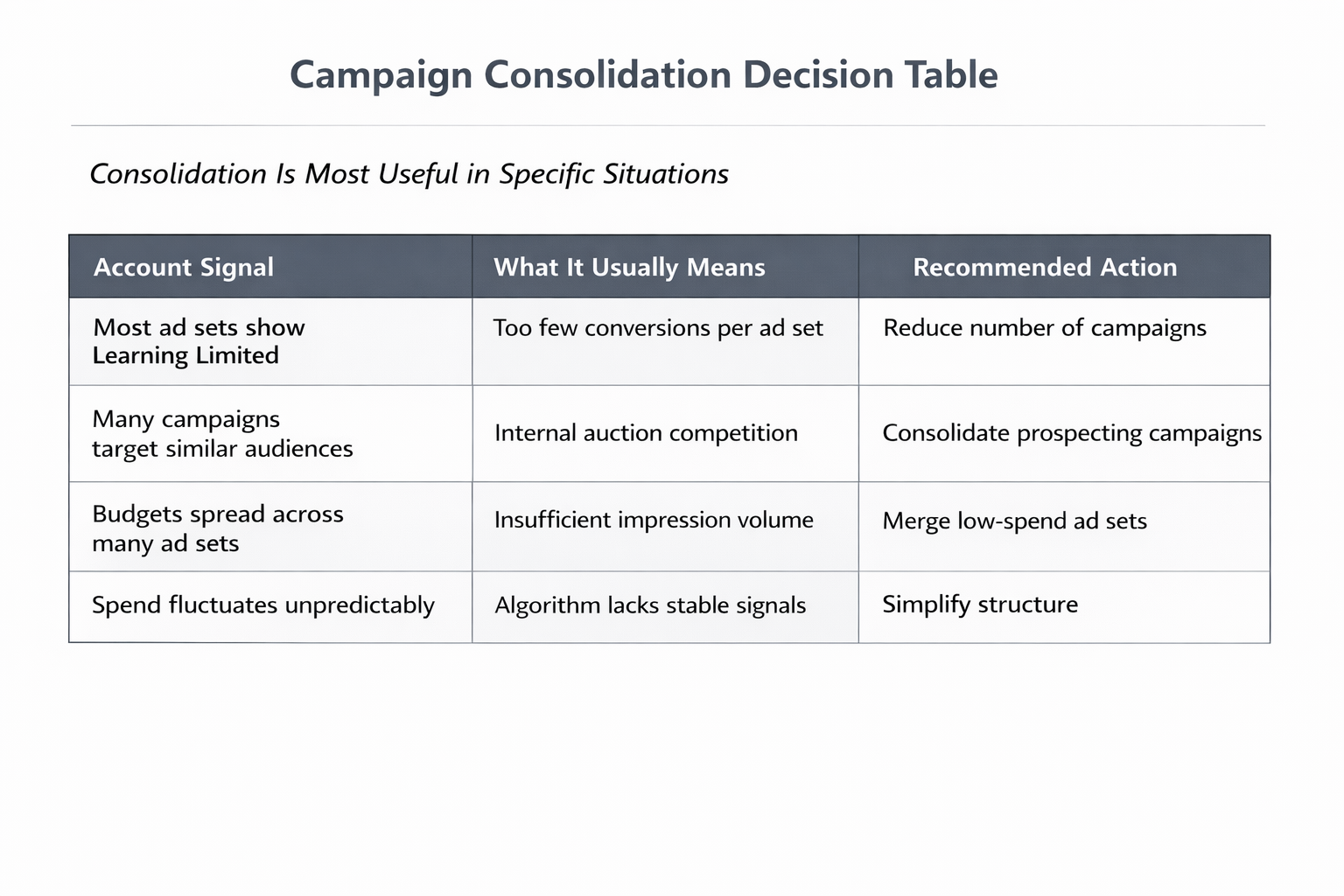
1. Low-volume accounts
Accounts with fewer than ~50 weekly conversions spread across many campaigns generate weak optimization signals.
2. Overlapping audiences
Campaigns targeting similar interests or lookalikes often compete in the same auctions. Consolidation removes internal bidding competition.
3. Budget-limited structures
Small budgets divided across many ad sets provide too little delivery per ad set to generate meaningful data.
When Consolidation Can Reduce Performance
Consolidation can hurt performance when campaigns require structural separation.
Typical examples include:
-
different countries
-
different conversion objectives
-
retargeting vs prospecting campaigns
Retargeting audiences convert more easily, which can cause the algorithm to shift most spend toward them and limit prospecting delivery.
The goal is not maximum consolidation, but clear optimization structures.
A Practical Way to Evaluate Whether Consolidation Is Needed
Before restructuring, check these signals in Ads Manager:
-
many ad sets stuck in Learning Limited;
-
conversions spread thinly across campaigns;
-
rising CPM when similar campaigns run simultaneously;
-
unstable daily spend.
If these appear, testing a consolidated structure often improves delivery stability.
The Structural Principle Behind Campaign Consolidation
Meta’s delivery system performs best when three conditions are present:
-
sufficient conversion volume;
-
flexible budget allocation;
-
clear optimization objectives.
Fragmented campaign structures weaken all three.
Consolidation works because it restores signal density. More conversions feed into fewer optimization units, allowing the algorithm to detect behavioral patterns faster and compete more effectively in auctions.
For many advertisers, performance gains after consolidation are not the result of new creatives or targeting ideas. They come from giving the optimization system a cleaner dataset to work with.
When campaign structures become unnecessarily complex, simplifying them often unlocks the performance that was already present in the account.