Campaign duplication is a common tactic in digital advertising. Marketers duplicate campaigns to test changes, scale performance, or run similar campaigns across multiple audiences. Yet many advertisers notice that a duplicated campaign rarely performs exactly like the original.
In some cases, performance drops sharply after duplication. Conversion rates decline, costs increase, and engagement slows down. This phenomenon is not random. Several underlying mechanisms in advertising platforms can cause duplicated campaigns to lose their initial optimization advantage.
Understanding these mechanisms allows marketers to duplicate campaigns strategically instead of unintentionally resetting performance.
Loss of Historical Learning
Most modern advertising platforms rely on machine learning models to optimize campaign delivery. These models use historical performance data such as click‑through rate (CTR), conversion rate, audience response patterns, and engagement signals.
When a campaign is duplicated, the platform typically treats the copy as a new campaign. The historical learning accumulated by the original campaign is not always transferred.
As a result, the duplicated campaign may return to the early learning phase where the algorithm experiments with different audience segments and placements. During this stage performance is often unstable.
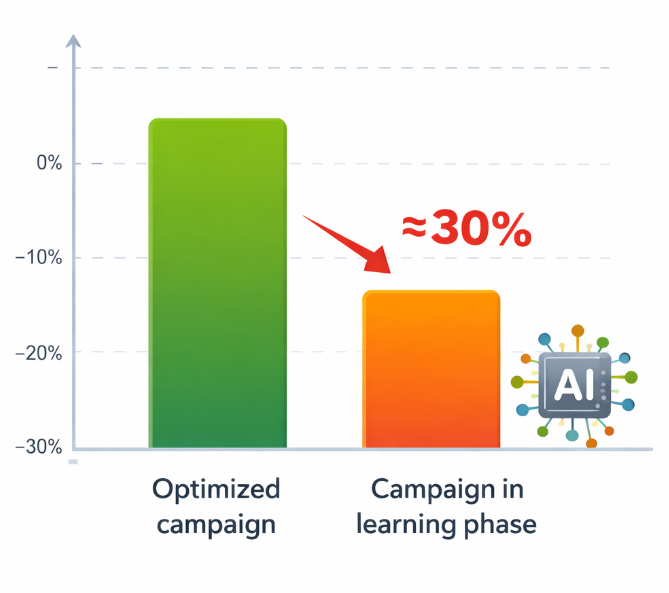
Performance can temporarily decline when campaigns re-enter the learning phase and algorithms rebuild optimization signals
Industry research shows that campaigns in learning phases can experience up to 20–40% performance volatility compared with fully optimized campaigns.
Audience Re‑Evaluation
Duplicated campaigns often trigger a new round of audience evaluation. Even if the targeting settings remain identical, the platform may reassess which users should receive the ads.
This can create temporary inefficiencies because the system must rediscover which segments respond best. Some platforms also restrict audience overlap between campaigns, meaning the duplicated version may reach a slightly different group of users.
If the original campaign already saturated the highest‑converting audience segments, the duplicated campaign may initially target less responsive users.
Budget and Auction Dynamics
Digital advertising operates within real‑time auction environments. When a campaign is duplicated, the new campaign enters the auction independently of the original.
This can affect performance in several ways:
-
The duplicated campaign may compete against the original for the same impressions
-
Auction competition can increase cost per click or cost per acquisition
-
Budget distribution across campaigns can change delivery patterns
Research in digital advertising auctions suggests that internal competition between similar campaigns can increase acquisition costs by 15–30% in some cases.
Reset of Optimization Signals
Advertising algorithms rely on multiple optimization signals including:
-
engagement quality
-
conversion feedback
-
time‑of‑day performance
-
creative performance
When a campaign is duplicated, many of these signals must be rebuilt. Even if the creative assets remain the same, the system still needs time to confirm performance reliability.
This signal rebuilding process may temporarily reduce ad delivery efficiency.
Creative and Placement Re‑Testing
Duplicated campaigns can also trigger creative re‑evaluation. Platforms may retest the same ads across placements to verify their performance again.
This process can redistribute impressions differently from the original campaign. For example, the duplicated campaign may initially deliver more impressions to placements with lower historical conversion rates until the algorithm re‑optimizes.
According to multiple ad platform reports, creative re‑testing phases can last between 3 and 7 days depending on budget and traffic volume.
How to Duplicate Campaigns Without Losing Performance
While duplication can reset performance signals, marketers can minimize the impact by using more controlled scaling strategies.
1. Gradually Increase Budget Instead of Duplicating
Increasing the budget of a successful campaign often preserves its optimization signals. Many platforms recommend raising budgets by no more than 20–30% per adjustment to avoid resetting the learning phase.
2. Modify Targeting Incrementally
If duplication is required, consider adjusting targeting parameters such as geography, audience segments, or placements. This reduces direct competition between campaigns.
3. Allow Time for Re‑Optimization
Duplicated campaigns need time to rebuild their optimization signals. Avoid making major changes during the first several days so the algorithm can stabilize delivery.
Conclusion
Campaign duplication is a useful tactic but it can unintentionally reset performance signals inside advertising platforms. The loss of historical learning, audience re‑evaluation, auction competition, and signal rebuilding can all contribute to temporary performance declines.
By understanding these mechanisms and duplicating campaigns strategically, marketers can avoid unnecessary disruptions and maintain stable campaign performance.
Recommended Articles