If your Meta ads — on Facebook or Instagram — used to deliver strong results, but now seem stuck, you're not alone.
Many advertisers, even experienced ones, run into a moment where performance plateaus or drops off completely. The same targeting, budget, and creative strategy that once worked suddenly doesn’t — and worse, you can’t clearly explain why.
This guide explains what’s really going on when performance marketing stops performing, how to spot early warning signs, and what to do about it.
Whether you manage campaigns in-house or for clients, the tips below will help you reset your strategy and get back to results that scale.
Why performance marketing underperforms (even when you're doing “everything right”)
Performance marketing promises predictability. Set a goal. Spend your budget. Optimize based on data.
But here’s the reality: today’s platforms (especially Meta) rely less on exact inputs — and more on machine learning that needs high-quality signals. When those signals disappear, degrade, or get misaligned, performance drops.
It’s not just about targeting the wrong audience or writing the wrong copy. Often, it’s a deeper issue of signal loss, overused audiences, or broken funnel logic.
Let’s break it down.
1. Privacy rules are cutting off your data
In the past, Meta ads had access to detailed user-level behavior. That changed fast.
Thanks to Apple’s App Tracking Transparency (iOS 14.5), cookie deprecation, and stricter data laws in Europe and beyond, you now receive fewer signals about user behavior post-click.
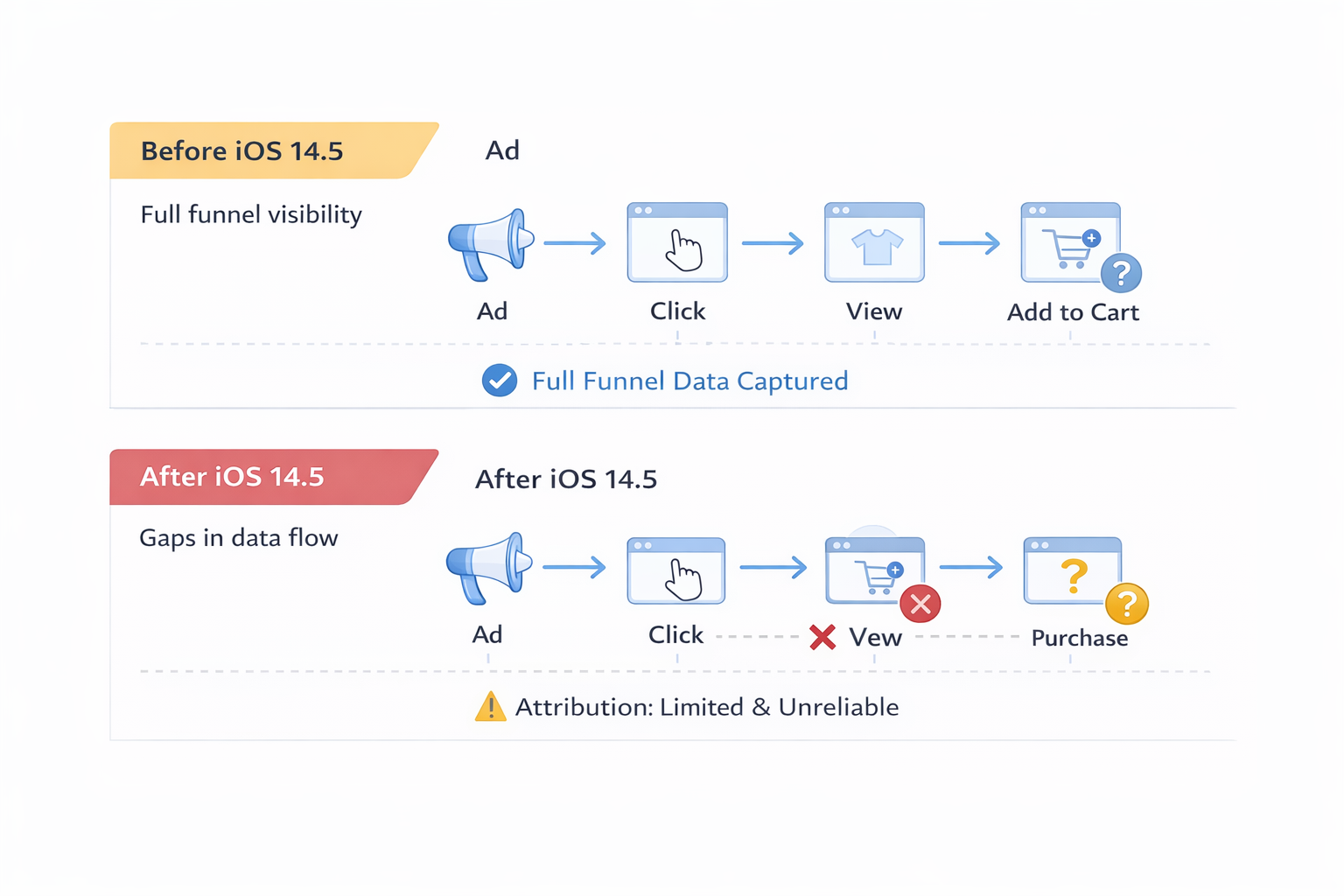
This leads to problems like:
-
Attribution gaps: You can’t tell which ad, audience, or touchpoint drove the conversion.
-
Retargeting pool shrinkage: Fewer people can be tracked for follow-up ads, meaning your mid-funnel dries up.
-
Weaker machine learning: Meta’s algorithm has less feedback on which users are converting.
This isn’t just a Meta problem. All performance platforms now struggle to connect the dots across the user journey.
Want to dig deeper? Start with: Server-Side Tracking: Beginner’s Guide.
2. You’re running into ad fatigue
One of the most common — and most overlooked — issues is creative burnout.
Even if your targeting and budget are dialed in, performance can fall off a cliff simply because your audience has seen the ad too many times.
Signs of ad fatigue:
-
CTR drops, even with the same audience and spend.
-
Frequency rises above 3.0, meaning the same people keep seeing your ads.
-
Negative or sarcastic comments appear, especially on long-running campaigns.
It’s not enough to swap out colors or change a headline. You need creative variety — different formats, fresh angles, and hooks that speak to new objections or benefits.
Get help with: How to Avoid Ad Fatigue and Keep Optimal Ads Conversion Rate.
3. Your lookalike audiences are no longer working
Lookalike audiences used to be a Meta advertiser’s secret weapon.
But today, most lookalikes are based on old, weak, or misaligned seed audiences. If your seed list comes from people who visited your site months ago — or never converted — the resulting lookalike may be large, but it won’t convert.
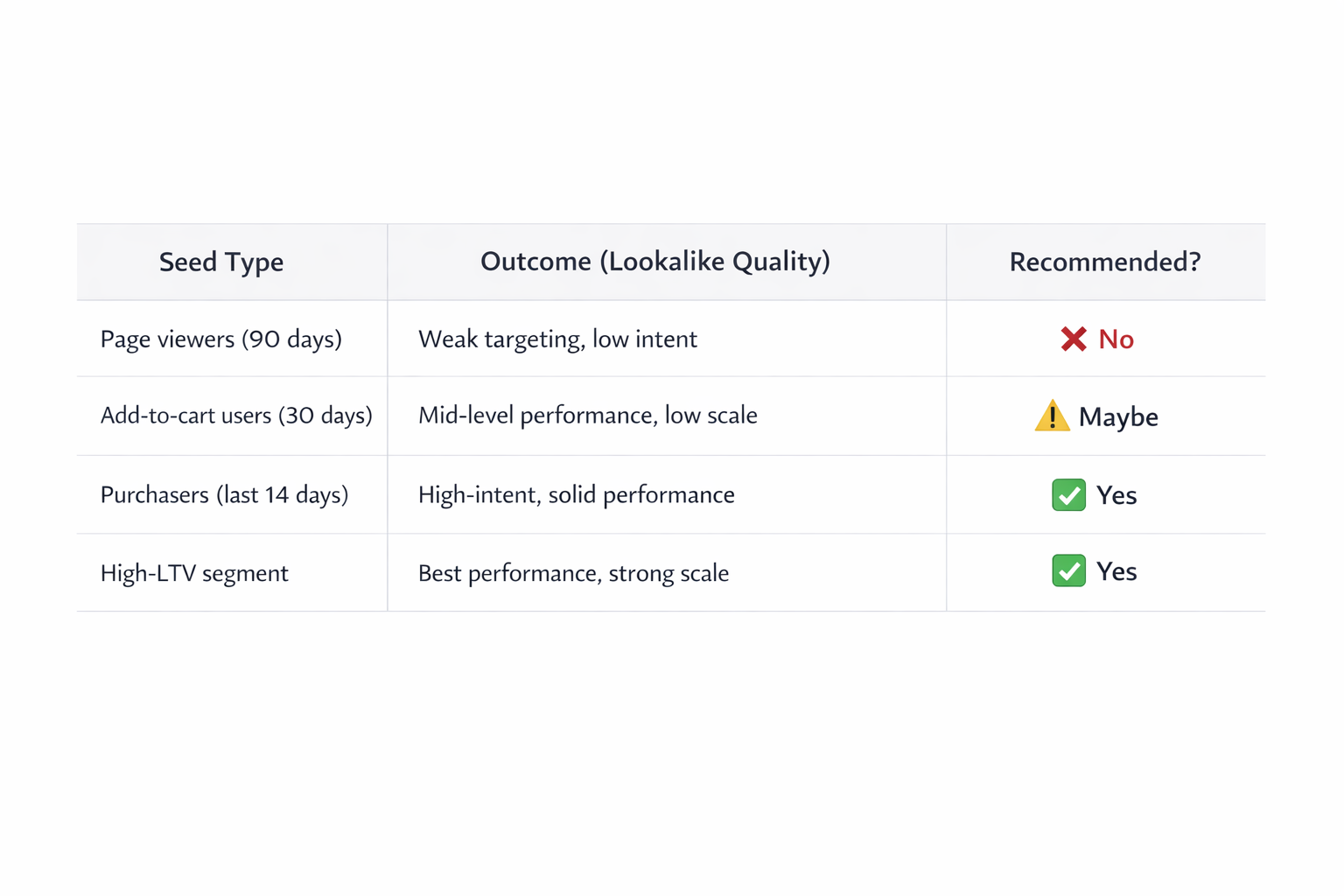
Common causes of underperforming lookalikes:
-
Too broad or outdated seed audiences, such as all visitors from last year.
-
Low-intent actions, like page views instead of purchases or high-value events.
-
Failure to update seeds regularly, which results in outdated modeling.
Here’s a practical fix: What to Do When Lookalikes Stop Performing.
Red flags that your campaign is stalling
Not all performance drops are obvious. Many campaigns seem fine on the surface, but the data says otherwise.
Here are some silent warning signs to watch for:
Your cost per result is creeping up
This is often the first (and easiest to ignore) red flag.
If your CPA, CPL, or CPM increases without any major change in strategy, something under the surface is shifting.
Investigate:
-
Are you seeing audience overlap or saturation?
-
Is frequency rising but CTR falling?
-
Are you forcing the platform to keep spending on exhausted audiences?
Clicks are coming, but sales aren't
This is a funnel issue, not an ad issue. Your creative may be strong, but the landing page experience is failing to convert.
What to check:
-
Landing page load time, especially on mobile;
-
Offer-message match — Does the promise in your ad match what users see after clicking?
-
Page friction — Are people confused about next steps?
You may have a leak post-click. Find out more here: From Click to Conversion: Where Funnels Usually Break.
Performance drops when you increase budget
If things work fine at $100/day but collapse at $300/day, that’s a sign of a fragile campaign structure.
Here’s why scaling can break results:
-
You didn’t broaden your audience to match budget growth;
-
You didn’t refresh creatives to match frequency spikes;
-
Meta’s learning phase got disrupted, leading to poor delivery.
How to fix underperforming performance campaigns
When performance drops, resist the urge to "turn off everything" or "start over." Instead, fix the weak points systematically.
Step 1: Refresh your audience strategy
Start by rebuilding your audience layers.
Ask:
-
Are my custom audiences still relevant and active?
-
Are my lookalike audiences seeded from high-value users?
-
Am I using the same broad Advantage+ strategy and expecting different results?
One powerful option: Use LeadEnforce to build custom audiences from followers of Facebook groups, or relevant Instagram pages — something you can’t do natively in Meta Ads Manager.
This gives you access to real behavior-based signals, not just inferred interests.
Step 2: Train the algorithm with better signals
Meta’s ad delivery system relies on variety to learn. If you keep feeding it the same creative, same objective, and same users — it stalls.
Ways to reset the signal loop:
-
Run engagement campaigns, then retarget watchers or clickers;
-
Mix formats — Test video, carousels, Reels, and static posts;
-
Change objectives, even temporarily, to rebuild momentum (e.g., switch from conversions to traffic or leads).
Step 3: Rebuild your warm audiences
With pixel signals fading, in-platform engagement is now your best retargeting tool.
Try this:
-
Run a video with a clear hook and retarget viewers who watched at least 15 seconds;
-
Use post-saves, profile visits, and story views to build middle-of-funnel lists;
-
Use LeadEnforce to target followers of complementary pages to rewarm cold traffic.
Rebuilding your funnel doesn’t require a full rebuild — just smarter layering.
Step 4: Test new offers, not just new creative
Even if your ad gets clicks, a tired or unclear offer will hurt results.
What you can test:
-
Add urgency: "Spots available this week only" or "Ends Friday"
-
Add flexibility: "Try risk-free for 7 days"
-
Add bundling: "Buy one, get the second 50% off"
Test offers like you test creative. A great product with a weak offer is still a poor performer.
How to protect performance moving forward
Once you've fixed the problem, build habits that prevent future breakdowns.
Set a weekly test-and-review system
Here’s a simple weekly rhythm:
-
Monday — Launch 2–3 new ads, hooks, or angles.
-
Wednesday — Check CTR, CPC, and any post-click drop-offs.
-
Friday — Turn off underperformers. Scale winners. Log what you learned.
Consistency creates compound learning — and compounds results.
Track more than just Ads Manager
Meta data isn’t enough anymore. Cross-check with tools like:
-
Google Analytics (via UTM parameters);
-
Hotjar/Clarity for heatmaps and session replays;
-
Meta Conversion API (CAPI) for stronger attribution.
The more feedback loops you build, the faster your recovery — and the smarter your next round of decisions.
Final thoughts
Performance marketing hasn’t stopped working. But it has changed — dramatically.
You can't rely on just one tactic or one platform insight anymore. You need:
-
Better audience sourcing;
-
Stronger creative variety;
-
Offer and funnel alignment;
-
Clear, ongoing signal generation.
When your ads stall, look deeper than the surface. Fix the inputs, and the algorithm will fix the output.