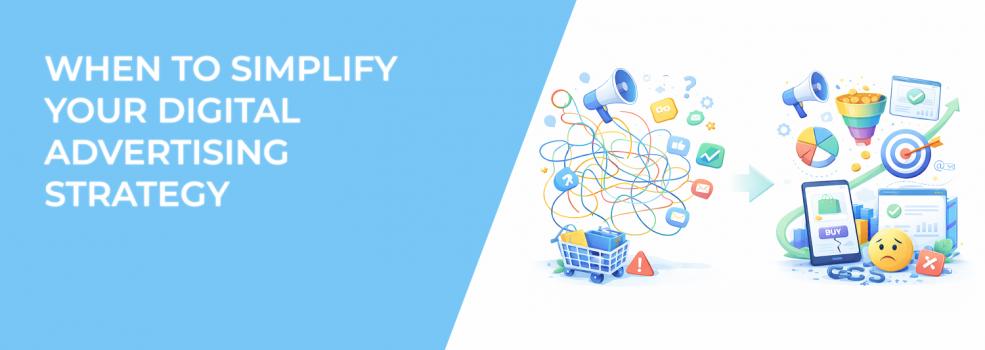
Digital advertising gives businesses powerful tools for targeting, automation, and optimization. But those same tools can also lead to bloated, hard-to-manage setups.
It’s common to end up with too many campaign types, overlapping audience segments, scattered creatives, and messy reporting. Over time, it becomes hard to tell what’s working and even harder to scale effectively.
Simplifying your strategy doesn’t mean doing less. It means doing more of what works faster. A lean structure allows for cleaner testing, clearer insights, and smarter budget allocation.
In a world of short attention spans, rising ad costs, and tighter margins, simplicity often beats control.
Signs your advertising strategy needs simplification
Not every performance dip calls for more segmentation or more testing. Sometimes, it’s complexity itself that’s the problem.
Look for these warning signs:
-
You can’t identify what’s driving results.
If campaigns, audiences, or creatives overlap, it's hard to know what’s actually performing. Inconsistent attribution data makes it even worse. As explained in Why audience overlap is killing your Facebook ad performance, internal competition often leads to wasted spend and unclear insights. -
Budgets are spread too thin.
Running too many campaigns or ad sets with limited budgets slows optimization. You end up with experiments that don’t produce actionable results. -
Your analytics setup is scattered.
Pulling reports from multiple platforms, tracking too many KPIs, or switching attribution settings frequently makes analysis harder, not better. -
More time is spent managing than learning.
If your team is constantly adjusting bids, pausing campaigns, or renaming things — instead of learning what’s working — your structure might be the problem.
If you see more than one of these signs, it’s likely that complexity is holding you back.
Where complexity hides in your strategy
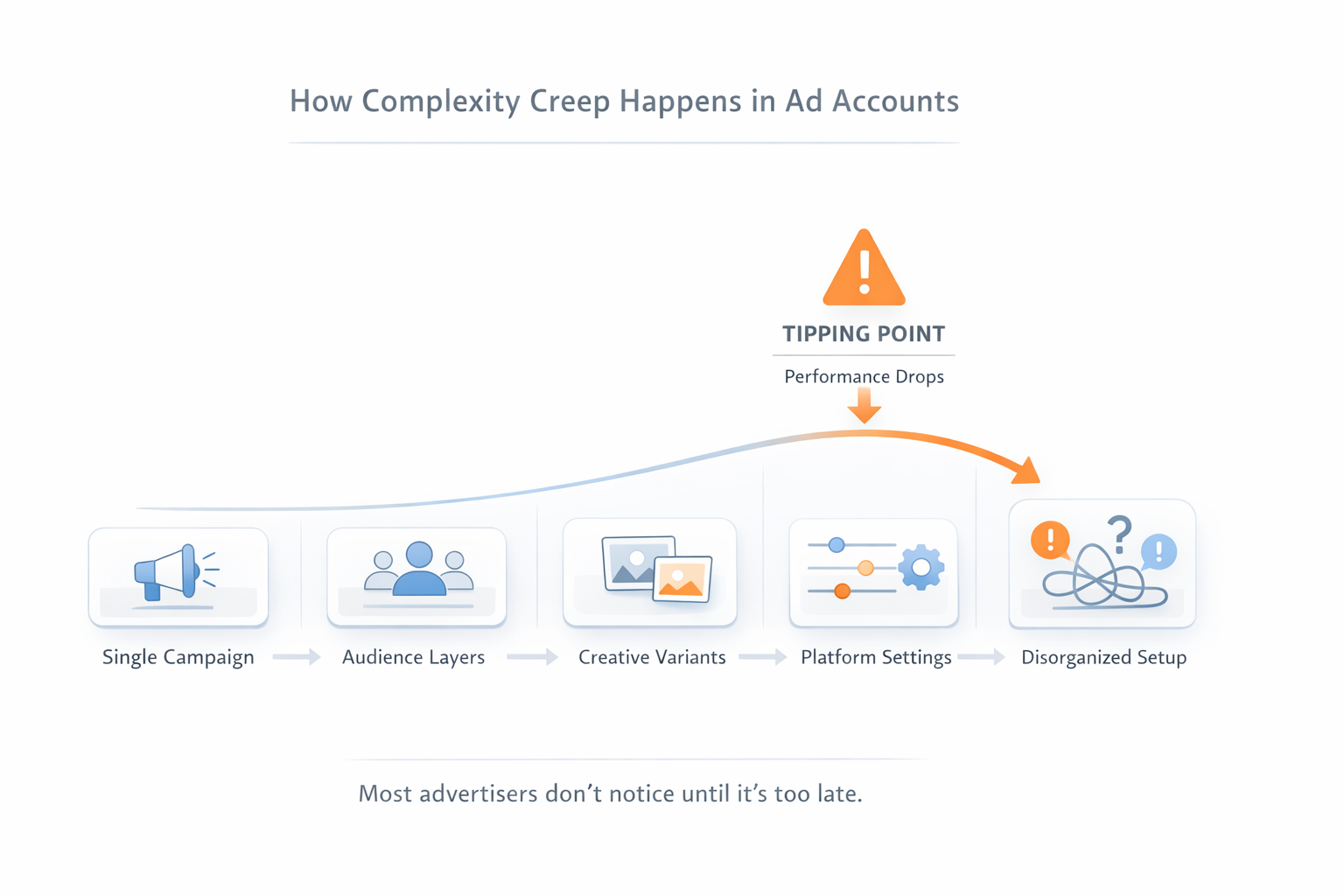
Complexity builds up slowly. Here are three areas where it tends to creep in without notice and how to fix it.
1. Targeting
Many advertisers over-segment their audiences, trying to personalize every message. But this often results in low-scale, high-cost campaigns with unclear learnings.
Instead:
-
Group similar audiences into intent-based segments (e.g., “engaged users” instead of dozens of small retargeting lists);
-
Reduce redundant lookalikes or demographic filters;
-
Use broad segments on platforms that optimize delivery based on conversion signals.
Too much granularity limits reach without improving results. See Broad targeting: when it beats narrow for a deeper explanation.
2. Campaign goals and bidding
It’s tempting to run different campaigns for every funnel stage — awareness, traffic, conversions, and so on. But having too many goals makes it hard to measure real business impact.
Instead:
-
Align campaigns to a small set of core outcomes (such as leads or purchases);
-
Standardize bidding strategies so performance comparisons stay clean;
-
Eliminate internal competition between campaigns targeting the same audience.
Simplifying your goal structure helps avoid performance cannibalization, a problem discussed in How to simplify your ad strategy for consistent results.
3. Creative testing
Most advertisers test too many elements at the same time — headlines, visuals, CTAs, formats — across multiple channels. This creates noise instead of insight.
To simplify:
-
Test one creative variable at a time (message first, design second);
-
Group creatives by angle or use case, not just by format;
-
Limit testing to your most reliable channels or audiences.
This approach produces clearer learnings and reduces wasted spend.
Simplifying measurement and attribution
Modern advertising spans many channels, devices, and sessions. Adding more tools or dashboards rarely fixes that complexity.
Here’s how to simplify measurement without losing clarity:
-
Stick to 2–3 core KPIs.
Common examples include cost per lead, cost per acquisition (CPA), and marketing efficiency ratio (MER). -
Use blended attribution models.
Avoid relying only on platform-level reporting. Blended views reflect the full customer journey more accurately. -
Automate reporting where possible.
Use a single dashboard for core metrics. Avoid daily platform hopping unless you’re actively optimizing.
If measurement still feels unclear, Ad account simplification: when less is more explains how structure and reporting work together.
When simplification unlocks growth
Simplification is especially useful during moments of change:
1. When scaling spend.
Increasing budgets exposes structural weaknesses. Simplifying first makes scaling safer and more predictable.
2. When launching new offers or channels.
A clean setup helps isolate variables and find real signals faster.
3. When results plateau or decline.
Resetting to one audience, one offer, and one campaign can restore clarity before adding complexity back in.
What a simplified digital strategy looks like
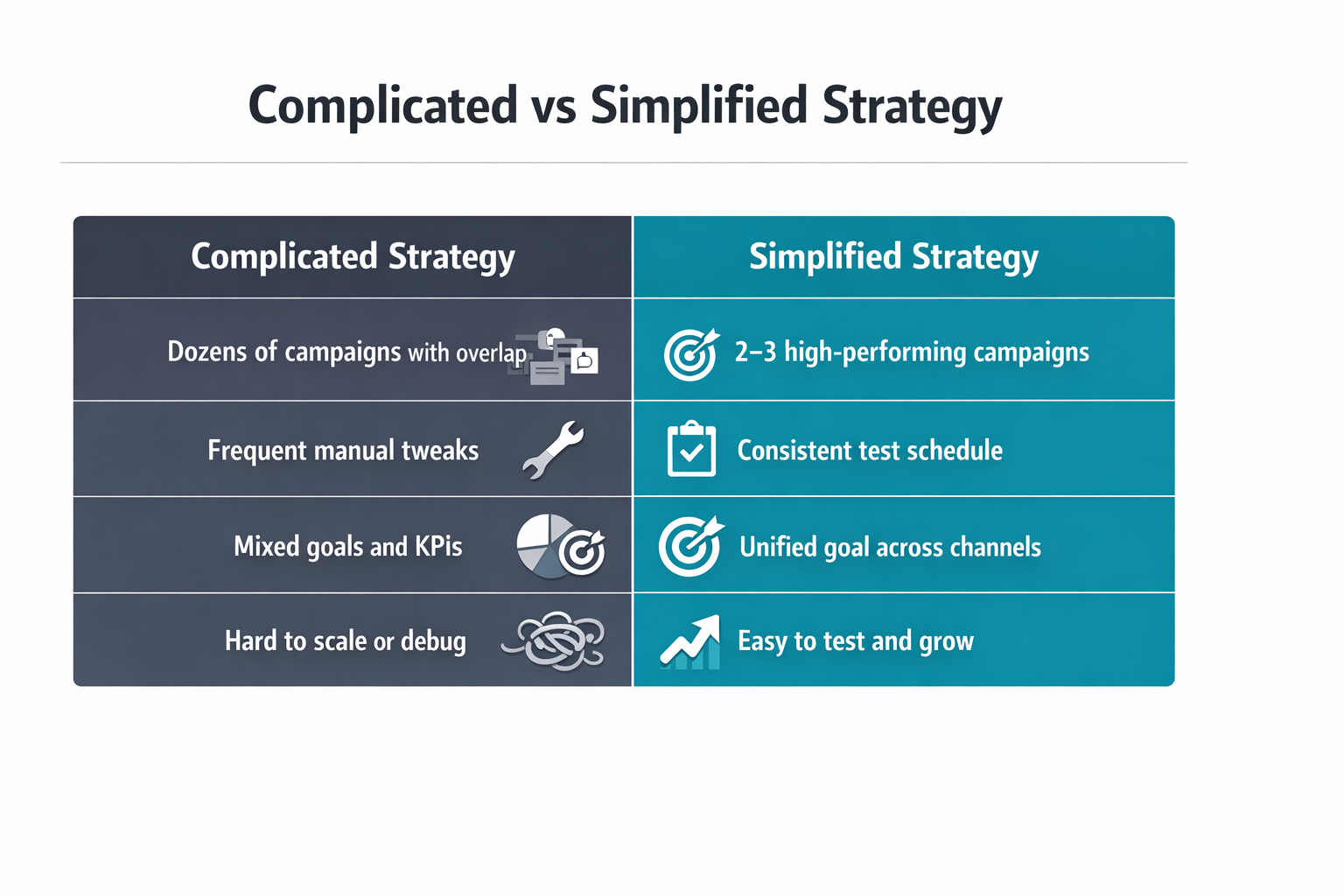
A lean, high-performing advertising system typically includes:
-
One or two platforms aligned with your strongest channels;
-
Two or three campaign types supporting the funnel (e.g., prospecting and retargeting);
-
Clear naming conventions and structured creative libraries;
-
Centralized attribution and reporting;
-
A defined process for testing and learning.
Simplicity brings consistency. Consistency makes scale possible.
Final thought: simplify before you scale
Many advertisers treat simplification as a fallback — something to do when performance drops.
In practice, simplification works best as a foundation. It creates cleaner feedback loops, faster learning, and more confident scaling.
A complex strategy doesn’t signal sophistication. A simple one produces results.