
As advertising platforms evolve, so does the temptation to add more layers: new campaigns for every audience, separate ad sets for every creative, and endless tests running in parallel. While this approach feels thorough, it often produces the opposite of the intended result. Complex account structures fragment data, slow down optimization, and make it harder for algorithms to learn efficiently.
Ad account simplification focuses on doing fewer things better. By reducing unnecessary complexity, advertisers can concentrate budget, speed up learning, and make performance trends easier to identify and act on.
Why Ad Accounts Become Overcomplicated
Overcomplication rarely happens overnight. It is usually the result of incremental decisions made over months or years:
-
Creating new campaigns instead of iterating within existing ones
-
Duplicating ad sets for small audience or creative variations
-
Keeping underperforming elements active “just in case”
-
Running many low-budget ad sets that never exit the learning phase
Each of these choices adds friction. Together, they create accounts that are difficult to manage and even harder to optimize.
The Performance Cost of Complexity
Advertising platforms rely on data volume to optimize delivery. When budgets and conversions are split across too many campaigns and ad sets, performance suffers.

Ad sets typically need about 50 conversions in 7 days to exit the learning phase and unlock stable optimization
Several industry studies show clear patterns:
-
Ad sets that generate fewer than 50 conversions per week often remain stuck in the learning phase, leading to unstable delivery and inconsistent results
-
Accounts with highly fragmented budgets tend to see higher cost per acquisition compared to those with consolidated structures
-
Simplified campaign structures have been associated with conversion increases of over 20% after consolidation, driven by stronger signal density and faster optimization
These outcomes highlight a key principle: algorithms perform best when they have fewer, stronger signals rather than many weak ones.
Benefits of a Simplified Account Structure
Faster Learning and Optimization
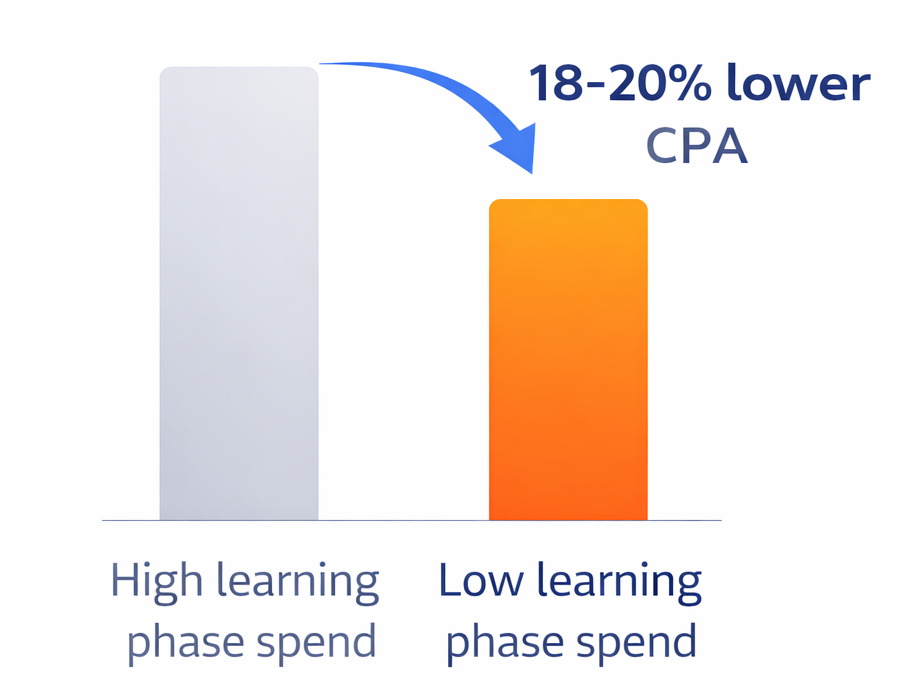
Advertisers that minimize time and spend in the learning phase often achieve up to 20% lower cost per acquisition
Consolidation allows each campaign and ad set to collect data more quickly. This shortens the learning period and helps platforms identify winning audiences and creatives sooner.
Clearer Insights
With fewer moving parts, performance analysis becomes more reliable. Trends are easier to spot, and optimization decisions are based on meaningful data rather than noise.
Easier Budget Scaling
Scaling is more predictable when budgets are concentrated. Increasing spend on a small number of proven campaigns is significantly safer than trying to scale dozens of marginal ad sets.
Reduced Management Overhead
Simpler accounts require less time to monitor and maintain. This frees up resources for strategic work such as creative development and audience research.
When Simplification Makes the Most Sense
Ad account simplification is particularly effective in the following scenarios:
-
When multiple campaigns target similar audiences with minor variations
-
When many ad sets deliver low or inconsistent volume
-
When performance reporting becomes difficult to interpret
-
When scaling efforts repeatedly lead to volatility
In these cases, merging campaigns or ad sets and reallocating budget can produce immediate improvements in stability and efficiency.
A Practical Approach to Simplifying Your Account
A successful simplification process does not mean removing structure entirely. It means keeping only what serves a clear purpose.
Key steps include:
-
Identify campaigns and ad sets with overlapping audiences or objectives
-
Pause or merge low-volume ad sets that fail to exit the learning phase
-
Consolidate budgets into fewer, higher-performing campaigns
-
Maintain creative diversity within ad sets instead of duplicating structures
This approach balances control with efficiency, allowing performance to improve without sacrificing strategic flexibility.
Conclusion
In digital advertising, more options do not always lead to better results. Overly complex ad accounts dilute data, slow optimization, and increase operational costs. Simplification shifts the focus back to performance fundamentals: strong signals, clear insights, and scalable structures.
By reducing clutter and concentrating resources, advertisers can unlock better results with less effort—proving that, in many cases, less truly is more.
Related Reading
-
Smarter Targeting, Bigger Impact: How Data-Driven Audiences Improve Results