When performance starts slipping in a Facebook account, most advertisers look at targeting, bids, or creative fatigue. Messaging is rarely the first suspect.
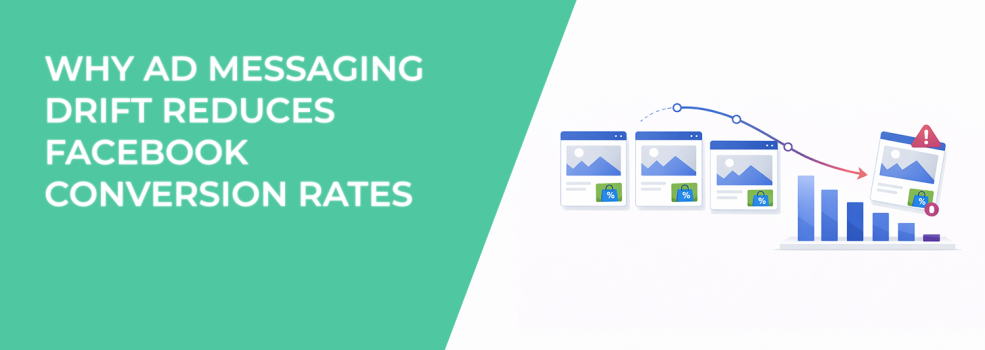
But in many accounts, declining conversion rates are not caused by audience saturation or structural targeting issues. They are caused by messaging drift — a gradual misalignment between what your ads promise and what your landing page, funnel, or offer actually delivers.
If you're running performance campaigns built on structured audience frameworks like those outlined in the Facebook Custom Audiences Guide: Everything You Need to Know, this misalignment directly affects auction efficiency, learning stability, and cost per acquisition.
Let’s break down why it happens and how to fix it.
What Ad Messaging Drift Actually Means
Ad messaging drift occurs when the core promise in your ad diverges from:
-
The landing page headline.
-
The offer framing.
-
The product positioning.
-
The intent level of the audience.
-
The stage of the funnel.
This often happens gradually. A new creative angle gets tested. A copywriter reframes the benefit. The landing page remains unchanged. Over time, the narrative fragments.
From the outside, nothing looks obviously broken. CTR might even increase. But conversion rate declines.
That gap is not cosmetic. It’s structural.
How Messaging Alignment Impacts Conversion Mechanics
Conversion does not happen because someone clicks. It happens because the user’s expectation, formed by the ad, matches the reality they encounter after the click.
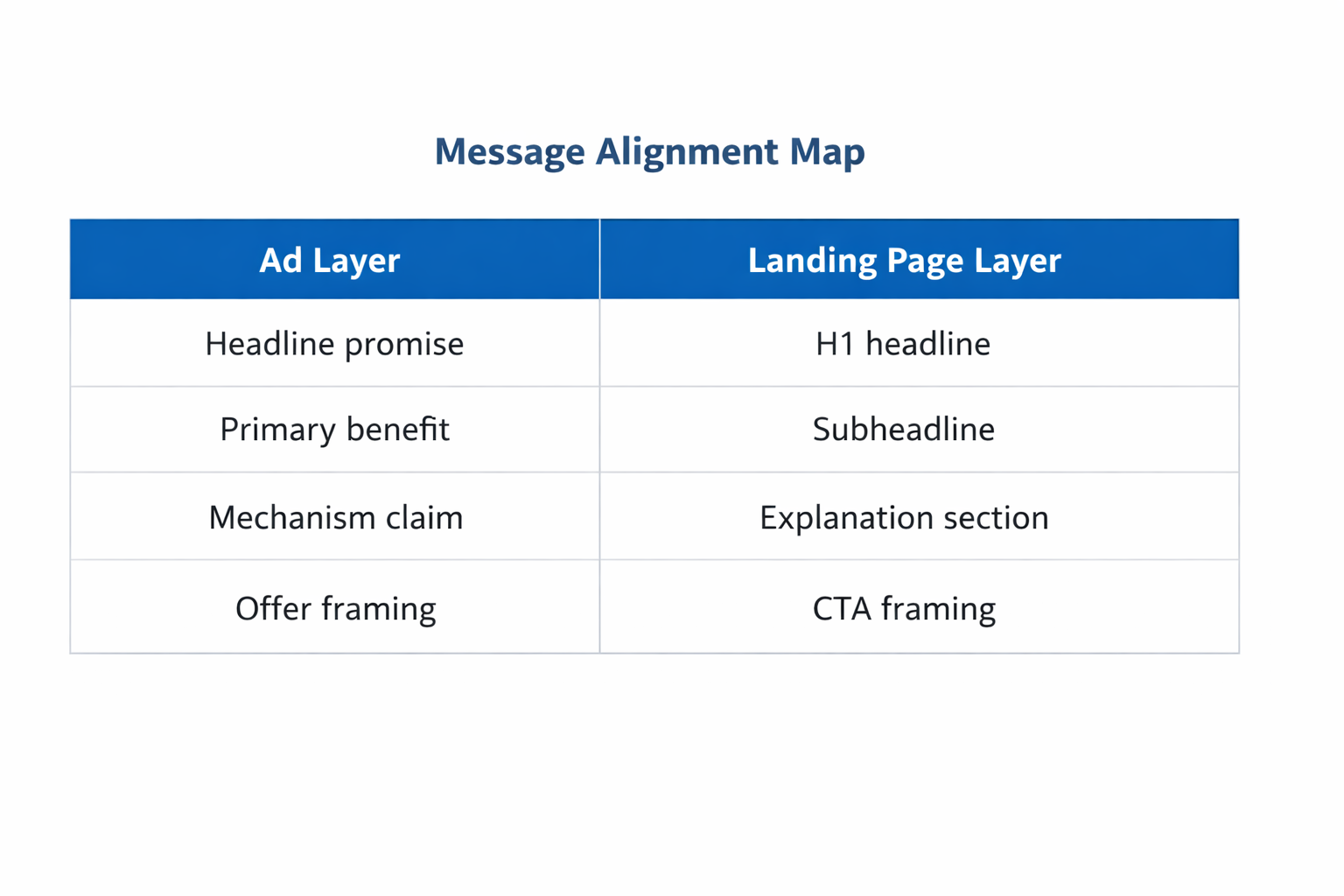
Here’s what typically happens when alignment is tight:
-
Expectation formation.
The ad establishes a clear outcome, problem, or mechanism. The user clicks with a specific mental model of what they’re about to see. -
Expectation confirmation.
The landing page headline mirrors the same core benefit and framing. The user experiences continuity instead of cognitive reset. -
Friction reduction.
Because the narrative is consistent, the user doesn’t need to reinterpret the offer. Cognitive load remains low. -
Action completion.
The user proceeds through the funnel without hesitation because nothing feels unexpected or misaligned.
When messaging drifts, this chain breaks between steps one and two. Even small shifts in framing create friction.
For example:
-
The ad emphasizes “lower CPA immediately.”
-
The landing page opens with “build long-term brand equity.”
-
The ad promises “done-for-you implementation.”
-
The page describes a self-serve tool.
The user may not consciously articulate the mismatch, but conversion probability drops.
Why CTR Can Increase While Conversion Rate Falls
This is where many advertisers misdiagnose the problem.
Messaging drift often increases click-through rate because broader or more aggressive claims attract more attention. However, those clicks come from users with different expectations than your funnel is built to serve.
That creates three structural issues:
-
Intent dilution. You attract curiosity clicks rather than high-intent buyers. This becomes especially problematic if your campaign relies on tightly defined segments such as those described in How to Create High-Intent Custom Audiences for Facebook Lead Ads.
-
Audience contamination. The algorithm optimizes toward people who respond to the new angle, not necessarily those who convert.
-
Learning distortion. The system receives inconsistent feedback signals, reducing optimization clarity.
Over time, the campaign may enter a cycle where CTR looks healthy, CPC improves, but CPA worsens and conversion rate steadily declines.
If you only monitor engagement metrics without mapping them to audience structure, the root cause remains hidden. This is particularly dangerous in layered strategies such as those discussed in How to Layer Detailed Targeting for Hyper-Specific Facebook Audiences.
The Algorithmic Impact of Messaging Drift
Meta’s delivery system optimizes based on conversion feedback tied to audience segments. When messaging misalignment lowers conversion rates, two things happen.
First, signal quality weakens. The platform receives more non-converting clicks relative to converting ones, reducing event density and clarity.
Second, audience modeling shifts. The algorithm begins prioritizing users who engage with the creative angle rather than those structurally aligned with your offer.
If your account relies on segmentation frameworks like those covered in Maximizing ROI through Facebook Audience Segmentation, messaging drift can distort performance comparisons between segments. You may incorrectly conclude that one audience is weaker when the issue is narrative misalignment.
In mature accounts, even a modest decline in conversion rate can push ad sets below stable event thresholds. That affects pacing, scaling capacity, and budget efficiency.
Common Causes of Messaging Drift
Messaging drift rarely comes from a single decision. It emerges from incremental changes across creative, offer, and targeting.
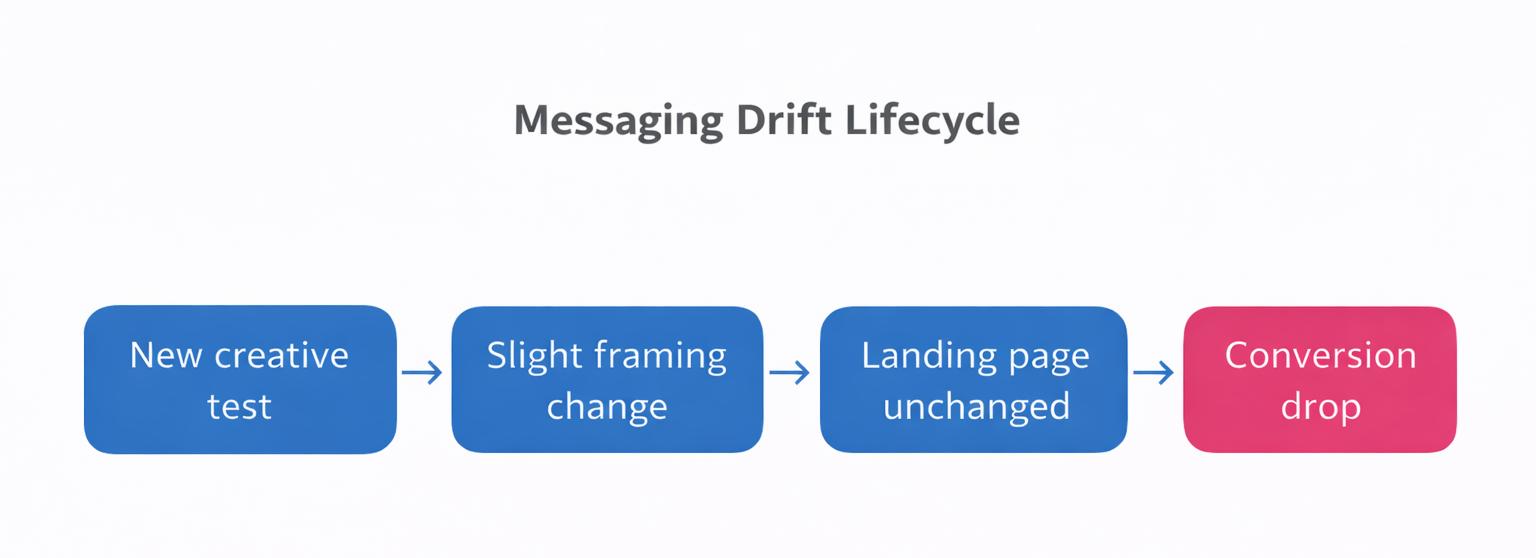
1. Creative Testing Without Offer Synchronization
You test new angles in ads but do not update the landing page to reflect the winning narrative.
For example:
-
Ads pivot to “automation” as the primary benefit.
-
The landing page still leads with “manual control.”
The system optimizes toward automation-focused responders, but the funnel does not reinforce that expectation.
2. Scaling Prospecting With Broader Hooks
When scaling cold traffic, advertisers often broaden messaging to increase reach. This can unintentionally shift the audience intent level.
If your funnel is built for structured prospecting and lookalike expansion strategies such as those explained in How to Build Lookalike Audiences that Actually Convert, but your ads adopt curiosity-driven or vague aspirational messaging, conversion efficiency drops.
The audience model changes faster than your funnel structure does.
3. Retargeting Message Carryover
Retargeting angles sometimes bleed into prospecting campaigns.
Ads may reference prior awareness or assume context that only warm audiences have. If you’re running layered warm and cold frameworks like those detailed in The Complete Guide to Warm, Cold, and Custom Audiences in Meta Ads, message discipline becomes critical. Cold traffic requires explanation; warm traffic requires reinforcement.
Mixing those structures reduces clarity.
4. Funnel Iteration Without Creative Update
Landing pages evolve. Offers change. Pricing shifts.
Ads remain unchanged.
Now the ad is selling one version of the value proposition while the page presents another.
How to Diagnose Messaging Drift Properly
Instead of guessing, use structured analysis.
Step 1: Map the Core Promise
Write down, in one sentence, what each ad variation promises.
Then write down, in one sentence, what the landing page promises.
If those two sentences are not conceptually identical, you likely have drift.
Step 2: Segment by Message Angle
Break down performance by creative angle:
-
Problem-driven.
-
Outcome-driven.
-
Feature-driven.
-
Proof-driven.
Look at conversion rate per angle, not just CTR.
If one angle produces high CTR but low CVR, inspect whether your landing page reinforces that specific framing. If not, create a dedicated variant instead of forcing it into a generalized structure.
Step 3: Analyze Scroll and Drop-Off Behavior
If you track on-page engagement, ask:
-
Do users bounce immediately?
-
Do they scroll but hesitate at pricing?
-
Do they abandon at form submission?
Patterns reveal where expectation mismatch occurs — headline, explanation, or offer mechanics.
Step 4: Compare Structural Audience Performance
If you are working with distinct Custom, engagement, or seeded segments as described in How to Create High-Converting Facebook Custom Audiences, compare conversion rates by segment under identical messaging.
If one segment underperforms only under a specific angle, the issue may be narrative relevance rather than audience quality.
Realigning Messaging Without Killing Performance
You do not need to reset campaigns to fix this. But changes must be controlled and intentional.
1. Lock the Core Value Proposition
Define one primary promise for the campaign. Everything else should support it.
If your core message is “reduce CPA through better signal quality,” then your ad headline, primary text, landing page H1, and first explanatory paragraph must reinforce that same mechanism.
2. Mirror Language Intentionally
Exact wording does not need to match, but conceptual framing must.
If the ad says, “Scale profitably without increasing budget,” the page should open with, “How to scale revenue without raising ad spend.”
That mirroring creates continuity.
3. Align Message to Funnel Stage
Cold traffic messaging should:
-
Establish the problem clearly.
-
Define the mechanism briefly.
-
Pre-frame the offer.
Warm traffic messaging can assume context and focus on proof or urgency.
If you are structuring campaigns around Custom vs Lookalike expansion, as explored in Custom vs Lookalike Audiences: What Works Best for Facebook Campaigns?, ensure that message complexity matches the awareness level of each segment.
4. Test Landing Variants Instead of Only Ad Variants
If a new angle performs well on CTR, build a landing page variant that reinforces that specific angle rather than forcing it into the existing structure.
This preserves signal quality and protects conversion probability.
Final Perspective
Ad messaging is not just creative expression. It is a structural component of performance architecture.
When messaging drifts, conversion friction increases. When friction increases, signal clarity decreases. When signal clarity decreases, optimization weakens.
If your account shows declining conversion rates without obvious targeting or bidding issues, review narrative alignment before restructuring audiences or expanding budgets.
Often, the fix is not in the audience or the budget.
It is in restoring continuity between what you promise and what you deliver.