
Meta’s Value Rules feature enables advertisers to increase or decrease the value of specific conversion events depending on certain audience attributes. Instead of treating every conversion equally, marketers can signal to Meta’s optimization algorithm which users are more valuable.
According to industry benchmarks, advertisers that correctly use value-based optimization can improve return on ad spend by up to 20–30%. Despite this potential, many campaigns underperform because Value Rules are configured without a clear strategy or data validation.
Below are the most common mistakes advertisers make when implementing Value Rules in Meta Ads and how to avoid them.
1. Applying Value Rules Without Reliable Conversion Data
One of the most common mistakes is implementing Value Rules before collecting enough conversion data. Meta’s optimization algorithms rely heavily on historical event data to identify patterns and predict future conversions.
If campaigns generate fewer than 50 conversions per week per optimization event, the system may not have enough information to properly apply value adjustments. In such cases, Value Rules can create more noise than signal.
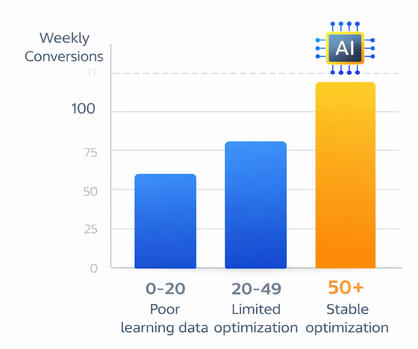
Minimum conversion volume needed for stable campaign optimization in Meta Ads
To avoid this problem:
-
Ensure consistent conversion tracking
-
Accumulate sufficient historical data before introducing value adjustments
-
Test Value Rules gradually instead of applying multiple rules at once
2. Overcomplicating Value Adjustments
Many advertisers attempt to apply multiple layered Value Rules across demographics, devices, and regions simultaneously. While this may seem like a precise optimization strategy, it often introduces unnecessary complexity.
When too many rules interact, it becomes difficult to determine which rule actually influenced performance. Complex rule structures can also confuse the optimization algorithm.
A practical approach is to begin with one or two high-impact segments—such as top-performing geographic regions or high-value customer demographics—and expand only after validating performance improvements.
3. Ignoring Statistical Significance
Another common mistake is making rule adjustments based on small sample sizes. If a segment has only a handful of conversions, its performance may be influenced by random variation rather than a true trend.
For example, a campaign may appear to show that one demographic group generates 40% higher revenue. However, if the conclusion is based on only 10 conversions, the result is not statistically reliable.
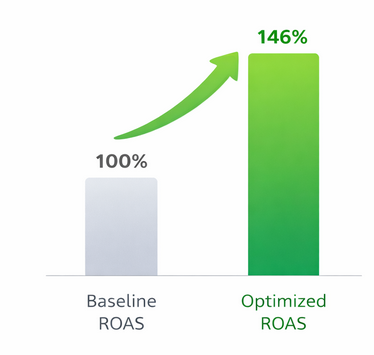
Value-based bidding strategies such as Value Rules can significantly increase return on ad spend
Industry research suggests that at least several hundred conversions are typically required to confidently identify meaningful performance differences between segments.
4. Setting Unrealistic Value Multipliers
Value Rules allow advertisers to increase or decrease conversion values by specific percentages. However, setting aggressive multipliers—such as increasing value by 200% for certain segments—can distort bidding behavior.
Large multipliers may cause the algorithm to over-prioritize a segment that actually represents a small portion of potential revenue. This often leads to reduced reach and higher costs per acquisition.
Instead, most performance marketers recommend moderate adjustments of 10–30% when testing new Value Rules.
5. Failing to Align Value Rules With Business Goals
Value Rules should reflect real business value rather than superficial performance metrics.
For example, if a business assigns higher value to mobile users simply because they convert more frequently, it may ignore that desktop customers generate larger average order values.
Without aligning Value Rules with revenue or lifetime value metrics, advertisers risk optimizing for conversions that contribute less to overall profitability.
A better strategy is to base rules on factors such as:
-
customer lifetime value
-
average order value
-
repeat purchase probability
6. Not Monitoring Performance After Implementation
Some advertisers treat Value Rules as a "set and forget" configuration. In reality, performance must be monitored continuously.
Consumer behavior, seasonality, and market conditions can all change the value of different segments over time. A rule that improved performance during one quarter may become ineffective later.
Performance audits should be conducted regularly to evaluate:
-
conversion value trends
-
cost efficiency by segment
-
potential rule conflicts
7. Overlapping Audience Segments
Another overlooked problem occurs when Value Rules overlap. For instance, a user might qualify for both a geographic rule and a demographic rule.
When multiple rules apply to the same conversion event, the combined adjustment may produce unexpected value inflation or suppression. This makes it harder for the algorithm to interpret true conversion value.
Advertisers should carefully review rule structures to minimize overlap and ensure each rule represents a clear optimization signal.
Conclusion
Value Rules in Meta Ads can significantly improve campaign efficiency by helping the algorithm prioritize higher-value conversions. However, their effectiveness depends on careful implementation, reliable data, and continuous performance monitoring.
The most successful advertisers approach Value Rules as an iterative optimization process rather than a one-time configuration. By starting with clear data, applying moderate adjustments, and validating performance over time, marketers can unlock the full potential of value-based optimization.