Broad targeting looks simple in Meta Ads. You remove interest filters and let the system find buyers. Delivery expands, CPM drops, and lead volume increases.
Then revenue slows down. Sales teams report weaker conversations and fewer qualified opportunities. The issue is not reach. It is buyer intent.
What Broad Targeting Really Does
When you launch a broad ad set, you give the algorithm maximum freedom. It decides who sees your ads based on predicted action probability.
Meta optimizes for the event you select. It does not understand your internal definition of a qualified lead. It only reacts to measurable behavior.
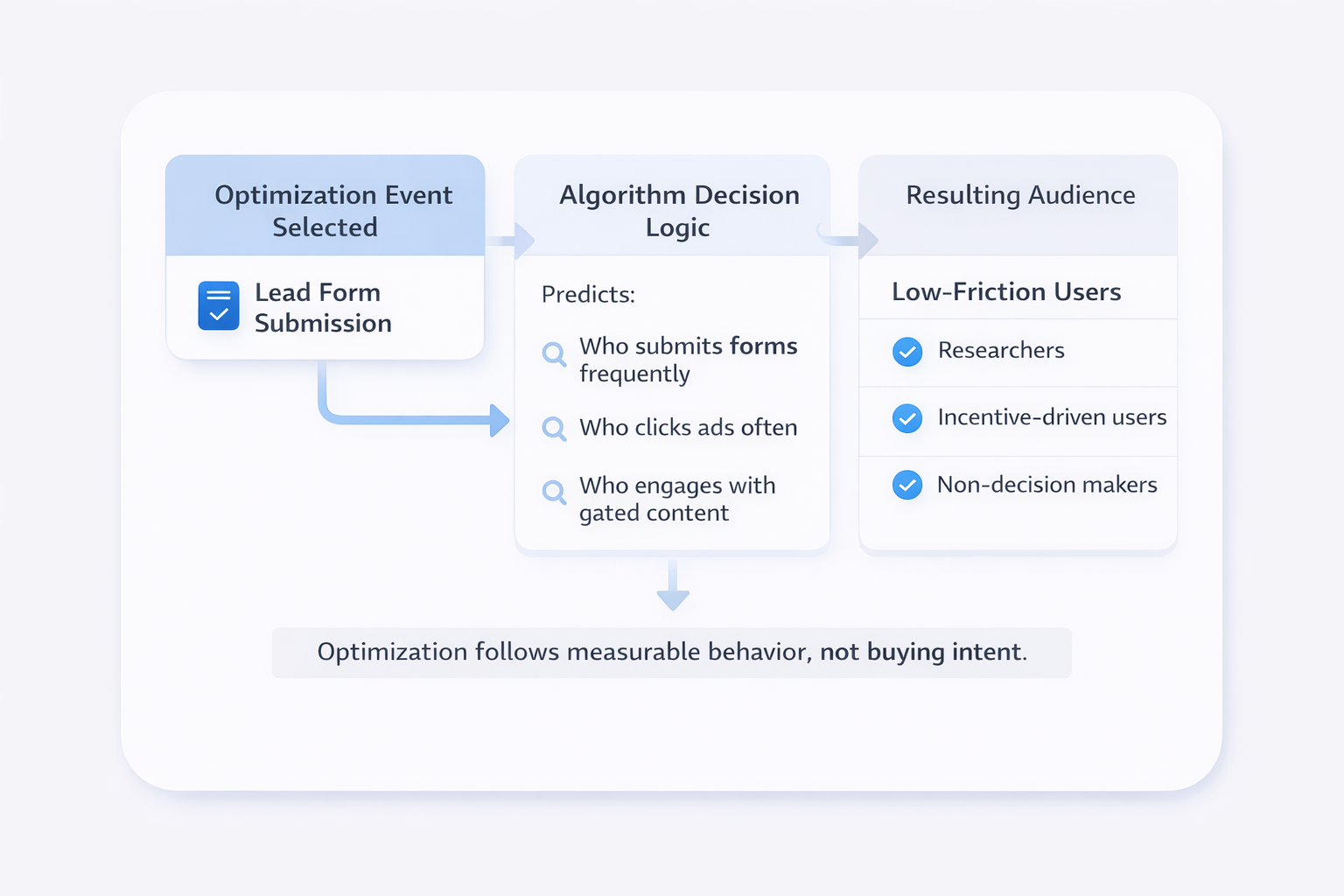
If you optimize for a standard lead event, the system looks for people who frequently complete forms. That behavior does not equal purchase readiness.
For a deeper breakdown of audience types and how Meta evaluates them, see The Complete Guide to Warm, Cold, and Custom Audiences in Meta Ads.
The Algorithm Optimizes for Ease of Action
The system identifies users who are likely to complete your chosen event quickly. That often means low-friction users.
In practice, this leads to patterns like:
-
Users who regularly download guides and attend webinars; they are active researchers but not active buyers, so they inflate lead volume without pipeline impact.
-
Users who respond to gated content; they exchange email for value but avoid booking calls or speaking with sales.
-
Users who interact with many ads; they convert easily but often lack authority or budget.
These users increase reported conversions. They do not increase closed revenue.
Why Cost Per Lead Can Drop While Deal Quality Falls
Broad targeting often reduces CPM because the audience pool expands. The system finds cheaper impressions outside competitive buyer segments.
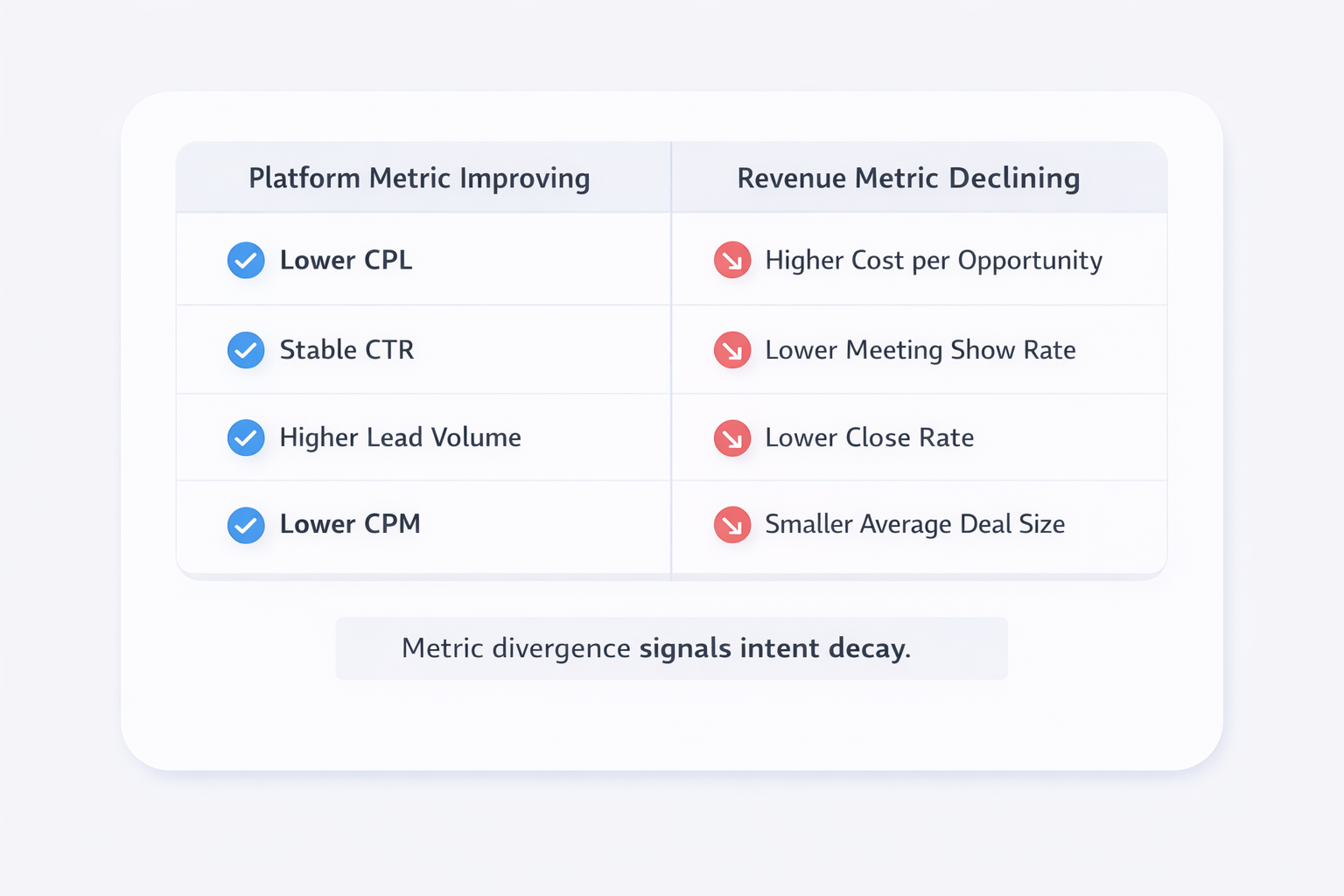
Lower CPM usually leads to lower CPL. On the surface, performance improves.
However, cheaper traffic often means weaker intent. You may notice these shifts:
-
Cost per lead decreases; cost per qualified opportunity rises because more leads fail basic qualification checks.
-
CTR stays stable; meeting booking rate drops because users lose interest after submitting the form.
-
Lead volume increases; revenue per campaign declines because average deal size shrinks.
For example, you might generate 200 leads instead of 120. Yet only 8 become opportunities instead of 15. The volume hides the quality loss.
If you want to understand how high-intent custom audiences change this dynamic, review How to Create High-Intent Custom Audiences for Facebook Lead Ads.
How Broad Targeting Expands Into Passive Demand
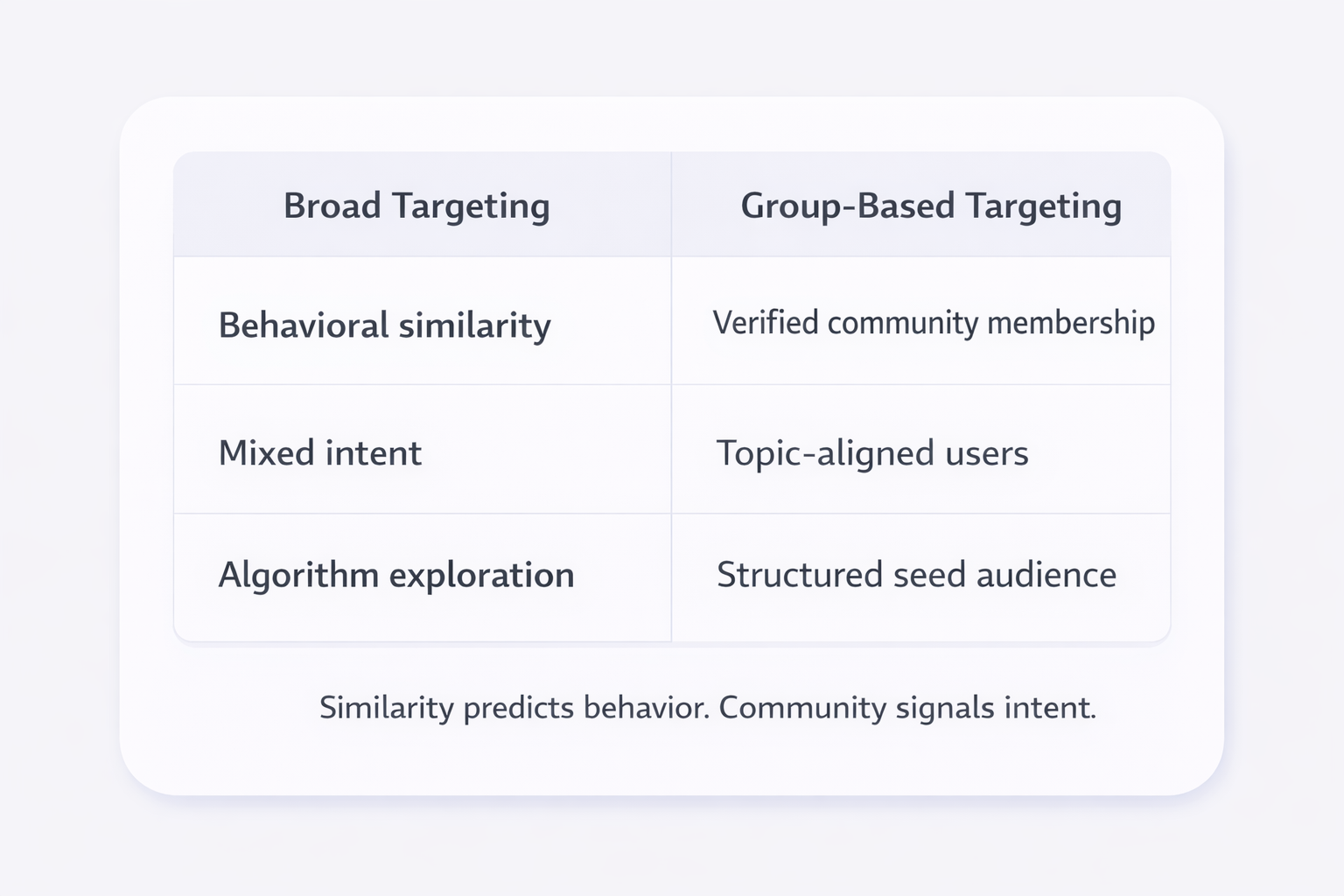
Without constraints, the algorithm explores users who resemble past converters behaviorally. It does not verify urgency or buying stage.
Many of these users are not actively searching for your solution. They respond because the ad is persuasive or emotionally appealing.
Passive demand behaves differently:
-
A user sees a strong hook about saving ad spend; they submit a form to compare tools later, not to buy now.
-
A small business owner downloads your checklist; they have interest but no allocated budget.
-
A marketing assistant signs up for a demo; the real decision-maker never joins the call.
Each case generates a conversion event. None guarantees commercial intent.
Over time, broad targeting shifts audience composition. You attract reactive users instead of proactive buyers.
The Limitation of Broad Targeting in Niche Markets
Broad targeting struggles when your audience is specific. If you sell to members of defined professional communities, broad delivery rarely isolates them precisely.
Meta does not allow direct targeting of Facebook Group members. That removes a strong intent signal for many advertisers.
If you work in niche B2B or specialized consumer markets, group membership often reflects real interest. For example:
-
Amazon FBA sellers gather in large industry groups; those members already discuss tools and software.
-
Performance marketers join advanced ad strategy groups; they actively evaluate platforms and tactics.
-
Local contractors participate in trade groups; they look for vendors and partnerships.
Broad targeting cannot directly isolate these communities. It may find similar behavioral profiles, but similarity does not equal shared commercial intent.
For a breakdown of what is and is not possible with group targeting, see Targeting Facebook Groups with Ads: What’s Possible and What’s Not.
How Leadenforce Helps Reduce Low-Intent Traffic
Leadenforce addresses this limitation by enabling audience creation from Facebook Group members. Instead of relying only on inferred behavior, you can build audiences tied to specific communities.
This improves starting signal quality.
For example:
-
You can build a custom audience from members of niche industry groups; these users already engage with relevant topics and show clear interest.
-
You can combine group-based audiences with lookalikes; this trains expansion models on higher-intent seeds instead of generic leads.
-
You can exclude unrelated groups; this prevents overlap with loosely connected or irrelevant segments.
By starting with stronger intent signals, broad expansion becomes more controlled. The algorithm searches widely but begins from a more relevant foundation.
To understand how group-based targeting supports ready-to-buy users, review Using Facebook Groups to Reach Ready-to-Buy Users.
You can also explore How to Find and Target Facebook Groups Relevant to Your Business.
How to Diagnose Low-Intent Traffic
Platform metrics are not enough. You need revenue-linked diagnostics tied to audience segments.
Start with structured comparisons:
-
Compare cost per lead to cost per qualified opportunity; if the gap widens, screening rejects more broad traffic.
-
Track meeting show rate by campaign; low-intent segments often produce higher no-show rates.
-
Break down revenue by audience source; group-based or custom audiences may outperform broad ad sets.
Add behavioral analysis:
-
Check average session duration; serious buyers spend more time reviewing case studies and pricing.
-
Review pages per session; shallow visits often signal low urgency.
-
Analyze time to reply after lead submission; high-intent users respond quickly to outreach.
These indicators reveal intent shifts before revenue collapses.
When Broad Targeting Works Well
Broad targeting performs well when account data is strong. It needs clear commercial feedback.
It works best when:
-
You optimize for deep-funnel events; opportunities or purchases guide delivery decisions.
-
CRM data syncs consistently; offline conversions reinforce real buyer profiles.
-
You build strong seed audiences first; high-quality custom audiences improve expansion accuracy.
For a full framework on building stronger custom audiences as your core strategy, see Why Custom Audiences Should Be the Core of Your Ad Strategy.
The Real Trade-Off
Broad targeting increases reach and lowers delivery friction. It also increases exposure to passive users.
If your signals are weak, you scale low-intent traffic efficiently. If your signals are strong, you scale real demand.
Broad targeting does not determine traffic quality on its own. Your audience structure and optimization signals do.